Journal articleFree to read
Hydrogeological factors of petroleum and gas capability of Jurassic deposits of the Chardzhou stage
Гидрогеологические факторы нефтегазоносности юрских отложений Чарджоуской ступени
- Institute of Geology and Exploration of Oil and Gas Fields (IGIRNIGM), Tashkent, Uzbekistan
Highlights
- Depth of the Palaeozoic basement: 3.0–3.5 to 5.0–5.5 km.
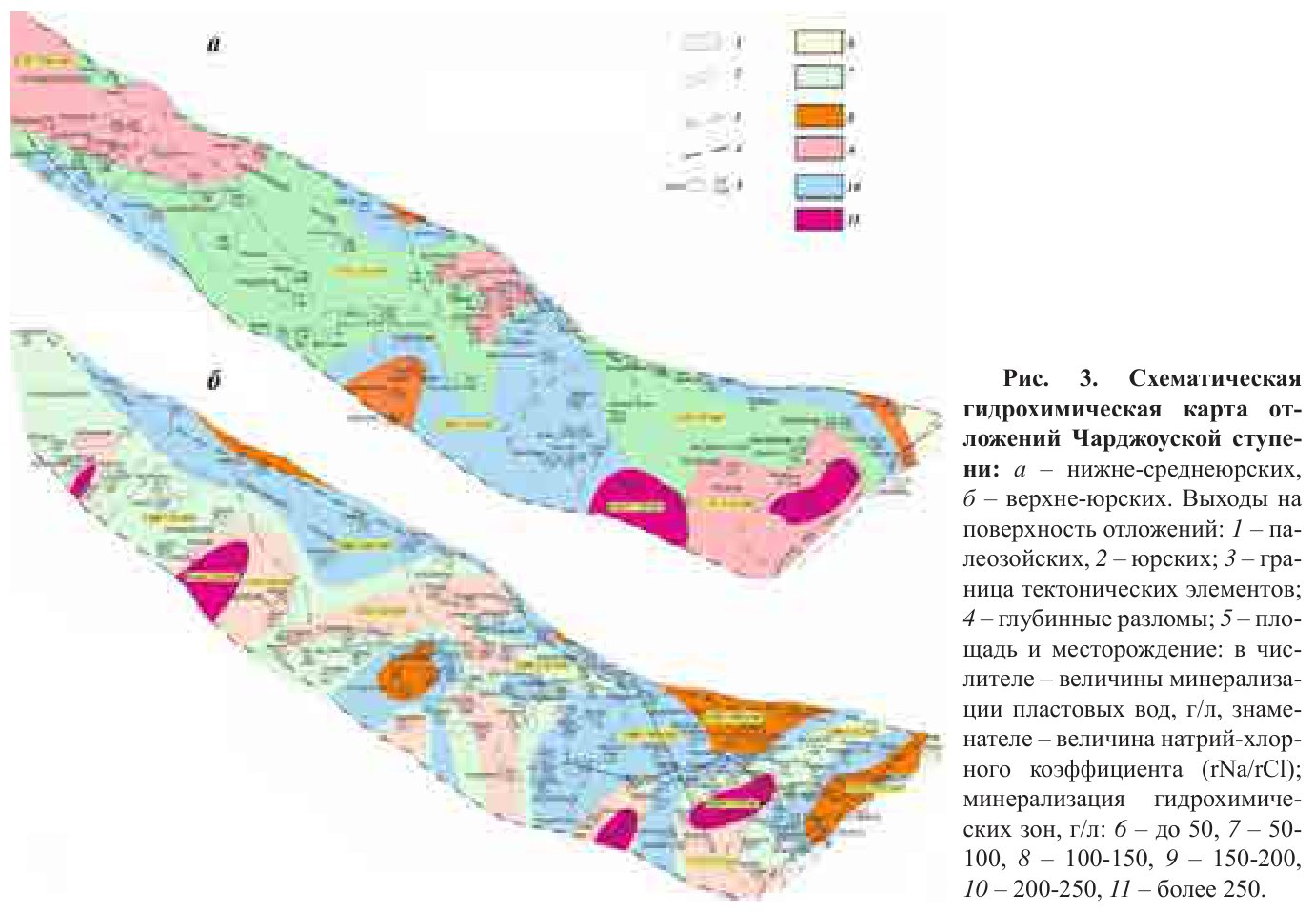
- Lower–Middle Jurassic water: 107–131 g/L on the Kultak uplift (Kultak, Alan, South Alan, Pamuk); 206–237 g/L on the Ispanly-Chandyr uplift; 199–258.8 g/L on the Kandym uplift; 199–273 g/L on the Kulbeshkak uplift; 252 g/L at Kimerek; rNa/rCl 0.53–0.96.
- Lower–Middle Jurassic water in the Beshkent trough: 162.2–246.0 g/L at North Guzar, Shakarbulak, North Nishan and Ilim; 284.0 g/L at Shurtan, 252.0 g/L at Chunagar, 330.3 g/L at Nishan and 333.5 g/L at Izgancha.
- Upper Jurassic brines: 201–277.3 g/L (Umid, Urtabulak) to 305.8 g/L (Shimoliy Tegermen) on the Dengizkul uplift; 215.0–230.0 to 278.0–283.2 g/L on the Ispanly-Chandyr uplift.
- Upper Jurassic anomalies: 255.3 g/L in well Darakhtli 2, 265.2 g/L in Girsan 6, 285.5 g/L in Chilkuvar 2, 296.9 g/L in Mangit 2 and 407.2 g/L in Eshonkuduk 1, with iodine 46.6–48.7 mg/L and bromine 638.7–835 mg/L.
- Iodine and bromine: up to 37.4 and 283 mg/L on the Dengizkul uplift; bromine 987 mg/L at South Zekry; iodine 42.4–52.8 mg/L at Pirnazar and Markovskaya; iodine 57.7–67.9 mg/L and bromine 350–652 mg/L at Urtabulak–Kokdumalak.
- Dissolved gas in Jurassic water: 200–2,410 cm³/L; nitrogen 0.5–1.5%, hydrogen sulphide up to 3.0–4.3%; gas saturation coefficient close to 1 near pools, 0.42–0.48 outside them and 0.13–0.27 in empty structures.
- Upper Jurassic water near the south-western spurs of the Gissar range (Lyangar, Shurasan, Amanata, Babasurkhan): 13.3–20.4 g/L.
Abstract
The hydrochemical aspects of the oil and gas potential of Jurassic deposits of the Chardzhou stage are considered. The hydrogeochemical zoning of fluids in Jurassic deposits revealed, taking into account the characteristics of the vertical and horizontal zoning of waters. The continuity of aqueous migration of chemical elements, hydrocarbons and the unity of the dynamics and chemistry of underground fluids are an important point that largely determines their oil prospecting significance in specific geological conditions. Hydrogeological features of groundwater deserve attention as a search criterion when choosing a rational direction for prospecting and exploration work in specific geological objects.
English abstract from the journal issue PDF. The authors’ abstract, reproduced under .
In plain English
Written for oil and gas exploration, this paper describes formation water in the Jurassic rocks of the Chardzhou step, the hydrogeological area between the Bukhara and Amu Darya regional faults in the Bukhara–Khiva region. The Palaeozoic basement, the floor of the aquifers, lies 3.0–3.5 to 5.0–5.5 km deep. Lower–Middle Jurassic water is held in the sandstone and siltstone horizons XX–XVII of the terrigenous formation, and Upper Jurassic water in horizon XV of the carbonate formation. Water chemistry changes westwards and north-westwards, from the south-western spurs of the Gissar range towards the Kulbeshkak uplift.
In the Lower–Middle Jurassic, water of 50–100 g/L occurs in parts of the Beshkent trough, at Jilinskaya, Mangit and Kamashi, where less saline water of 96.4–100.5 g/L points to infiltration, especially near faults. The Kultak uplift holds 107–131 g/L. Water is most saline in the centre and south-west of the step, at 199–273 g/L on the Ispanly-Chandyr, Kandym and Kulbeshkak uplifts. In the raised part of the Beshkent trough it exceeds 250 g/L, reaching 330.3 g/L at Nishan and 333.5 g/L at Izgancha. Lower salinity near the edges of some gas-condensate pools, such as 77 g/L at Dengizkul, may come from condensation water.
Upper Jurassic water is mostly chloride–calcium brine of 100–200 g/L and more, possibly because lithological barriers or faults keep it stagnant. It carries 5–10 mg/L of iodine, 100–300 mg/L of bromine and 100–200 mg/L of ammonium, and iodine–bromine water with more than 20 mg/L of iodine and 300 mg/L of bromine occurs in the brine fields of the centre of the step. Salinity reaches 305.8 g/L at Shimoliy Tegermen on the Dengizkul uplift and, in single wells of the Beshkent trough, 255.3–296.9 g/L and 407.2 g/L in well Eshonkuduk 1, which the authors link to buried brine from between salt beds. Only on the edge of the trough, next to the south-western spurs of the Gissar range, has modern and ancient infiltration water apparently partly replaced the sedimentary brines: at Lyangar, Shurasan, Amanata and Babasurkhan, Upper Jurassic water holds 13.3–20.4 g/L.
Gas dissolved in the Jurassic water is mostly methane, 200–2,410 cm³/L, and increases with depth. Compared with the Bukhara step, it holds less nitrogen, 0.5–1.5%, and more acid gases, especially hydrogen sulphide at up to 3.0–4.3%. The authors conclude that the stagnant, highly saline water favours the formation and preservation of oil and gas pools. Several of these brine values also appear in a 2024 regional study, and a 2026 paper covers the Cretaceous aquifers of the same step; this paper gives the Jurassic values field by field, with the dissolved gases.
Figures (1)
How to cite
T. Kh. Shoimurotov, Kh. F. Khudoiberdiev, K. B. Yusupov, A. T. Mukhammadiev and N. S. Khudoiberdieva (2023). Hydrogeological factors of petroleum and gas capability of Jurassic deposits of the Chardzhou stage. Geologiya i mineral'nye resursy (Geology and Mineral Resources), No. 5, 2023, pp. 57–62. https://mridm.uz/en/assets/journal/pdf/5_2023.pdf