Journal articleFree to read
Mechanism of microcomponents distribution in formation waters, concomitant to oil and gas fields of Bukharo-Khivinsky region
Закономерности распространения микрокомпонентов в пластовых водах, сопутствующих нефтяным и газовым месторождениям Бухаро-Хивинского региона
- Institute of Geology and Exploration of Oil and Gas Fields (IGIRNIGM), Tashkent, Uzbekistan
Highlights
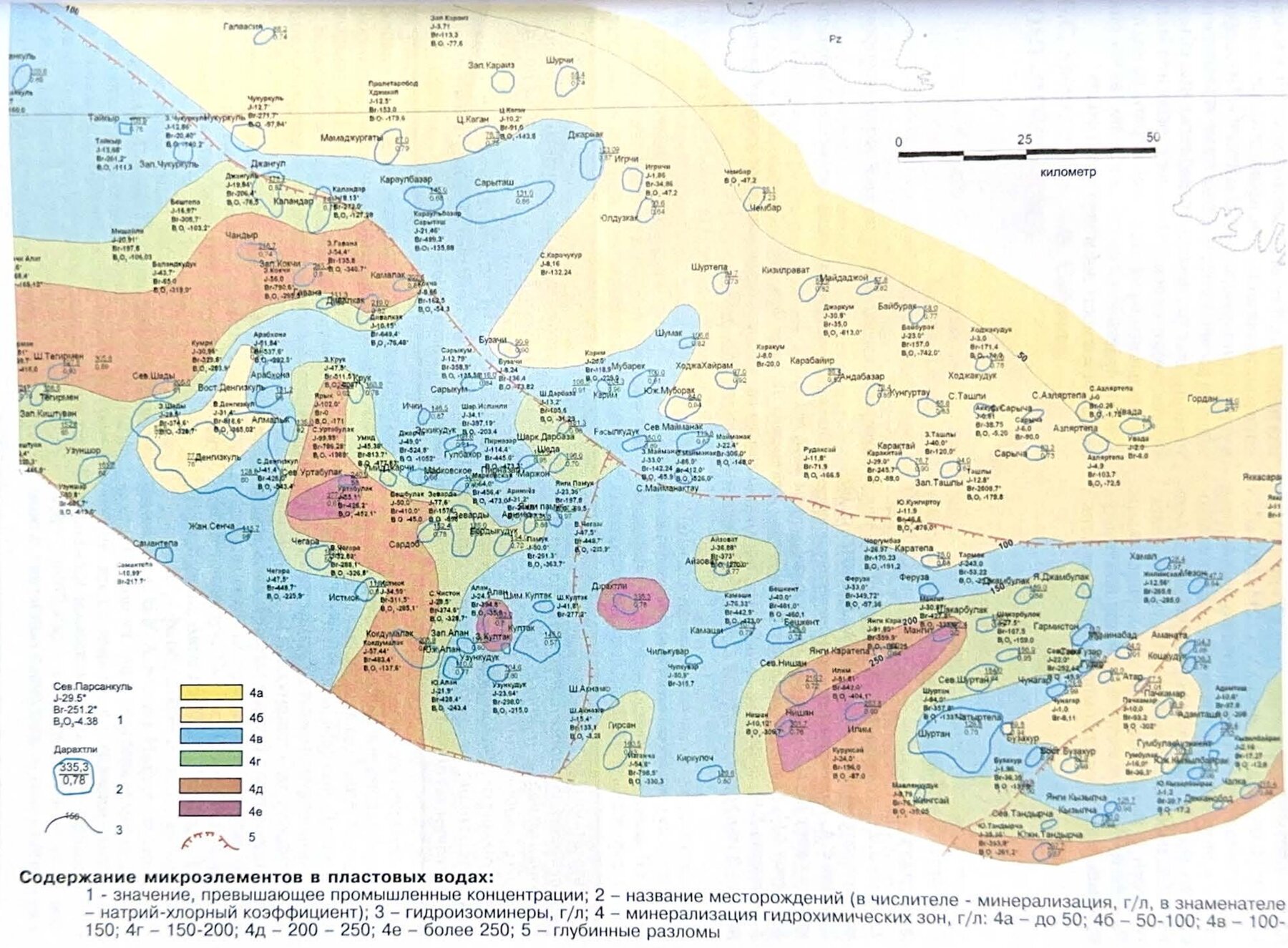
- Salinity zones of formation water: under 50, 50–100, 100–150, 150–200, 200–250 and over 250 g/L.
- Dengizkul uplift, water of 100–150 g/L: iodine 31.14–49 mg/L, bromine 311.5–524.8 mg/L, boron oxide up to 1,052 mg/L.
- South Zekry and South Kemachi, brines of 150–200 g/L and more: iodine up to 116 and 206 mg/L, bromine up to 1,206 and 1,265 mg/L, boron oxide up to 1,014 and 2,440 mg/L.
- Beshkent trough, Upper Jurassic carbonates: iodine 1.27–84 mg/L, bromine 7–357.8 mg/L, boron oxide 3–1,337 mg/L.
- Yangi Karatepa: iodine up to 84.7 mg/L, bromine up to 559.9 mg/L; Shurtan: iodine 84 mg/L, bromine 357.8 mg/L, boron oxide 1,337 mg/L.
- Estimated natural reserves of formation water: Kemachi-Zekry 49,612,500 m³, Khauzak 717,696,000 m³, Alan 860,789,793 m³, Feruza 21,467,600 m³.
Keywords
- formation water
- brines
- iodine
- bromine
- boron
- Bukhara–Khiva region
- Beshkent trough
- Dengizkul uplift
Summary
Written about formation water as a source of iodine, bromine and boron, this paper describes microcomponents in the water of oil and gas fields in the Bukhara–Khiva region. Of all mineralised groundwaters, only iodine and bromine are extracted on an industrial scale; in the region, iodine is produced from the associated water of the Kruk oil and gas field. A map shows zones of formation-water salinity, from under 50 g/L to over 250 g/L, with iodine, bromine and boron oxide contents at each field.
On the Dengizkul uplift, formation water of 100–150 g/L holds 31.14 mg/L (East Dengizkul) to 49 mg/L (Jarchi) of iodine, 311.5 mg/L (Istmok) to 524.8 mg/L (Jarchi) of bromine and up to 1,052 mg/L of boron oxide (Jarchi). Where strong brines of 150–200 g/L and more occur, in the water at the margins of the South Zekry and South Kemachi fields, contents exceed the minimum industrial concentrations 6–20 times: iodine up to 116 and 206 mg/L, bromine up to 1,206 and 1,265 mg/L and boron oxide up to 1,014 and 2,440 mg/L respectively.
In the Upper Jurassic carbonate rocks of the Beshkent trough, iodine ranges from 1.27 to 84 mg/L, bromine from 7 to 357.8 mg/L and boron oxide from 3 to 1,337 mg/L (Shurtan). High and anomalously high concentrations occur mainly in strong chloride–calcium brines. The authors recommend the Kemachi-Zekry, Khauzak, Pirnazar, South Zekry, Alan, Yangi Karatepa and Feruza fields for larger laboratory tests, and estimate the natural reserves of formation water in their productive horizon XV at 21,467,600 m³ (Feruza) to 860,789,793 m³ (Alan).
Figures (1)
How to cite
H. N. Musaev, T. I. Muminjanov and H. F. Hudoyberdiev (2008). Mechanism of microcomponents distribution in formation waters, concomitant to oil and gas fields of Bukharo-Khivinsky region. O‘zbekiston neft va gaz jurnali (Uzbek Journal of Oil and Gas), No. 2, 2008, pp. 4–6. https://drive.google.com/file/d/1O8oXDL-DIcHnrxIphkb-AiSkUKk1_WPq/view