Journal articleFree to read
Hydrogeoseismological earthquake precursor
Гидрогеосейсмологические предвестники землетрясений
- Institute of Seismology, Academy of Sciences of the Republic of Uzbekistan, Tashkent, Uzbekistan
Highlights
- Ozodbash spring, 41.54° N, 69.63° E: flow 5 L/min, water 17–19 °C, mineralisation 0.7–1.0 g/L.
- Sampling twice a week, August 2010 to November 2013.
- Earthquakes: Tuyabuguz, 25 May 2013, M 5.6 at 70 km; Marjanbulak, 26 May 2013, M 6.2 at 200 km.
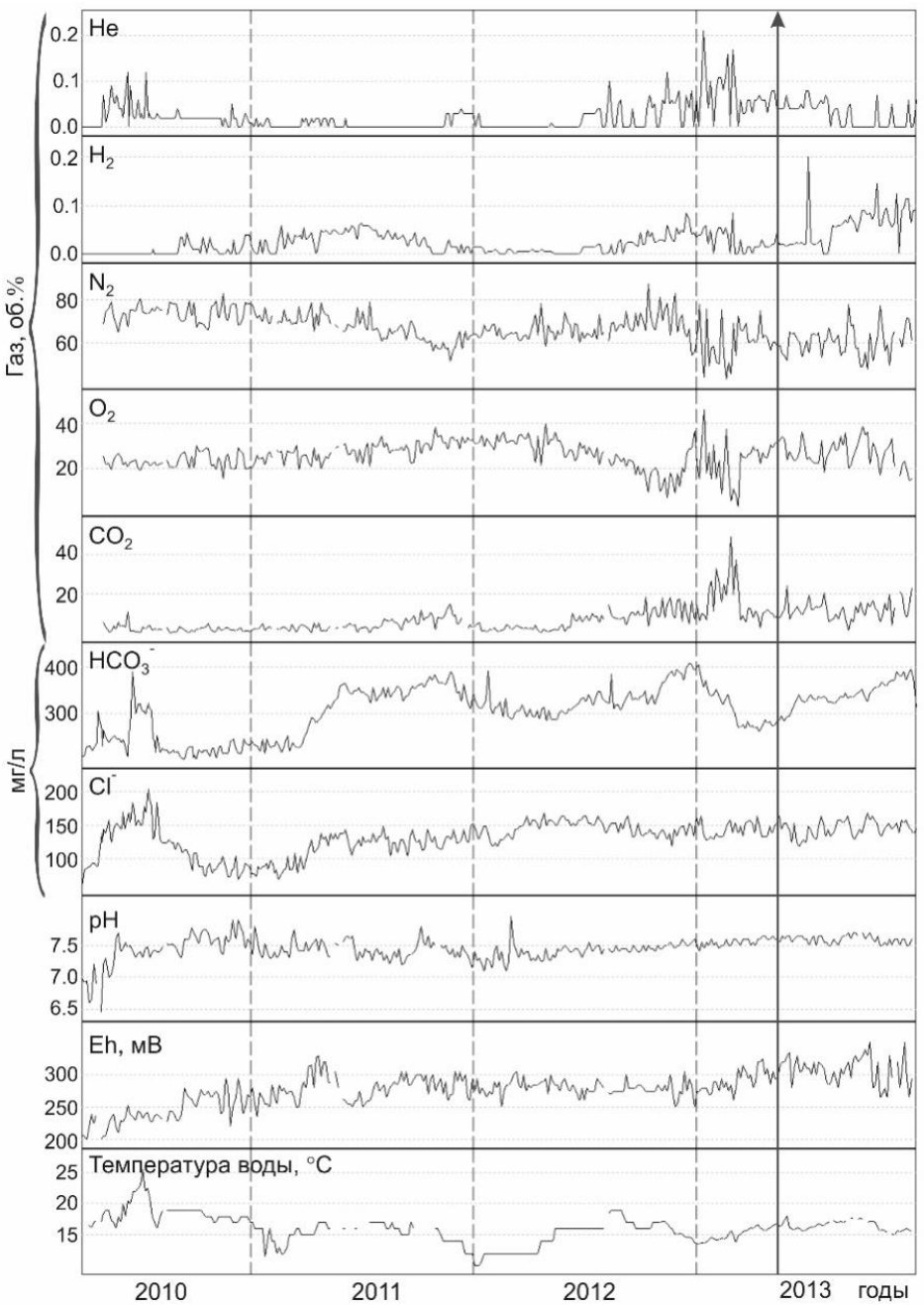
- Anomalies from about nine months before 25 May 2013, lasting 55–160 days, with extremes of 150–800% above background.
- pH rose from 7.1 to 7.6 as hydrogen increased.
Keywords
- hydrogeoseismology
- groundwater
- dissolved gases
- helium
- Pretashkent artesian basin
- Ozodbash spring
- earthquake precursors
Summary
Sh. S. Yusupov and L. Yu. Shin, of the Institute of Seismology of the Academy of Sciences of Uzbekistan in Tashkent, present long-term observations of hydrogeoseismological precursors, changes in the gas, chemical, isotopic and physical properties of groundwater before strong earthquakes, at the Tashkent geodynamic test site. Such observations are made on self-flowing wells and springs.
The Ozodbash spring (41.54° N, 69.63° E) lies in the Pretashkent artesian basin, in the Karzhantau fault zone, and is fed by groundwater from Palaeozoic rocks. Its flow is 5 L/min, the water temperature 17–19 °C and mineralisation 0.7–1.0 g/L. From August 2010 to November 2013 it was sampled twice a week; chloride and bicarbonate were measured by standard methods and the gas by chromatography. The record covers the Tuyabuguz earthquake of 25 May 2013 (M 5.6, 70 km from the spring) and the Marjanbulak earthquake of 26 May 2013 (M 6.2, 200 km). Clear anomalies, mainly in the gas composition, appeared about nine months before the earthquake of 25 May 2013; they lasted 55–160 days, with extremes 150–800% above the long-term background. Similar changes were seen in the Chatkal, Minora and DAN wells, which tap Upper Cretaceous and Quaternary waters in the same fault zone within 20–30 km. Ozodboshi is also one of the sampling points of a later isotope study of the basin's groundwater.
The authors link the gas anomalies to more helium, hydrogen and carbon dioxide entering the water from isolated pores as the host rocks deform before an earthquake; the rise in hydrogen came with a rise in pH from 7.1 to 7.6, a disturbed carbonate balance and changes in oxidation. They explain the precursors by changing mixing of waters of different composition in zones of higher permeability and by water–rock interaction in fractured rock. They call for automatic recording, at least hourly, of water temperature, pressure, flow, conductivity, pH and Eh, and for isotope studies of He, H₂, O₂, N₂, CO₂, Ar and SO₂ in groundwater.
Figures (1)
How to cite
Sh. S. Yusupov and L. Yu. Shin (2019). Hydrogeoseismological earthquake precursor. Seysmologiya muammolari (Problems of Seismology), No. 2, 2019, pp. 36–40. https://seismos.uz/uploads/pdf/journal/%D0%A1%D0%B5%D0%B9%D1%81%D0%BC%D0%BE%D0%BB%D0%BE%D0%B3%D0%B8%D1%8F%20%D0%BC%D1%83%D0%B0%D0%BC%D0%BC%D0%BE%D0%BB%D0%B0%D1%80%D0%B8%202019%20%E2%84%962.pdf