Journal articleFree to read
Changing of water stable isotopes values in the Pskem river basin
Писком дарёси ҳавзасида сувнинг стабил изотоплари миқдорининг ўзгаришлари
- National University of Uzbekistan, Tashkent, Uzbekistan
- University of Fribourg, Fribourg, Switzerland
- Latvian State University, Riga, Latvia
- Hydrometeorological Research Institute, Tashkent, Uzbekistan
Highlights
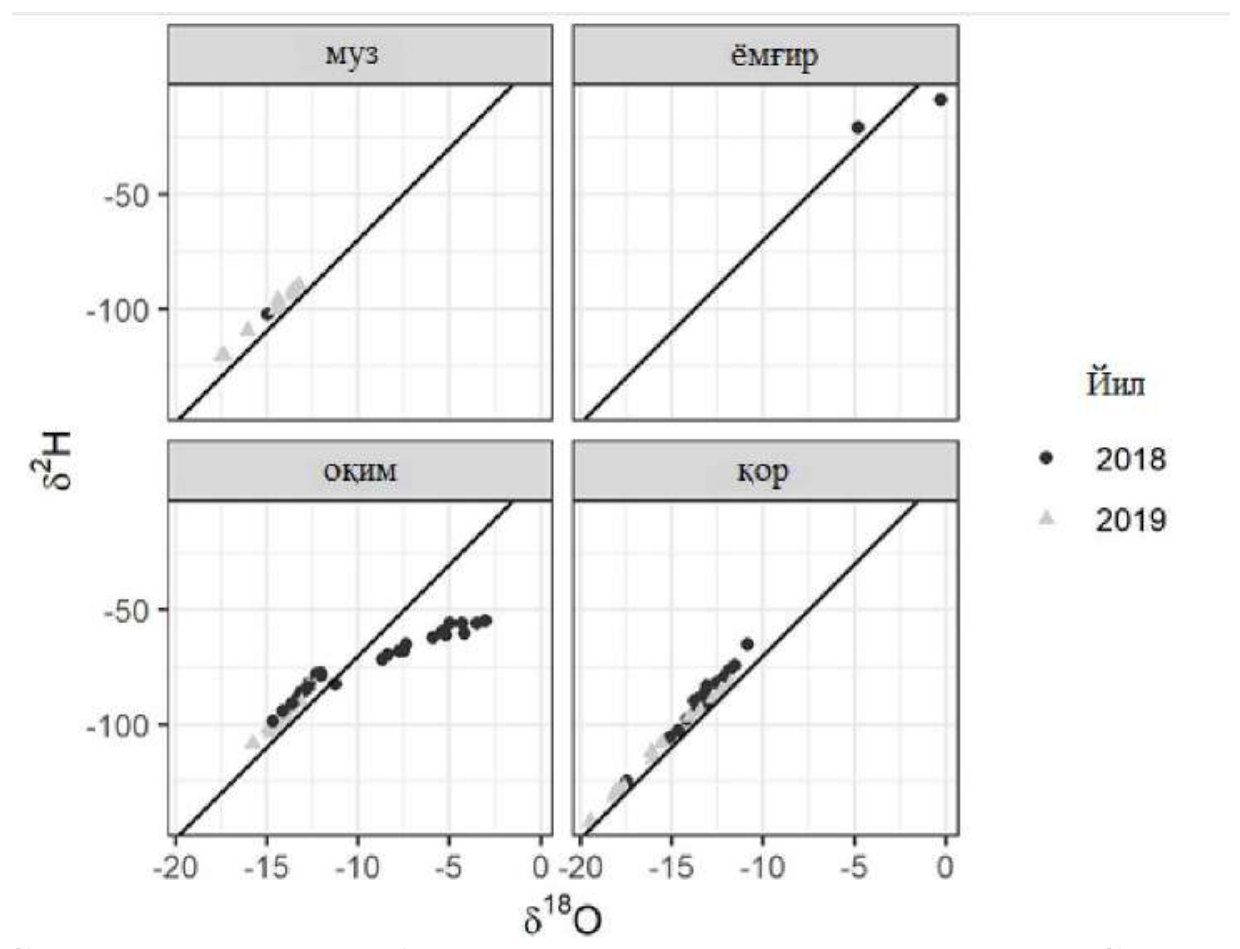
- 120 samples, August 2018 and August 2019: snow 35, glacier ice 11, river water 57 unaffected and 15 evaporated, rain 2.
- Mean δ¹⁸O and δ²H (‰): snow −14.20 and −97.7; ice −14.81 and −101.4; river water −13.92 and −94.2.
- Lowest values in snow: δ¹⁸O −19.48‰, δ²H −142.3‰; mean d-excess: snow 15.8‰, ice 17.0‰, river water 17.2‰.
- Local meteoric water line: δ²H = 7.60 (±0.13) δ¹⁸O + 11.0 (±1.8), r² 0.971, 105 samples.
- Local evaporation line: δ²H = 3.24 (±0.24) δ¹⁸O − 43.1 (±1.6), r² 0.929, 15 samples.
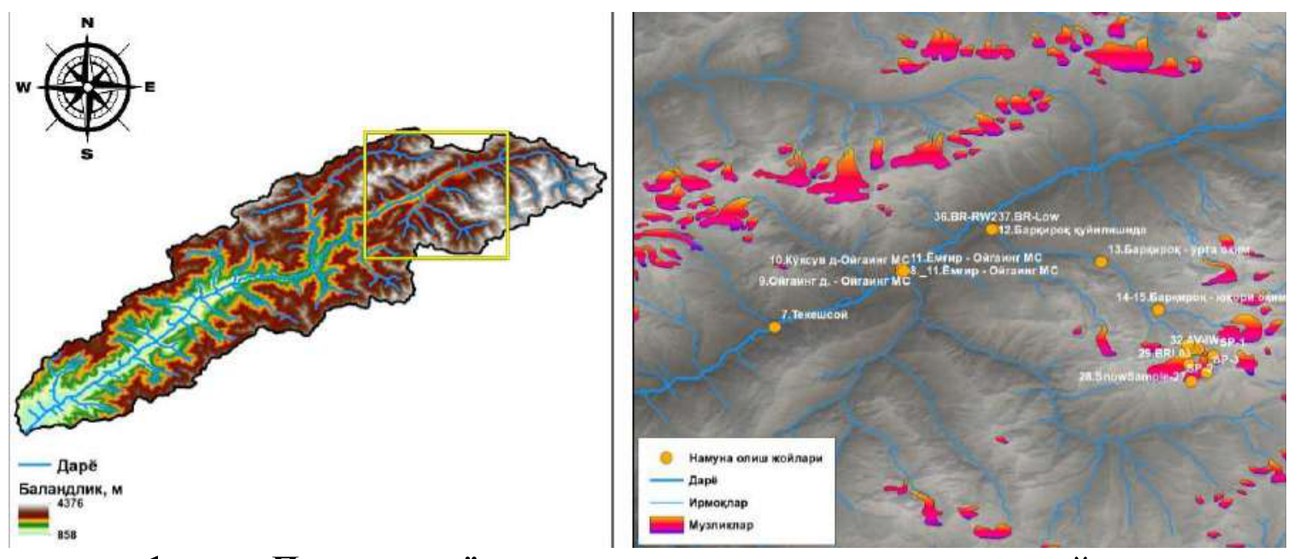
- Pskem basin: 2,830 km², mean elevation 2,740 m, mean annual flow 76.7 m³/s.
Keywords
- river basin
- isotope hydrology
- stable water isotopes
- δ²H and δ¹⁸O
- global meteoric water line
- local meteoric water line
- Pskem River
Summary
The authors sampled the upper Pskem basin, the main tributary of the Chirchik, in August 2018 and August 2019, mostly around the Barkrak glacier and Barkraksay on the Oygaing River: 120 samples of snow, glacier ice, river water and rain. Hydrogen and oxygen isotopes were measured with a Picarro L2120-i analyser at the environmental monitoring laboratory of the Faculty of Geography and Earth Sciences, University of Latvia, to ±0.1‰ for δ¹⁸O and ±1‰ for δ²H.
Snow, ice and river water have mean δ¹⁸O of −13.9‰ to −14.8‰ and mean d-excess of 15.8–17.2‰, so most samples plot above the global meteoric water line. Fifteen river and meltwater samples are enriched by evaporation and fall on a local evaporation line, δ²H = 3.24 δ¹⁸O − 43.1, which the authors relate to the low air humidity of August and do not take as typical of the whole region.
The local meteoric water line for the basin, δ²H = 7.60 δ¹⁸O + 11.0 from 105 samples, has a slope close to the global line but is shifted to higher δ²H. A line computed from a global model of precipitation isotopes for 42° N, 71° E and 3,100 m has a similar slope, 7.75, and an intercept of 15.2. Snow layers in the accumulation zone of the Barkrak glacier record the isotopes of seasonal precipitation, which the authors see as a basis for separating the sources of river flow in later work.
Figures (2)
How to cite
G. U. Umirzakov, T. Saks, A. Kalvans, B. E. Nishonov and S. R. Isabekov (2023). Changing of water stable isotopes values in the Pskem river basin. Gidrometeorologiya va atrof-muhit monitoringi (Hydrometeorology and Environmental Monitoring), 2023, No. 2, pp. 80–88. https://nigmi.uz/portfolio/hydrometeorology-and-environmental-monitoring-scientific-journal-%e2%84%96-2-2023-y/