Journal articleFree to read
Features of radon behaviour in various groundwaters
Особенности поведения радона в различных подземных водах
- Central Research Laboratory, Navoi Mining and Metallurgical Combinat, Navoi, Uzbekistan
- Department of General Physics, Navoi State Mining Institute, Navoi, Uzbekistan
Highlights
- More than 100 analyses of radon in groundwater.
- Radon soon after sampling (Table 1, six samples): 247 ± 24 to 466 ± 53 Bq/L.
- Radon after 24 hours: 1.63 ± 0.23 to 2.60 ± 0.31 Bq/L.
- Limit for drinking water used for comparison: 60 Bq/L.
- Wells: 180 m deep in the Nurabad uranium ore field (water for the town’s heating systems) and 250 m deep in the Uchkuduk uranium ore field.
- Lowest measurable radon activity in water: 0.5 Bq/L; main measurement error: not more than 30%.
Keywords
- radon
- groundwater
- radioactivity
- barbotage
- activated charcoal
- Nurabad
- Uchkuduk
Summary
The authors made more than 100 measurements of radon in groundwater with the KAMERA radon monitoring system. Radon is driven out of a water sample by bubbling (barbotage) onto SK-13 columns of activated charcoal, and the activity of the radon held in the charcoal is then measured in the laboratory. With the BDB-13 beta detector the lowest measurable radon activity in water is 0.5 Bq/L, and the main measurement error does not exceed 30%.
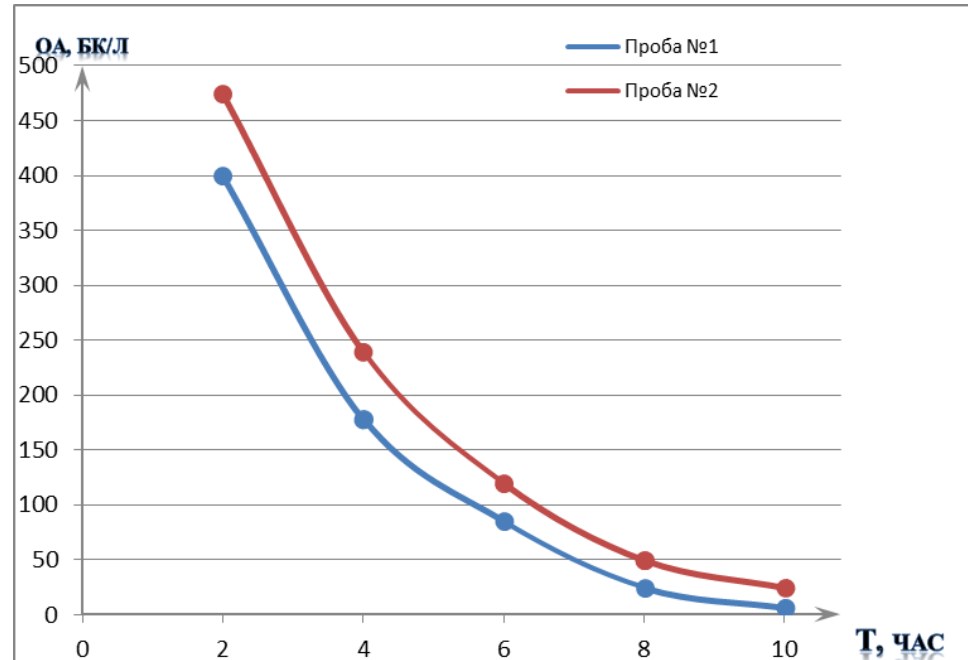
The samples come from groundwater wells. Sample No. 1 was taken from a well 180 m deep in the uranium ore field of Nurabad, which supplies water to the town’s heating systems; sample No. 2 from a well 250 m deep in the uranium ore field of Uchkuduk. In six samples (Table 1) radon measured soon after sampling was 247–466 Bq/L, several times the 60 Bq/L limit for drinking water. After the samples had stood for 24 hours it was 1.63–2.60 Bq/L, 100–200 times lower.
Measured every two hours, radon fell the same way in the water from both wells (Fig. 1). The authors conclude that groundwater gains radon through pores in the ground and loses it to the air once it reaches the surface, and that the radon content of groundwater does not depend on the radium it contains.
Figures (1)
How to cite
A. M. Muzafarov, I. A. Urunov, A. R. Zhurakulov and G. M. Allaberganova (2018). Features of radon behaviour in various groundwaters. Gorniy vestnik Uzbekistana (Mining Bulletin of Uzbekistan), 2018, No. 4 (75), pp. 125–127. https://gorniyvestnik.uz/ru/release/2018/4