Journal articleFree to read
On the possibility of establishing sanatorium-resort zones and medical and wellness tourism facilities based on recreational-climatic conditions and therapeutic mineral groundwater in the Surkhandarya region
Сурхондарё вилоятида рекреацион-иқлимий ва шифобаҳш минерал ер ости сувлари асосида санаторий-курорт зоналари ҳамда тиббиёт ва соғломлаштириш туризми объектларини ташкил этиш имконияти тўғрисида
- Institute of Hydrogeology and Engineering Geology (HYDROENGEO), Tashkent, Uzbekistan
Highlights
- Geothermal gradient used for the deep aquifers of the Surkhandarya artesian basin: 2.7 °C per 100 m.
- Alay-bed groundwater: 24.2–46 °C, depending on depth.
- Upper Cretaceous water: 37–45 °C in the centre of the basin, 11–18 °C at the margins; formation water in the west and south-west: 100–150 °C.
- Lower Cretaceous water: 50–150 °C (4,000–4,500 m); Jurassic water (2,000–5,000 m): about 100–180 °C; Palaeozoic: about 250 °C at 8,000 m, by extrapolation.
- Strongly hydrogen-sulphide thermal water (250–600 mg/L) from Palaeogene limestones and dolomites: 5–13.0 L/s.
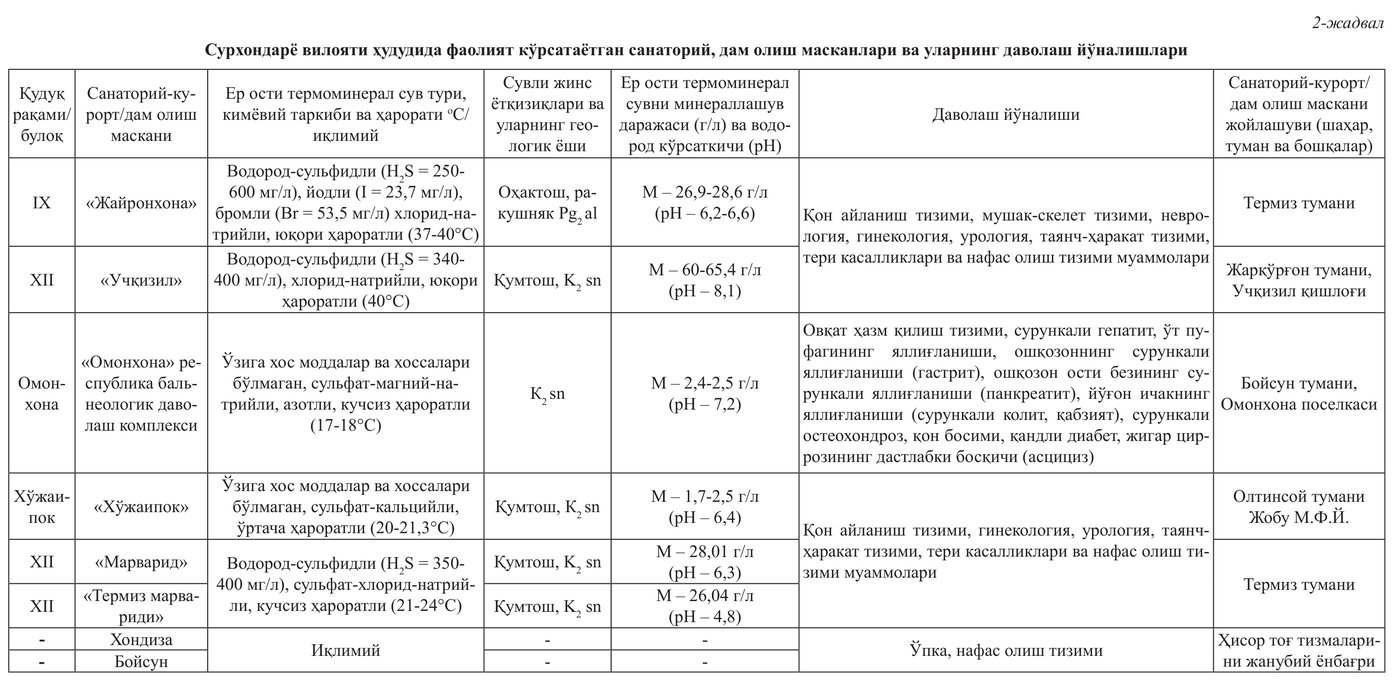
- Jayronkhona sanatorium, well IX: 37–40 °C, 26.9–28.6 g/L, pH 6.2–6.6, H₂S 250–600 mg/L, iodine 23.7 mg/L, bromine 53.5 mg/L.
- Uchkizil sanatorium, well XII: 40 °C, 60–65.4 g/L, pH 8.1, H₂S 340–400 mg/L.
Abstract
The article outlines the prospects for the integrated use of climatic conditions and therapeutic mineral waters in the southern regions to expand resort and recreational zones, using the Surkhandarya region as an example.
English abstract from the journal issue PDF. The authors’ abstract, reproduced under .
In plain English
Presidential resolution PP-335 of 23 September 2024 on medical and wellness tourism provides for sanatorium-resort zones in 2025–2026 in regions with therapeutic waters, including Boysun and Oltinsoy districts of Surkhandarya region. The article assesses the region’s climate for recreation, then its mineral and thermal groundwater and the sanatoriums that use it.
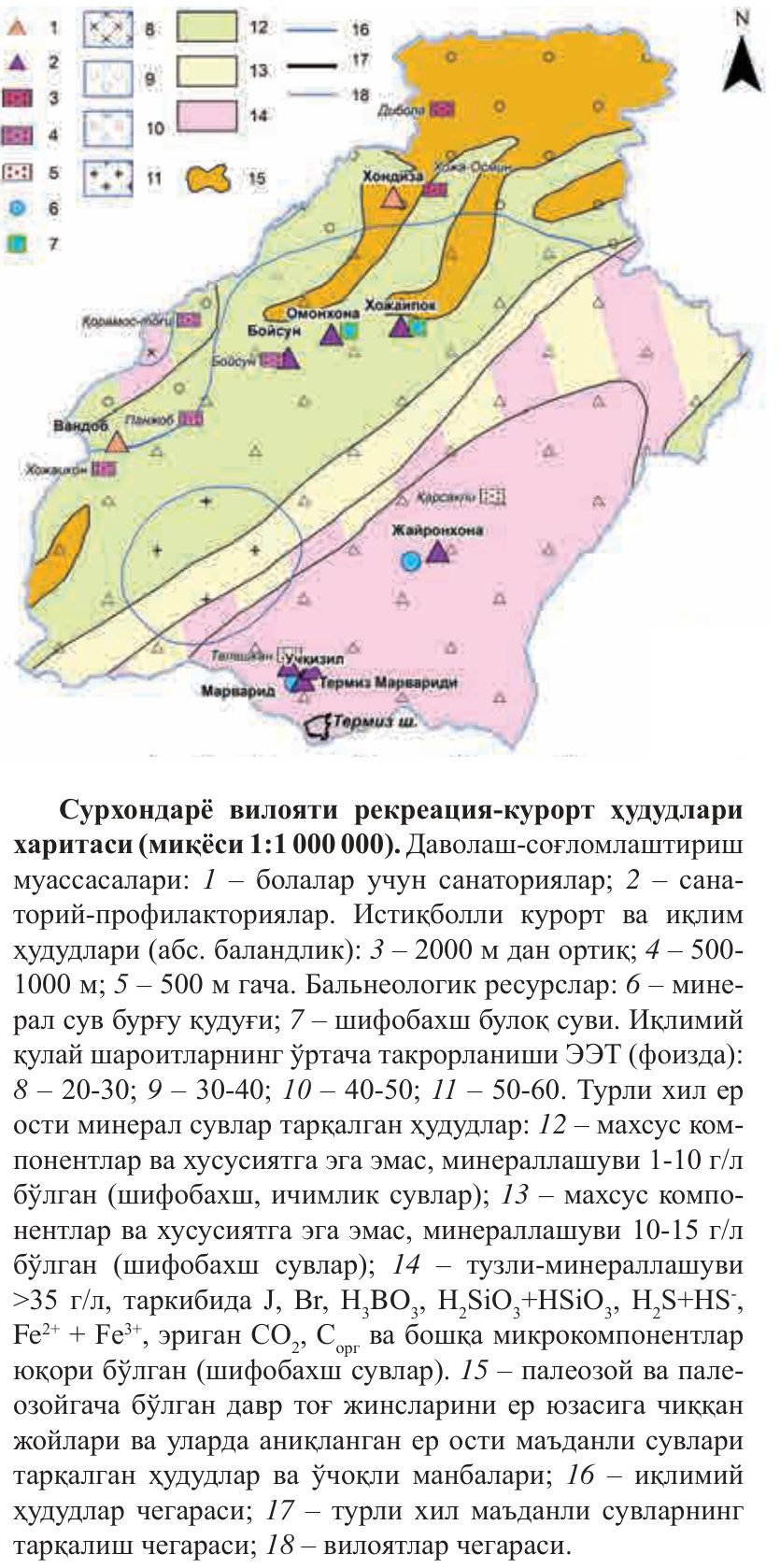
Strongly hydrogen-sulphide water (250–600 mg/L) comes as high-pressure thermal water from Palaeogene limestones and dolomites of the Alay and Bukhara beds, at 5–13.0 L/s. Highly mineralised chloride–sodium water occurs mainly in the formation water of the region’s oil and gas fields and is used for treatment at the Jayronkhona and Uchkizil sanatoriums. Slightly alkaline hydrogen-sulphide water occurs in Upper Cretaceous sandstones.
The Surkhandarya artesian basin is little studied for geothermal purposes, and the temperatures of its deep aquifers are mainly calculated from a geothermal gradient of 2.7 °C per 100 m. Groundwater in the Alay beds is 24.2–46 °C, depending on depth. In the west and south-west, where the aquifers lie deep, formation water is 100–150 °C; at the margins, where Upper Cretaceous beds are shallow, it is 11–18 °C, and in the centre of the basin Upper Cretaceous thermal water is 37–45 °C. Lower Cretaceous water is 50–150 °C depending on depth (4,000–4,500 m), Jurassic water (2,000–5,000 m) about 100–180 °C, and extrapolation gives about 250 °C for the Palaeozoic at 8,000 m.
Six sanatoriums use mineral water and two more are climatic resorts. Jayronkhona draws hydrogen-sulphide, iodine–bromine, chloride–sodium water at 37–40 °C from well IX in Palaeogene (Alay) limestone and shell rock, and Uchkizil uses 40 °C chloride–sodium water from well XII in Senonian sandstone. The spring water of Omonkhona (17–18 °C) and Khojaipok (20–21.3 °C) and the hydrogen-sulphide water of Marvarid and Termiz Marvaridi (21–24 °C) are cooler. The authors conclude that the region’s thermomineral groundwater could serve as an alternative energy source for industry, energy, agriculture, resorts and ecotourism, including modern greenhouses and fish farming.
Figures (2)
How to cite
T. I. Mumindzhanov, B. J. Ismailov, A. Kh. Yusupov, T. A. Gafurov, A. S. Ibragimov and Kh. F. Khasanbayev (2025). On the possibility of establishing sanatorium-resort zones and medical and wellness tourism facilities based on recreational-climatic conditions and therapeutic mineral groundwater in the Surkhandarya region. Geologiya i mineral'nye resursy (Geology and Mineral Resources), No. 4, 2025, pp. 61–67. https://mridm.uz/en/assets/journal/pdf/4_2025.pdf