Conference paperFree to read
Nonequilibrium state of the nuclides of the radium decay series in the natural waters of southern regions of the Republic of Kazakhstan
Неравновесное состояние нуклидов радиевого ряда в природных водах южных районов Республики Казахстан
- Trofimuk Institute of Petroleum Geology and Geophysics, Siberian Branch of the Russian Academy of Sciences, Novosibirsk, Russia
- Satbayev University, Almaty, Kazakhstan
https://doi.org/10.33764/2618-981X-2026-2-1-31-37
Highlights
- 3,630 groundwater samples from springs and water-supply wells (field work 2023–2025 and earlier Volkovgeologiya data): 3,532 U-238, 776 Rn-222, 656 Ra-226, 223 Pb-210, 203 Th-234, 48 Th-230 and 47 Po-210 determinations.
- Radon-222 up to 5,550 Bq/L (Central Kazakhstan region), 5,400 Bq/L (Scythian–Turan, mean 123.7 Bq/L), 5,098.6 Bq/L (Zhetysu Alatau–Tien Shan, mean 230.7 Bq/L) and 499.5 Bq/L (Yenisei–Altai–Sayan, mean 40.3 Bq/L).
- Uranium-238 up to 16 mg/L (Zhetysu Alatau–Tien Shan, mean 372.4 µg/L), 8,000 µg/L (Central Kazakhstan, mean 107.5 µg/L), 2,600 µg/L (Scythian–Turan) and 910 µg/L (Yenisei–Altai–Sayan).
- Scythian–Turan region: lead-210 up to 12.05 µg/L (mean 0.6 µg/L), polonium-210 up to 8.3 µg/L (mean 0.68 µg/L), radium-226 up to 12×10⁻⁴ µg/L.
- Thorium-234/uranium-238 ratio 0.004–133.6.
Keywords
- groundwaters
- radium decay series
- nonequilibrium state
- southern Kazakhstan
Summary
F. F. Dultsev of the Trofimuk Institute of Petroleum Geology and Geophysics in Novosibirsk and V. A. Zavaley, N. A. Medeshova and K. O. Zhynak of Satbayev University in Almaty, with B. T. Turdali of Viridi Navitas LLP, sum up what is known about the radium decay series in groundwater of southern Kazakhstan. This is the chain of decays that starts with uranium-238 and ends with stable lead-206. The data combine earlier analyses by Volkovgeologiya JSC with the authors' own analyses of water from springs and water-supply wells sampled in 2023–2025: 3,630 samples in all, with 3,532 determinations of uranium-238, 776 of radon-222, 656 of radium-226, 223 of lead-210, 203 of thorium-234, 48 of thorium-230 and 47 of polonium-210. The area lies where a fold belt of metamorphic, igneous and strongly deformed sedimentary rocks meets a platform with a thick Mesozoic–Cenozoic cover, and it holds many uranium deposits and occurrences.
The authors divide the area into four hydrogeological regions. In the Yenisei–Altai–Sayan region in the east, radon does not exceed 499.5 Bq/L (mean 40.3 Bq/L) and uranium-238 910 µg/L. In the Zhetysu Alatau–Tien Shan region in the south, uranium reaches 16 mg/L (mean 372.4 µg/L) and radon 5,098.6 Bq/L (mean 230.7 Bq/L). In the Central Kazakhstan region radon reaches 5,550 Bq/L, the highest value in southern Kazakhstan, and uranium-238 8,000 µg/L (mean 107.5 µg/L). In the Scythian–Turan region in the west, radon reaches 5,400 Bq/L (mean 123.7 Bq/L) and uranium-238 2,600 µg/L, and the highest lead-210, polonium-210, radium-226 and thorium-234 contents of the whole area were found.
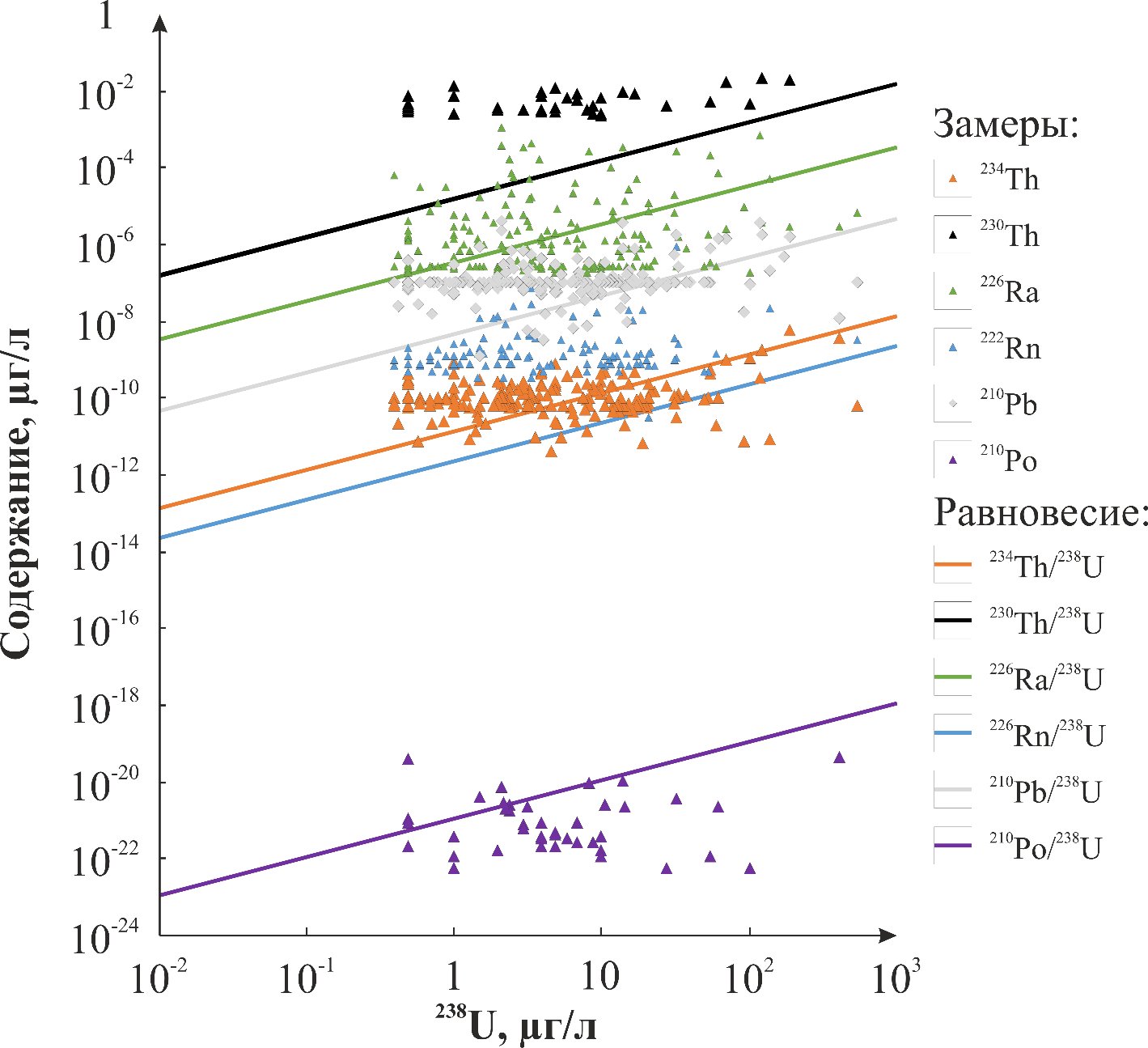
The ratio of thorium-234 to uranium-238 ranges from 0.004 to 133.6. Where uranium is low, thorium-234 activity is far higher than that of uranium; as uranium rises, the ratio falls below one. Thorium-230, lead-210 and polonium-210 follow the same trend, while radium-226 shows no clear dependence on uranium. Thorium-230 is above equilibrium with uranium in all analysed waters, and polonium-210 stays at or below it in practically all of them. Radon is above equilibrium in practically every sample. The authors explain this widespread radon supersaturation of groundwater by intense migration of the gas from the emanating reservoir rock as the parent nuclides decay.
The highest levels of the whole series are in the Scythian–Turan and Central Kazakhstan regions and the lowest in the Yenisei–Altai–Sayan region. The authors note that the radioactivity of natural waters matters most in settlements that use water from non-centralised supplies.
Figures (1)
How to cite
F. F. Dultsev, V. A. Zavaley, N. A. Medeshova, K. O. Zhynak and B. T. Turdali (2026). Nonequilibrium state of the nuclides of the radium decay series in the natural waters of southern regions of the Republic of Kazakhstan. Interexpo GEO-Siberia, vol. 2, no. 1, pp. 31–37. https://doi.org/10.33764/2618-981X-2026-2-1-31-37