Journal articleOpen access
Geochemistry of Thermal and Cold Mineral Water and Gases of the Tien Shan and the Pamir
https://doi.org/10.3390/w14060838
Highlights
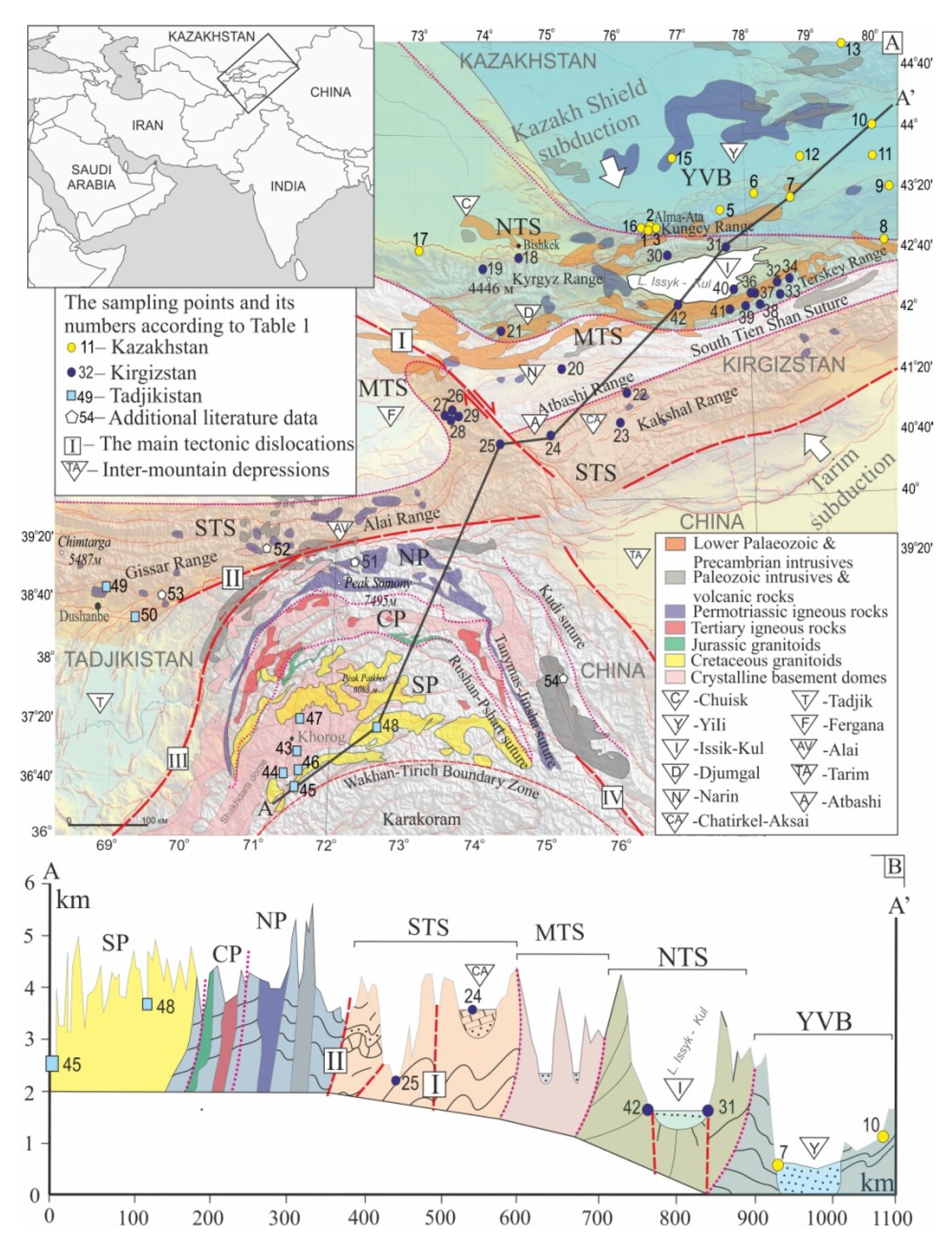
- More than 50 water discharges and 27 gas samples collected in 2018–2019; 30 thermal and 16 cold mineral waters described.
- Nearly 80% of the manifestations are low-enthalpy waters of 20–93 °C; the highest measured temperature is 94 °C.
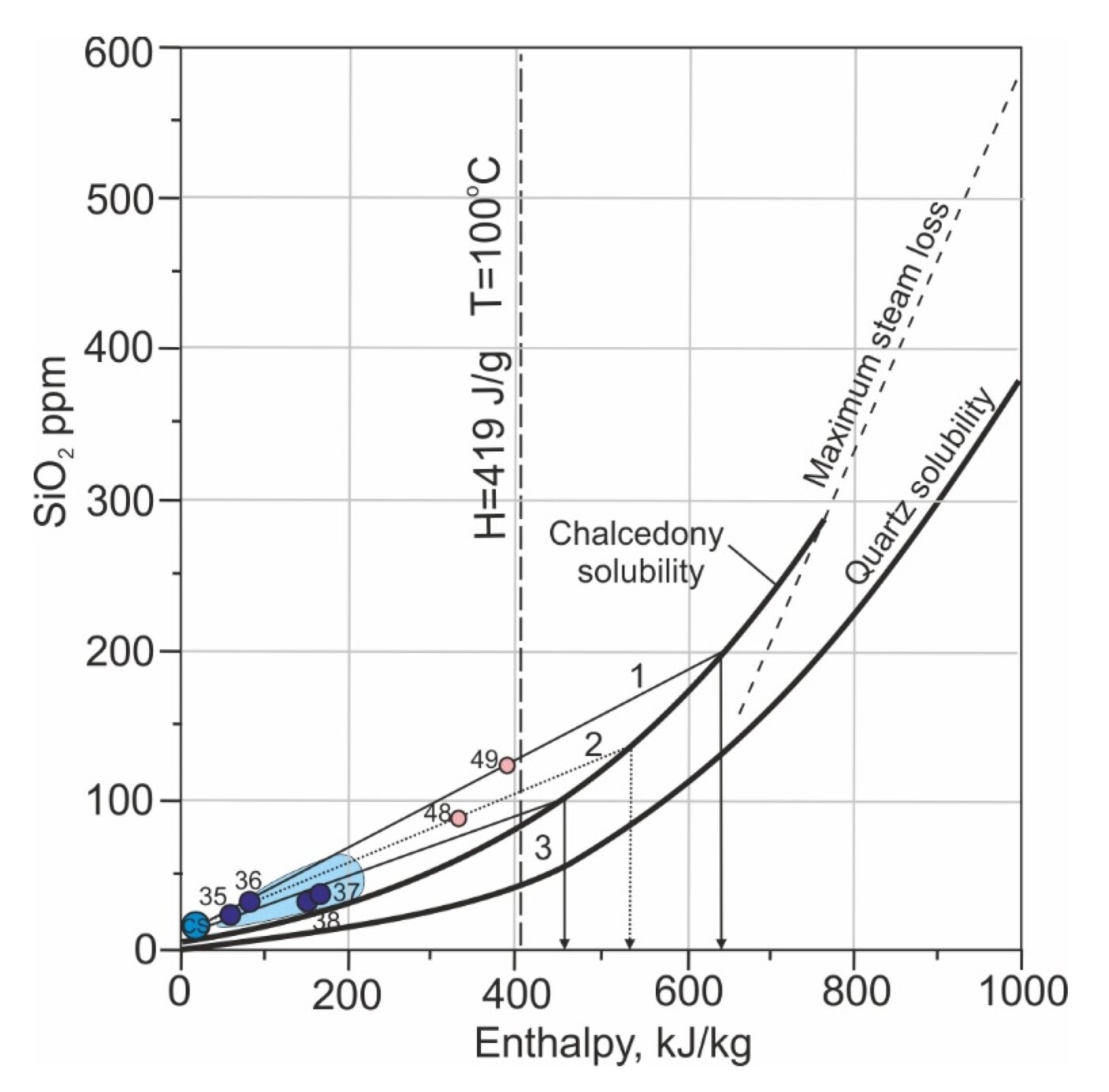
- Unmixed deep fluids do not exceed 110–150 °C (silica and cation geothermometers, equilibrium calculations).
- Silica–enthalpy mixing model: about 150 °C and 200 mg/L SiO₂ for Khoja-Obi-Garm, up to 120 °C in the Pamir and about 110 °C at Djety-Oguz.
- Water circulates at depths of 1 to 4 km.
- δ¹⁸O stays between −9.3 and −17.8‰ while chloride ranges from 4 to 7,594 mg/L; deuterium excess up to 23.6‰.
Abstract
This study presents the first regional hydrogeochemical portrait of the mineral waters and associated gases of the Central Asia region, shaped by the Tien Shan and the Pamir. A geochemical survey of more than 50 fluid discharges from the Northern Tien Shan to the Pamir was carried out between 2018 and 2019. Isotopic (δD, δ¹⁸O, d¹⁵N₂, d¹³CCO₂, d¹³CCH₄) and chemical data allow elucidating fluid genesis and general evolution in the continental collision zone. Geothermometric estimations as well as the content of the chemical components in waters (Cl, Li, B, Br) and gases (N₂, CO₂) suggest that the studied waters are not related to the presence of any active hydrothermal systems at shallow depth. Silica and cation geothermometers along with thermodynamic equilibrium calculations indicate that the temperature of unmixed deep fluids does not exceed 110 to 150 °C. The determination of d¹⁵N₂ and d¹³CCO₂ has revealed that the mantle genesis of gas flux matches with the areas of CO₂-rich waters manifestations. The dislocation of mineral and thermal waters of Central Asia along the major regional tectonic structures is provided by topographically driven and well-developed long circulation of waters at the depth of 1 to 4 km.
English abstract from the paper. The authors’ abstract, reproduced under CC BY 4.0.
Keywords
- thermal water
- geochemistry
- isotopes
- gases
- Tien Shan
- Pamir
In plain English
In 2018 and 2019 the authors sampled more than 50 discharges of mineral water and gas, from the south-east of Tajikistan along the Gissar–Alai, the Fergana ridge and the Southern Tien Shan ranges of Kyrgyzstan to southern Kazakhstan. They report the chemistry and stable isotopes of 30 thermal and 16 cold mineral waters, and the composition and carbon, nitrogen and helium isotopes of the gases.
All the waters are of meteoric origin. They fall into three groups: Ca–Mg–HCO₃ waters up to 35 °C, Na–HCO₃ waters up to 60 °C, and saline Na–Cl, Na–SO₄ and Na–Cl–HCO₃ waters up to 94 °C. The hottest water, 94 °C, comes from a borehole at Khoja-Obi-Garm in the Gissar Range. Thermal waters with nitrogen-rich gas occur in the Gissar–Alai segment of the Southern Tien Shan; cold CO₂-rich waters cluster along the Talas–Fergana Fault.
Silica and cation geothermometers and mixing models show that unmixed deep fluids do not exceed 110–150 °C. The authors find no active hydrothermal systems at shallow depth. The waters are not heated by hot intrusions; they gain heat from deep circulation, at 1–4 km, and the regional heat flow. Gas isotopes point to mantle gas where CO₂-rich waters rise, and the southern part of the Talas–Fergana Fault appears to be the most active.
Figures (2)
How to cite
G. Chelnokov, V. Lavrushin, I. Bragin, A. Abdullaev, A. Aidarkozhina and N. Kharitonova (2022). Geochemistry of Thermal and Cold Mineral Water and Gases of the Tien Shan and the Pamir. Water, 14(6), 838. https://doi.org/10.3390/w14060838