Journal articleFree to read
Exploration criteria for local accumulations of oil and gas based on the mixed-genetic scheme of natural hydrocarbon synthesis
Поисковые критерии локальных скоплений нефти и газа с позиции микстгенетической схемы природного синтеза углеводородов
- Institute of Geology and Exploration of Oil and Gas Fields (IGIRNIGM), Uzbekistan
- Institute of Geology and Geophysics, Academy of Sciences of the Republic of Uzbekistan, Uzbekistan
Highlights
- Regional heat-flow map at 1:500,000 from deep-well temperatures and 98 reservoir temperatures at 40 fields.
- Channel anomalies: 90–120 mW/m²; about 10 in the Bukhara–Khiva region.
- Field geothermal survey from 2001: temperature in shallow holes 2.0 m deep, along three geotraverses.
- New local anomalies 50–75 mW/m² above the regional background, 10–20 km across.
- Anomalies named: Tegermen, Guzhayli, West Beshtepa, Atbakar, West Kokchi, Kuvachi, Tashkuduk.
Keywords
- heat flow
- reservoir temperature
- field geothermal survey
- Bukhara–Khiva region
- deep heat and mass transfer
- oil and gas exploration
Summary
The authors, of the Institute of Geology and Exploration of Oil and Gas Fields (IGIRNIGM) and the Institute of Geology and Geophysics of the Academy of Sciences, propose a method for local oil and gas forecasting in which exploration is focused on areas over active channels of deep heat and mass transfer. The method has six stages, from large-scale mapping of the channels to 3D seismic surveys and siting exploration wells, and is set out for the Bukhara–Khiva oil and gas region.
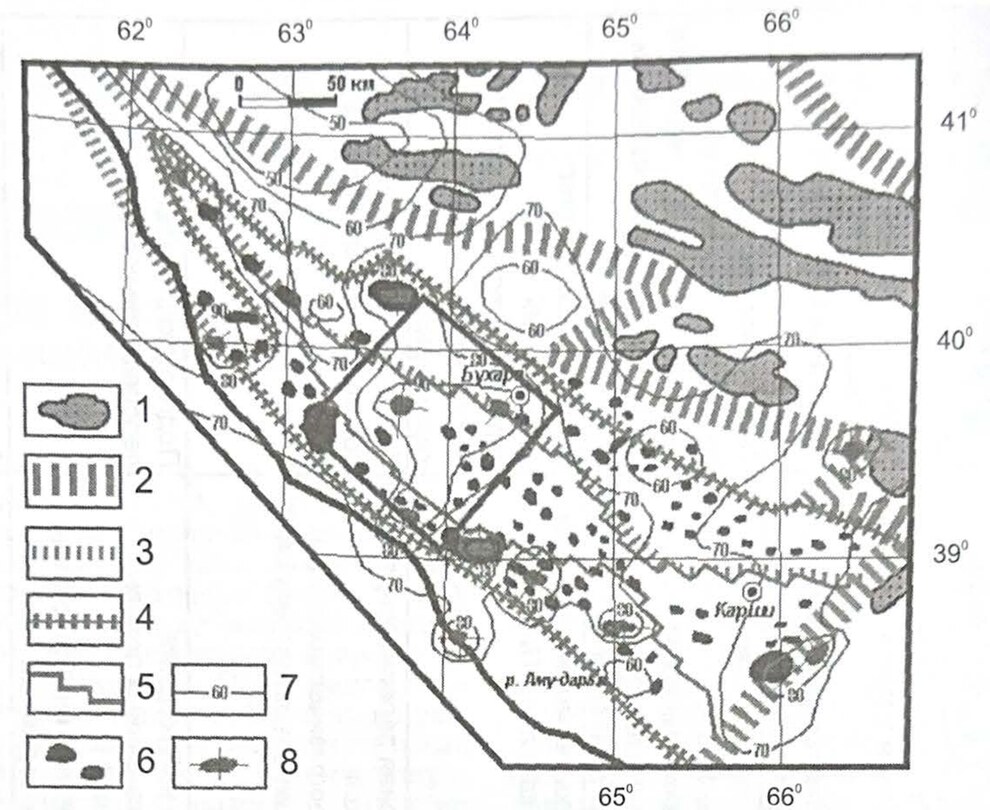
The first stage rests on a refined regional heat-flow map at 1:500,000, drawn over many years of the authors' geothermal studies in the Bukhara–Khiva region from temperatures measured in deep wells and 98 reservoir temperatures of oil and gas pools at 40 fields. The channels were mapped from intense isometric heat-flow anomalies of 90–120 mW/m²; about 10 such anomalies were found. They coincide with zones of abnormally high reservoir pressure, hydrogeological and geochemical anomalies and large oil and gas accumulations. The method also includes a detailed field geothermal survey at 1:50,000 in a separate promising zone.
In 2001 work began along three reference geotraverses: magnetotelluric sounding with V5 System 2000 equipment of Phoenix Geophysics, high-precision gravimetry, magnetometry and a field geothermal survey, which measures temperature in many shallow (2.0 m) holes. It confirmed the known Tegermen and Guzhayli heat-flow anomalies and found new ones, West Beshtepa, Atbakar, West Kokchi, Kuvachi and Tashkuduk, in the central, northern, south-eastern and north-western parts of the area. These are 50–75 mW/m² above the regional background and about 10–20 km across. In the Surkhandarya region, the Gadzhak field has an elevated helium content in gas, and regional geothermal studies there also show an active channel. Six of them, Tegermen, Guzhayli, West Beshtepa, Atbakar, West Kokchi and Tashkuduk, are among the nine channels on the heat-flow map reprinted in a 2025 review of natural hydrogen.
Figures (1)
How to cite
A. A. Abidov, F. G. Dolgopolov, A. A. Polikarpov and U. N. Rakhmatov (2004). Exploration criteria for local accumulations of oil and gas based on the mixed-genetic scheme of natural hydrocarbon synthesis. O‘zbekiston neft va gaz jurnali (Uzbek Journal of Oil and Gas), No. 3, 2004, pp. 6–9. https://drive.google.com/file/d/1gyGW2WEZ-HxUIw4F-reaKJUHd2YieLKM/view