Journal articleFree to read
Geodynamics and the genesis of oil and gas
Геодинамика и генезис нефти и газа
Highlights
- Heat-flow maps of five regions: Ustyurt, Bukhara–Khiva, Fergana, South-West Gissar, Surkhandarya; about 20 anomalies.
- Anomalies 90–120 mW/m²; background of the geothermal field no more than 65 mW/m².
- Bukhara–Khiva region: 10 anomalies over active channels.
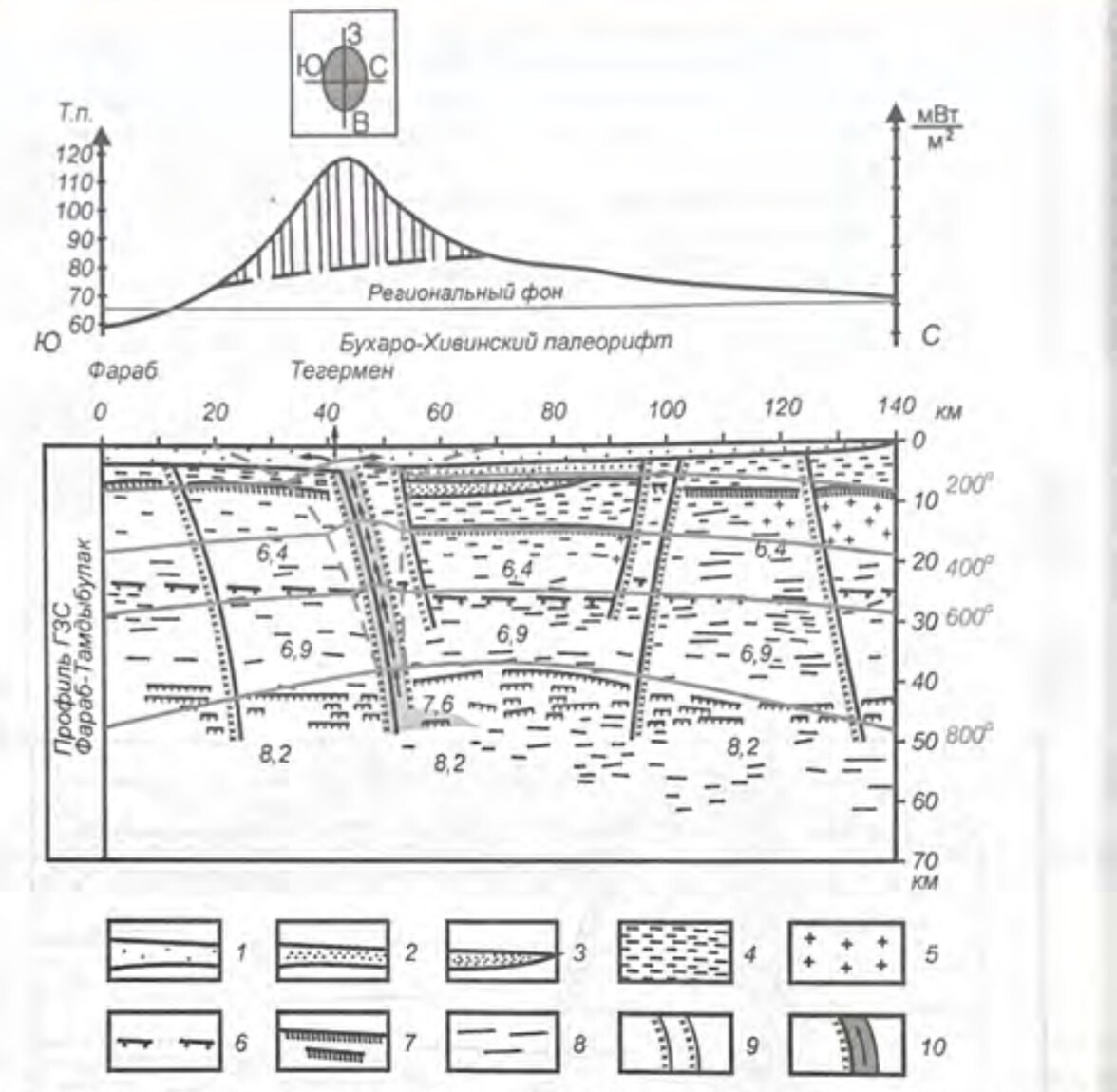
- Base of the sedimentary cover over channels: 30–55 °C above normal; normal again about 30 km from the channel axis.
- Channels 5–7 km wide, from the Moho to the lower Mesozoic–Cenozoic cover.
- Estimated 800–850 °C and 10–12 kbar at the source; 200–250 °C and 1–2 kbar where the channels end.
Keywords
- heat flow
- thermal anomaly
- sedimentary basins
- Bukhara–Khiva region
- deep heat and mass transfer
- origin of oil and gas
Summary
The paper, a report to a conference at Tashkent State Technical University on 3–4 June 2003, is mainly about the origin of oil and gas. It sets out a mixed-genetic scheme in which deep fluids rise along channels of deep heat and mass transfer, permeable zones at intersections of deep faults that cut the whole crust, and react with organic matter in sedimentary rocks. The channels were mapped from intense isometric heat-flow anomalies of 90–120 mW/m², against background values of the geothermal field of no more than 65 mW/m².
For this purpose new, more detailed heat-flow maps were drawn for the Ustyurt, Bukhara–Khiva, Fergana, South-West Gissar and Surkhandarya oil and gas regions of Uzbekistan, which show about 20 such anomalies. They correlate with zones of abnormally high reservoir pressure, hydrogeological and geochemical anomalies and large oil and gas accumulations. In the Bukhara–Khiva region 10 anomalies were mapped over active channels at intersections of Palaeozoic deep faults in the buried palaeorift; the author dates their activation to about 20 million years ago.
Seismic sections (deep seismic sounding and deep CDP) through the anomalies near the Urtabulak, Tegermen and Gazli fields, the Gadzhak–Boyangora area and Muruntau show the channels as subvertical zones without reflections, usually no more than 5–7 km wide; most of them start at the Moho and die out in the lower part of the Mesozoic–Cenozoic cover. The anomalous temperature is highest directly above the channels at the base of the sedimentary cover, where it is 30–55 °C above normal, and falls to normal values about 30 km from the channel axes. Thermodynamic estimates give 800–850 °C and 10–12 kbar at the level of the magma chambers that feed the channels, and 200–250 °C and 1–2 kbar in the lower Mesozoic–Cenozoic cover, where the channels end. A heat-flow map of the western Bukhara–Khiva palaeorift with nine named channels is reprinted in a 2025 review of natural hydrogen.
Figures (1)
How to cite
A. A. Abidov (2003). Geodynamics and the genesis of oil and gas. O‘zbekiston neft va gaz jurnali (Uzbek Journal of Oil and Gas), No. 3, 2003, pp. 4–18. https://drive.google.com/file/d/1BZPN_VeozBvUe-dyuMnZ5UjfeVytTAK3/view