Journal articleFree to read
Features of hazardous geological processes in the development of oil and gas fields
Особенности проявления опасных геологических процессов при освоении нефтегазоносных месторождений
- Scientific and Production Centre “Geology of Uranium and Rare-Earth Metals”, Uzbekistan
Highlights
- Kandym gas-condensate field: rock temperature 30–106 °C between 100 and 2,500 m depth.
- Mean geothermal step 35–40 m/°C; mean geothermal gradient 2.8–3 °C per 100 m.
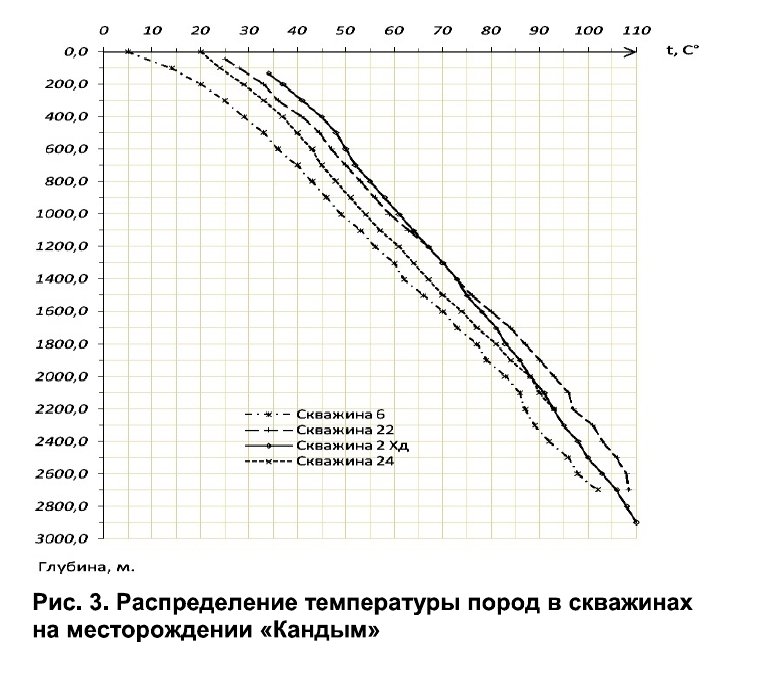
- Fig. 3: temperature against depth in wells 6, 22, 2 Khd and 24 of the Kandym field, to about 2,900 m.
- Gazli field: surface subsidence of 16 cm after 6 years (reservoir pressure down 15%) and 21 cm after 12 years (down 44%).
Summary
The author reviews the geological hazards that oil and gas production can set off, with examples from the Bukhara–Khiva oil and gas region, where the Gazli field and, on the Chardzhou tectonic step, the Kandym gas-condensate field lie. Among them are the reactivation of faults as stresses change, early flooding of reservoirs by bottom water, flows between layers, and subsidence over depleted fields: at Gazli the surface sank by 16 cm after 6 years of production and by 21 cm after 12 years.
Wells also change the temperature of the rocks around them: hot fluids rising through them warm the upper crust, and water injected at a different temperature disturbs the natural temperature profile, which the author calls thermal pollution. Temperature measurements in wells of the Kandym field show temperature rising almost in a straight line with depth, from 30 to 106 °C between 100 and 2,500 m; the mean geothermal step is 35–40 m per °C and the mean geothermal gradient 2.8–3 °C per 100 m (Fig. 3).
The author calls for rules on geo-ecological, hydrogeological and engineering-geological studies during field development, carried out in three stages: an audit of current conditions, monitoring of each field, and the inclusion of the field networks in state monitoring.
Figures (1)
How to cite
B. I. Tulyaganov (2011). Features of hazardous geological processes in the development of oil and gas fields. Gorniy vestnik Uzbekistana (Mining Bulletin of Uzbekistan), 2011, No. 4 (47), pp. 6–10. https://gorniyvestnik.uz/ru/release/2011/4