Journal articleOpen access
Modeling of Heat Propagation Processes Around a Geothermal Well Using COMSOL Multiphysics
https://doi.org/10.70769/2181-2284.ME.1(22).2026.14
Highlights
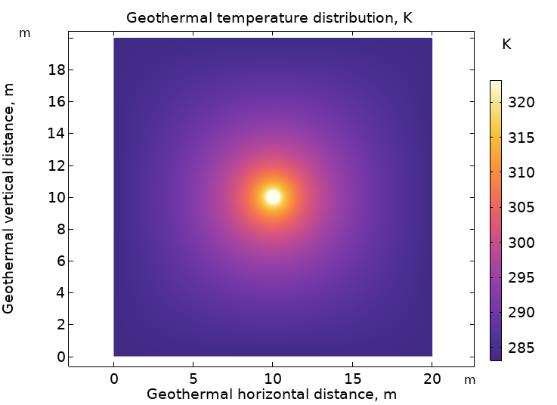
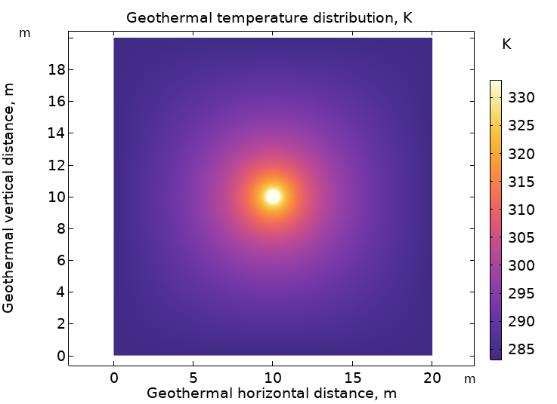
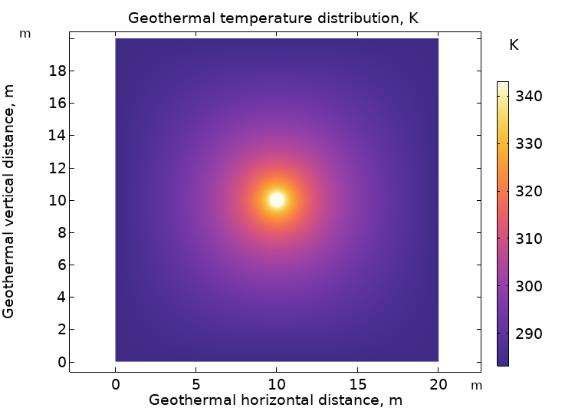
- Sources modelled: Mubarak at 50 °C; Otkuduk and Chirokchi at 60 °C; Karlyk at 70 °C.
- Source temperatures studied: 50–75 °C.
- Model area: 20 × 20 m around the well.
Abstract
The global depletion of conventional fuel and energy resources, together with increasing environmental impacts, has made energy conservation and the efficient utilization of existing energy resources an urgent priority. This study investigates natural geothermal energy sources located in the Kashkadarya region and analyzes heat propagation processes around geothermal wells using numerical modeling techniques. Heat transfer processes around geothermal wells were investigated through numerical simulations using the COMSOL Multiphysics software platform. A mathematical model was employed to evaluate the influence of geothermal source temperature on heat propagation within the surrounding soil. The numerical simulations demonstrated that increasing the geothermal source temperature within the range of TG = 50–75 °C significantly increased both the temperature gradient and the intensity of heat propagation in the soil medium. The obtained results provide a scientific basis for improving the efficiency of geothermal energy utilization. The findings demonstrate the high potential of geothermal energy sources for application in building heating systems. The proposed approach contributes to improving energy efficiency, reducing dependence on conventional fuels, and promoting environmentally sustainable heating technologies.
The authors’ abstract, reproduced under CC BY 4.0.
Keywords
- geothermal energy
- geothermal well
- heat propagation
- COMSOL Multiphysics
- Kashkadarya
In plain English
The authors model how heat spreads into the soil around geothermal wells in Kashkadarya region, using the COMSOL Multiphysics software, to judge how well these sources could heat buildings.
The warmer the source, the steeper the temperature gradient and the further the heat spreads. Temperatures are highest at the well and fall with distance from it.
Figures (3)
How to cite
Bobir Mansurovich Toshmamatov and Tulkun Amirovich Faiziev (2026). Modeling of Heat Propagation Processes Around a Geothermal Well Using COMSOL Multiphysics. Alternative Energy, 1(22), 107–111. https://doi.org/10.70769/2181-2284.ME.1(22).2026.14
In our news
 Modelling how heat spreads around geothermal wells in Kashkadarya27 March 2026