Journal articleOpen access
Comparative analysis of the specific activity of radium and radon in groundwater of the Kyzyl Kum region
Сравнительный анализ удельной активности радия и радона в подземных водах Кызылкумского региона
- Samarkand State University, Samarkand, Uzbekistan
- Navoi State University of Mining and Technologies, Navoi, Uzbekistan
- Department of General Physics, Navoi State University of Mining and Technologies, Navoi, Uzbekistan
Highlights
- Ten drinking-water wells sampled in April 2025; three 1-litre samples per well, each measured three times.
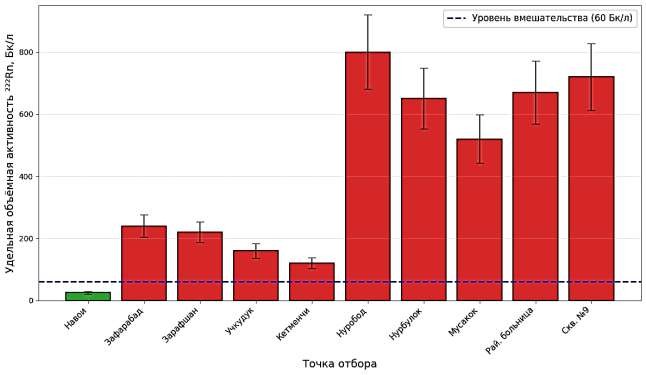
- Radon-222: 25 ± 4 Bq/L (Navoi) to 800 ± 120 Bq/L (Nurabad); above the 60 Bq/L intervention level in nine of ten wells.
- Radon at Zafarabad 240 ± 36, Zarafshan 220 ± 33, Uchkuduk 160 ± 24, Ketmenchi 120 ± 18, Nurbuloq 650 ± 98 and Musakok 520 ± 78 Bq/L.
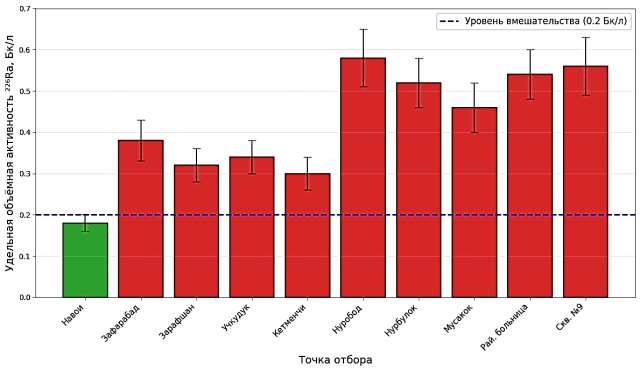
- Radium-226: 0.18 ± 0.02 Bq/L (Navoi) to 0.58 ± 0.07 Bq/L (Nurabad); 1.5–2.9 times the 0.2 Bq/L standard in nine wells.
- Radon share of the annual effective dose from radon and radium: 98.3–99.8%.
- Correlation between radon and radium: r = 0.89 (p < 0.01).
- Instruments: Alfarad Plus radiometer for radon (±15%); Kamera-01 system for radium-226 (±12%).
Abstract
Objective — comparative analysis of the specific activity of radium-226 (²²⁶Ra) and radon-222 (²²²Rn) in groundwater of the Kyzylkum region (Uzbekistan), a uranium-bearing territory, to assess compliance with regulatory requirements and radiation safety. Methodology. Sampling was conducted in April 2025 from 10 water supply wells used by the population for drinking purposes. Samples were collected in airtight 1 L glass containers with minimal aeration and transported to the laboratory within 4–6 hours. Measurements of ²²²Rn were performed using an "Alfarad Plus" radiometer (uncertainty ±15 %), and ²²⁶Ra using a "Kamera-01" measuring complex (uncertainty ±12 %). Each sample was measured in triplicate; results are presented as mean ± standard deviation. Statistical analysis was performed using MS Excel with Pearson correlation coefficient calculation between ²²²Rn and ²²⁶Ra activities. Results. In 9 out of 10 samples, ²²²Rn specific activity exceeded the intervention level (60 Bq/L) by a factor of 3.0–13.3, reaching 800 Bq/L. ²²⁶Ra activity exceeded the regulatory limit (0.2 Bq/L) by 1.5–2.9 times, with a maximum of 0.58 Bq/L. The contribution of ²²²Rn to the annual effective dose ranges from 98.3 to 99.8 %. A strong positive correlation between ²²²Rn and ²²⁶Ra activities was found (r = 0.89, p < 0.01), indicating a common geochemical source. Conclusions. Water from 9 out of 10 investigated wells does not meet radiation safety standards and is not recommended for drinking purposes without pre-treatment (aeration, filtration). The results justify the need for seasonal monitoring (4 times per year) and further hydrogeological studies to identify factors controlling radionuclide migration.
English abstract from the paper. The authors’ abstract, reproduced under CC BY 4.0.
Keywords
- uranium decay chains
- groundwater
- specific activity
- radium-226
- radon-222
- Kyzylkum region
- intervention level
- radiation safety
In plain English
In April 2025 the authors sampled ten water-supply wells that people use for drinking water in the uranium-bearing Kyzylkum region: wells in Navoi, Zarafshan and Uchkuduk, in the settlements of Zafarabad, Ketmenchi, Nurabad, Nurbuloq and Musakok, at a district hospital and well No. 9. Three 1-litre samples were taken from each well into sealed glass containers with as little aeration as possible, carried to the laboratory at 4–6 °C within 4–6 hours, and measurement began within 8 hours of sampling. Radon-222 was measured with an Alfarad Plus radiometer (NTC Amplituda, Russia; 10–10⁵ Bq/L, ±15%) after degassing onto a filter, and radium-226 with a Kamera-01 system (NTC Amplituda; 0.01–10 Bq/L, ±12%) by the emanation method. Each sample was measured three times.
Radon ranged from 25 ± 4 Bq/L in the Navoi well to 800 ± 120 Bq/L at Nurabad and was above the intervention level of 60 Bq/L in nine of the ten wells (Table 1, Fig. 1). After Nurabad it was highest at well No. 9 (720 ± 108 Bq/L), the district hospital (670 ± 101 Bq/L), Nurbuloq (650 ± 98 Bq/L) and Musakok (520 ± 78 Bq/L); Zafarabad had 240 ± 36 Bq/L, Zarafshan 220 ± 33 Bq/L, Uchkuduk 160 ± 24 Bq/L and Ketmenchi 120 ± 18 Bq/L. Radium-226 was 0.18 ± 0.02 Bq/L at Navoi and 0.30–0.58 Bq/L in the other wells, 1.5–2.9 times the standard of 0.2 Bq/L (Fig. 2). Only the Navoi well met both standards. Of the two radionuclides, radon gives 98.3–99.8% of the annual effective dose.
Radon and radium are strongly correlated (r = 0.89, p < 0.01), which the authors attribute to a common source: uranium-bearing rocks from which the radionuclides are leached. They find the values comparable to those reported from uranium-bearing areas of Kazakhstan (up to 650 Bq/L) and the Urals (up to 700 Bq/L), and link the higher maximum here to uranium ore occurrences close to the water-bearing horizons and to strongly fractured rock. They advise intensive aeration to remove radon and sorption filters for radium before the water is drunk, sampling four times a year, since the results come from a single spring sampling, and further study of the isotopic composition and migration of radionuclides in the water–rock system. Radon was measured earlier in deep wells of the Nurabad and Uchkuduk ore fields, and radionuclides in the Zarafshan, the Amu Darya and irrigation canals and in mine water of the former Yangiabad uranium mine.
Figures (2)
How to cite
B. Togaev, M. A. Kuvvatova, G. M. Allaberganova and A. M. Muzafarov (2026). Comparative analysis of the specific activity of radium and radon in groundwater of the Kyzyl Kum region. Universum: tekhnicheskie nauki (Universum: Technical Sciences), 2026, No. 7 (148), pp. 48–55. https://7universum.com/ru/tech/archive/item/23174