Journal articleFree to read
Efficiency of application of chemical-organic indicators of oil and gas potentiality in various hydrogeological conditions (on the example of the Northern Maimanak field)
Эффективность применения химико-органических показателей нефтегазоносности в различных гидрогеологических условиях (на примере месторождения Северный Майманак)
- Institute of Geology and Exploration of Oil and Gas Fields (IGIRNIGM), Tashkent, Uzbekistan
- Tashkent State Technical University, Tashkent, Uzbekistan
Highlights
- Formation temperature in the XVIII horizon: 92–94 °C at 2,455–2,477 m; 98 °C at 2,446 m; 97–104 °C at 2,455–2,584 m.
- Geothermal gradient in the Jurassic section: 2.72–4.23 °C/100 m (geothermal step 36.80–23.6 m/°C); 2.29–2.56 °C/100 m (43.5–39.0 m/°C) in the gas-bearing part at the crest.
- Mean formation temperature: 95 °C in the middle of the gas-condensate pool; 95.5 °C at the gas–water contact.
- Water of the XVIII horizon: 136.41–176.62 g/L; chloride 83.77–108.58 g/L, alkali metals 41.65–55.01 g/L, calcium 8.72–11.12 g/L; boron oxide 469.0 mg/L; pH 6.0–6.7.
- rNa/rCl 0.77–0.79; rSO₄/rCl 0.002–0.004.
- Reduced pressure heads: 480–508.6 m (well 3) and 452.4 m (well 1), falling to 390.9–424.8 m (wells 7 and 8); head gradient 27–30 m/km in the north-east, 40–45 m/km in the south-west.
- Dissolved gas: 972–1,080 cm³/L, of which methane 91.61–95.89%; gas saturation coefficient 0.51–0.58.
- Gas–water contact at −2,129, −2,134, −2,133 and −2,142 m in wells 1, 2, 4 and 10.
Abstract
The effectiveness of the application of chemical-organic indicators of oil and gas content in various hydrogeological conditions considered on the example of the North Maimanak field. The presence of water-dissolved organic matter (WDM) in the groundwater of sedimentation basins inextricably linked with the organic matter of the rocks. In the geological history of sedimentary basins, the existence of WDM in formation waters usually occurs in the process of formation, migration of hydrocarbons, formation of accumulations and their subsequent destruction. Thus, geochemical processes in the «water-rock» system turn out to be, in a way, direct indicators of the presence of hydrocarbon deposits. Therefore, data on the composition and concentration of individual groups of WDM in groundwater (naphthenic acids, phenols, benzenes, organic carbon, water-dissolved gases, etc.) are successfully used as direct search indicators of hydrocarbon accumulations, i.e., the halo effect of a gas condensate deposit is confidently traced by the contents of these components. Thus, it is possible to use organic-gas-hydrochemical parameters in assessing the oil and gas content of individual local structures, areas, and, probably, regions based on the results of testing the first exploration wells.
English abstract from the journal issue PDF. The authors’ abstract, reproduced under .
In plain English
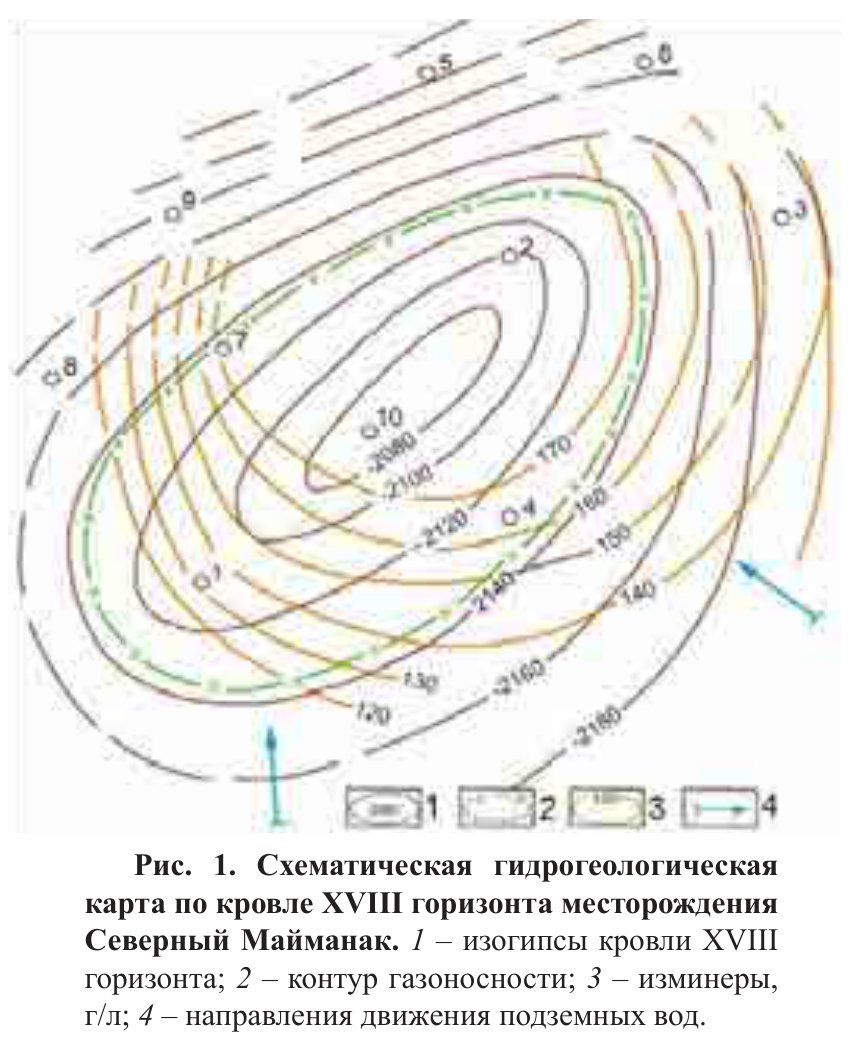
Written for oil and gas exploration, this paper tests how well organic matter and gases dissolved in formation water point to hydrocarbon pools. The test case is the North Maimanak field on the southern slope of the Mubarek uplift in the Bukhara–Khiva region. The field is a north-east-trending brachyanticline measuring 6 × 3 km, with an amplitude of 140 m, along the −1,880 m contour of the top of the Upper Jurassic carbonate formation. Its gas-condensate pool lies in the XVIII horizon of the Jurassic terrigenous formation, with the gas–water contact at −2,129 to −2,142 m.
Water in the XVIII horizon is a strong chloride–calcium brine of 136.41–176.62 g/L that grows saltier from south to north. Chloride (83.77–108.58 g/L) and alkali metals (41.65–55.01 g/L) dominate; sulphate is very low and the pH is 6.0–6.7. Reduced pressure heads fall from 480–508.6 m in well 3 and 452.4 m in well 1 to 390.9–424.8 m in wells 7 and 8, which shows the direction of water flow. The head gradient is 27–30 m/km in the north-east of the field and up to 40–45 m/km in the south-west.
Formation temperatures in the horizon rise from the centre of the structure towards its flanks: from 92–94 °C at 2,455–2,477 m to 98 °C at 2,446 m in the south-west and 97–104 °C at 2,455–2,584 m in the north-east. The geothermal gradient in the Jurassic section ranges from 2.72 to 4.23 °C per 100 m, depending on the rocks. It is lowest, 2.29–2.56 °C per 100 m, in the gas-bearing part of the section at the crest, which the authors explain by the insulating effect of the gas-condensate pool. The mean temperature is 95 °C in the middle of the pool and 95.5 °C at the gas–water contact.
Dissolved organic carbon ranges from 24.19 to 122.02 mg/L in 18 samples and peaks in the centre of the structure. Naphthenic acids, volatile phenols and benzene change most clearly with distance from the gas–water contact. The water holds 972–1,080 cm³/L of dissolved gas, mostly methane, with the most at the contact. By gas content the pool’s halo reaches 1,200 m sideways and 100 m vertically, and by gas saturation 1,000 m and 140 m. The authors conclude that more dissolved organic matter, high gas saturation of the water and a negative temperature anomaly go with hydrocarbon pools.
Figures (1)
How to cite
T. Kh. Shoimurotov, Sh. O. Gafurov and K. B. Yusupov (2023). Efficiency of application of chemical-organic indicators of oil and gas potentiality in various hydrogeological conditions (on the example of the Northern Maimanak field). Geologiya i mineral'nye resursy (Geology and Mineral Resources), No. 1, 2023, pp. 60–65. https://mridm.uz/en/assets/journal/pdf/1_2023.pdf