Journal articleFree to read
Development of renewable energy sources at the Navoi combine
Развитие возобновляемых источников энергии в Навоийском комбинате
- Navoi Mining and Metallurgical Combinat, Navoi, Uzbekistan
Highlights
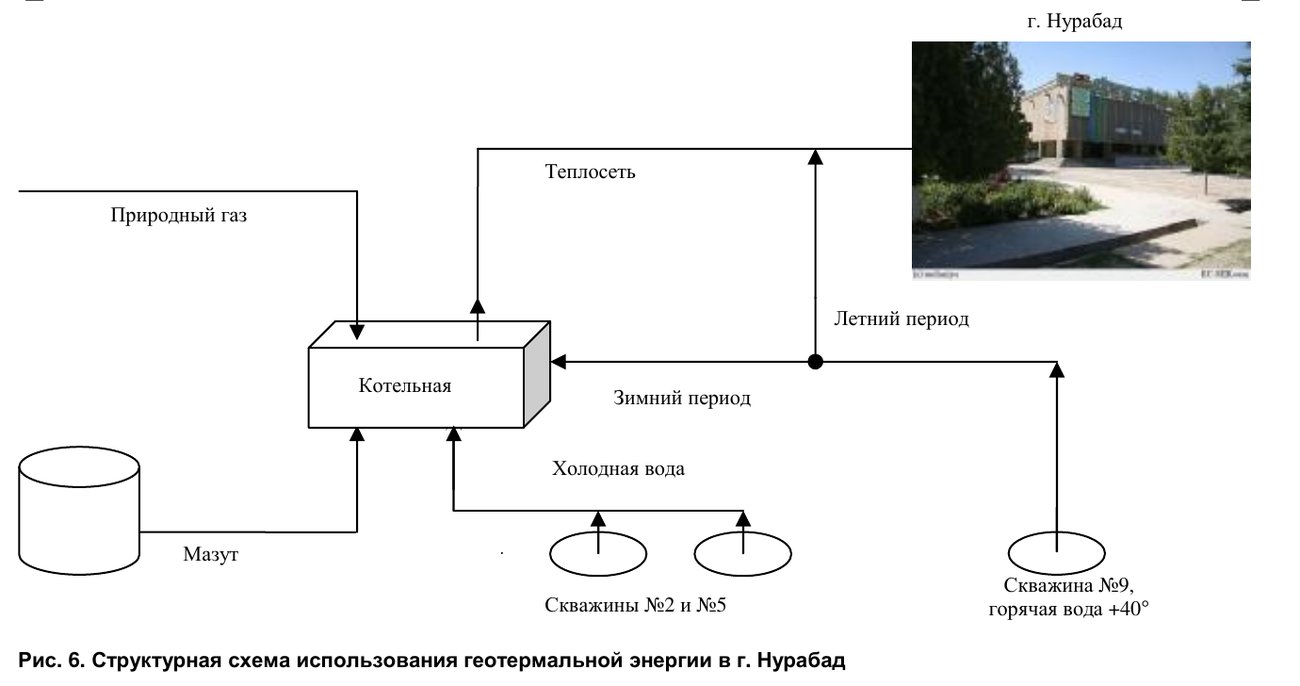
- Well No. 9: in service since 1980, used for hot water since 2008; 5.5 km from the Nurabad boiler house, 250 mm pipeline.
- Water temperature at the boiler house: 38 °C; Fig. 6 marks the well’s hot water as +40°.
- Running cost over three years: 187,128 thousand sum; fuel saved: 195,037 thousand sum.
- Saving claimed: more than 1,000 t of standard fuel and 65,062 thousand sum a year.
- Solar water heaters: 8 installations, 769.4 m² of collectors, about 700,000 kWh saved a year.
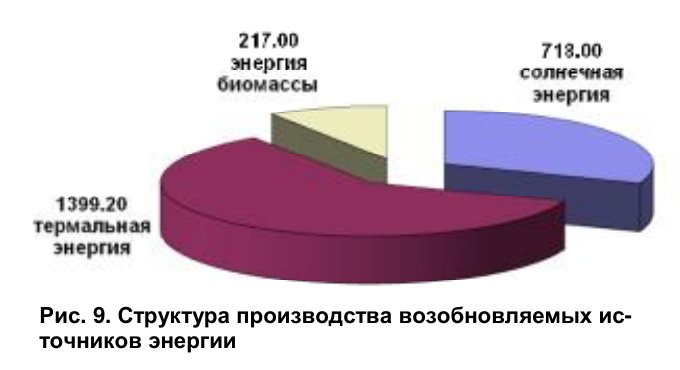
- Renewable energy of the combine in 2010 (Fig. 9, units not stated): thermal 1,399.20, solar 718.00, biomass 217.00.
Keywords
- renewable energy
- geothermal water
- hot water supply
- solar water heaters
- biogas
- Nurabad
- Navoi Mining and Metallurgical Combinat
Summary
The authors describe the renewable energy used by the Navoi Mining and Metallurgical Combinat, whose mines and plants lie in the desert, far from each other and from the main power lines and pipelines, so that supplying heat and hot water is a pressing problem. Since 2004 the combine has installed eight solar water heaters with 769 m² of collectors, which save about 700,000 kWh of electricity a year, and in 2009 it started a biogas plant in Zarafshan that makes 100 m³ of biogas a day.
The combine’s Southern Mining Administration uses geothermal water to supply hot water to the people of Nurabad. The water reaches the town’s boiler house through a 250 mm pipeline from well No. 9, 5.5 km away. The well was put into service in 1980 for drinking water; since 2008 its water, which arrives at 38 °C, has been used for hot water. In summer it goes straight into the hot-water network and the boiler house stops; in winter it passes through filters into the boiler house, is heated further and goes into the network for heating and hot water.
Over the last three years the geothermal system cost 187.1 million sum to run and saved 195.0 million sum of fuel. The authors put the saving at more than 1,000 tonnes of standard fuel a year at the Nurabad boiler house, worth 65.1 million sum. In 2010 thermal energy gave the largest share of the combine’s renewable energy, ahead of solar and biomass (Fig. 9).
Figures (2)
How to cite
K. S. Sanakulov and S. D. Dedov (2011). Development of renewable energy sources at the Navoi combine. Gorniy vestnik Uzbekistana (Mining Bulletin of Uzbekistan), 2011, No. 3 (46), pp. 12–18. https://gorniyvestnik.uz/ru/release/2011/3