Journal articleOpen access
Precipitation in the mountains of Central Asia: isotopic composition and source regions
https://doi.org/10.5194/acp-24-12203-2024
Highlights
- 915 precipitation samples from nine sites in 2019–2021; 272 from the Chirchik catchment (Oygaing 196, Pskem 30, Tashkent 46).
- Chirchik catchment δ¹⁸O: mean −8.2‰, range −32.4‰ to 4.3‰; snow averaged −15.4‰ and rain −4.0‰.
- Chirchik catchment δ¹⁸O averaged −2.3‰ in May–October and −10.8‰ in November–April.
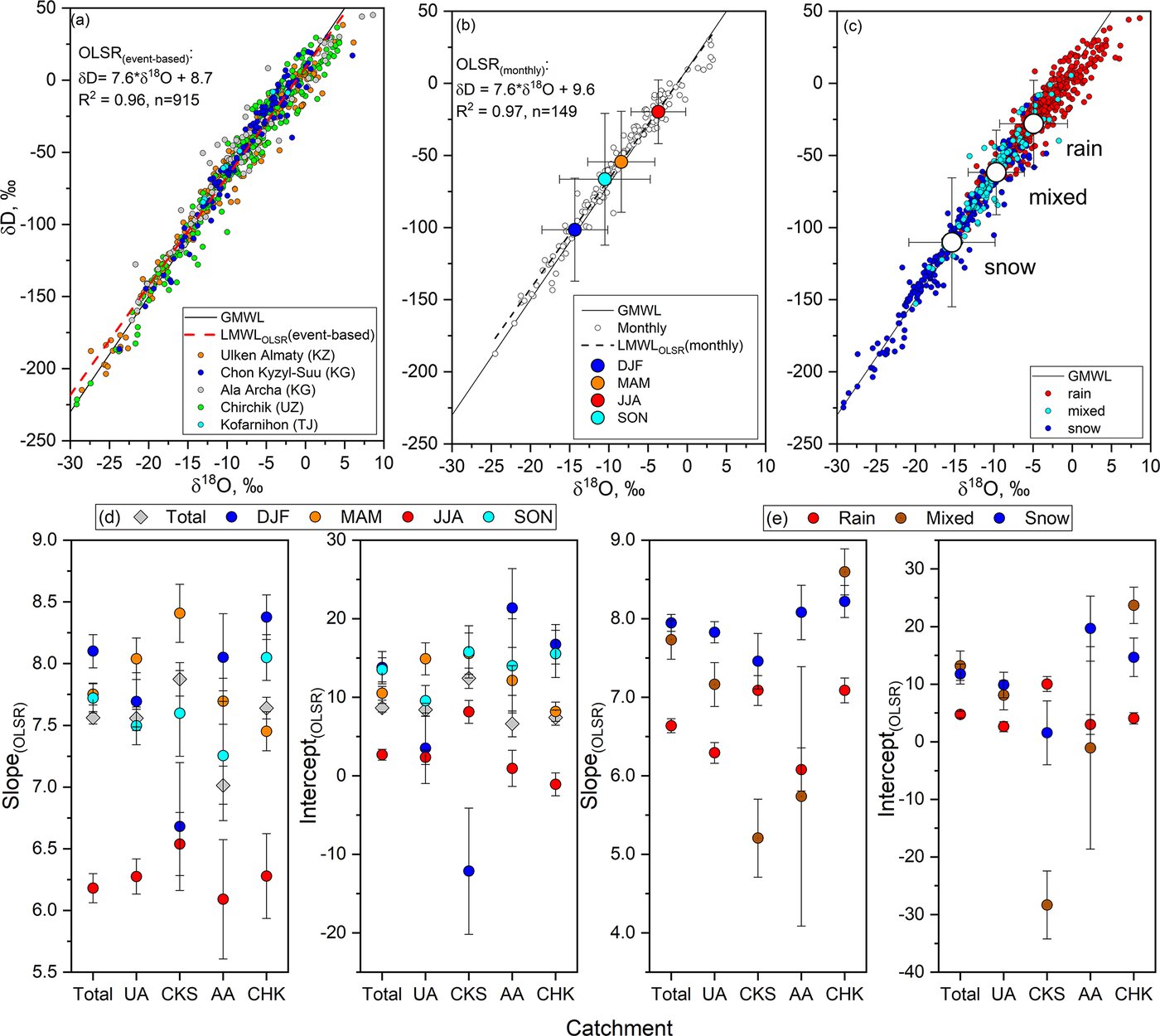
- Local meteoric water lines: δD = 7.56 δ¹⁸O + 8.65 for the whole region (R² = 0.96); δD = 7.66 δ¹⁸O + 7.65 for the Chirchik catchment (R² = 0.96, 272 samples).
- δ¹⁸O rises by 0.62‰ per °C of air temperature across the region, by 0.74‰ per °C at Oygaing and by 0.32‰ per °C at Tashkent.
- Recycled moisture from irrigated land and the study catchments supplied 29–71% of precipitation, depending on site and season.
Abstract
Over 900 event-based precipitation samples were collected in 2019–2021 in the Tien Shan and its foothills and analysed using cavity ring-down spectroscopy. δD and δ¹⁸O values were highest in summer and lowest in winter, and annual cycles of deuterium excess (d-excess) varied between sites, reflecting local conditions. The δ¹⁸O and δD values increased from north to south in all seasons except autumn, and latitude was a statistically significant predictor of δ¹⁸O and δD in the overall data set, along with elevation in winter and elevation and longitude in autumn. Elevation was a significant predictor of d-excess in all seasons, and local air temperature was a more important control over δ¹⁸O and δD than precipitation depth. Local meteoric water lines were derived using seven regression methods applied to non-weighted and weighted precipitation. Non-weighted ordinary least squares regression and reduced major axis regression methods are recommended overall, except for summer when the precipitation-weighted least squares regression should be used, particularly in the south. Atmospheric back-trajectory and mixing-model analyses were applied in combination to identify air mass source regions and their relative contribution to precipitation. Recycled moisture from irrigated land in the Amu Darya and Syr Darya basins and from the study catchments accounted for 29 %–71 % of precipitation, depending on the site and season. In the Chon Kyzyl-Suu catchment, local re-evaporation from Issyk-Kul accounted for up to 85 % of precipitation. These findings highlight the importance of moisture from terrestrial sources, especially irrigated land, for the formation of precipitation in the Tien Shan.
English abstract from the journal’s website. The authors’ abstract, reproduced under CC BY 4.0.
In plain English
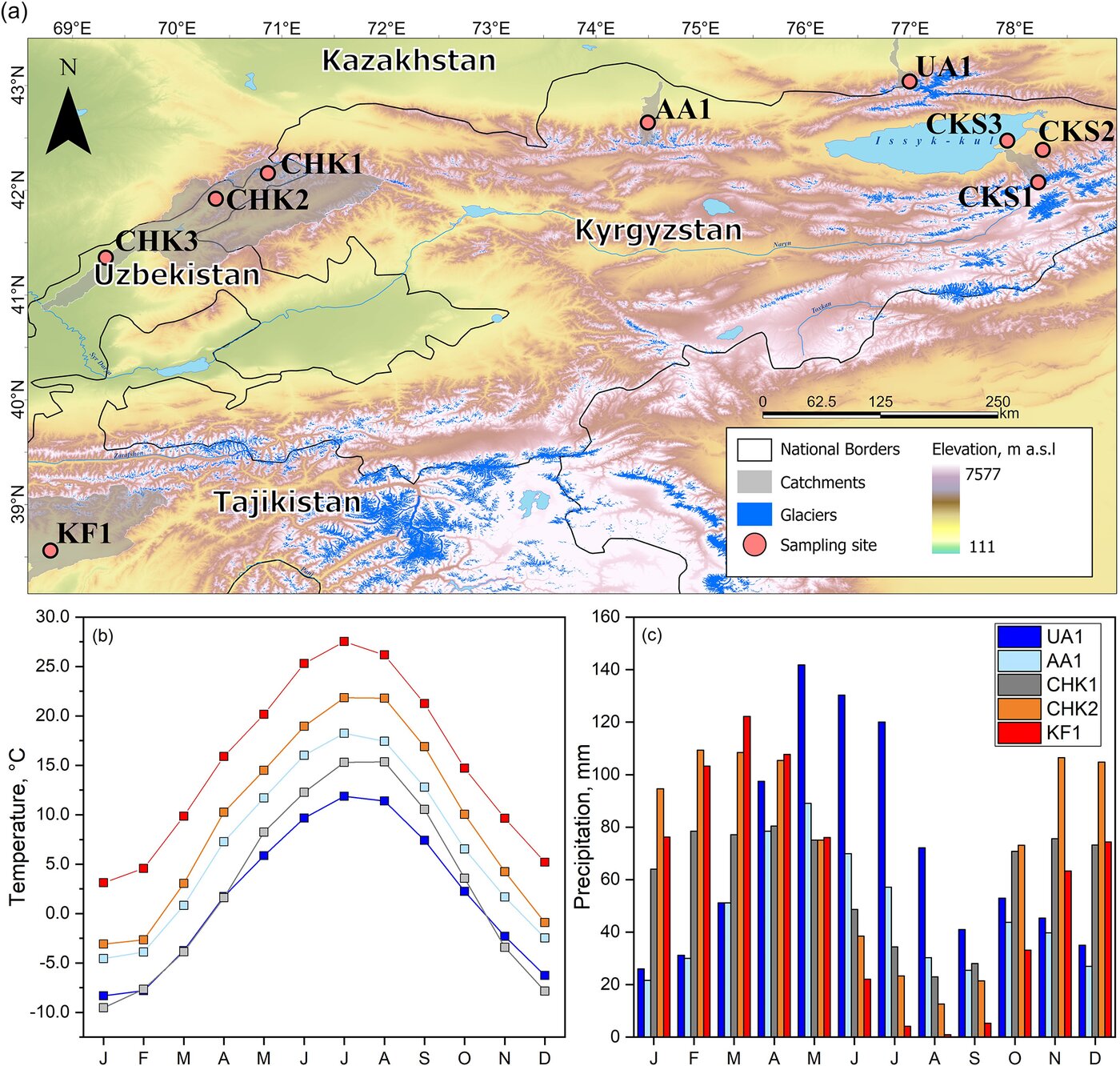
Between 2019 and 2021, 915 precipitation samples were collected at nine sites in the Tien Shan, the Pamir-Alay and their foothills in Kazakhstan, Kyrgyzstan, Uzbekistan and Tajikistan, almost all of them right after single rain or snow events. They were analysed for the stable isotopes of oxygen and hydrogen (δ¹⁸O and δD). Three sites lie in Uzbekistan’s Chirchik catchment: Oygaing at 1,490 m, Pskem at 1,255 m and Tashkent at 486 m. Before this study, the global GNIP database held only seven isotope measurements of precipitation from Uzbekistan, all from Tashkent.
Isotope ratios were highest in summer and lowest in winter, and rose from north to south. Local air temperature controlled them more than the amount of precipitation. For the whole region, the local meteoric water line is δD = 7.56 δ¹⁸O + 8.65, below the global line δD = 8 δ¹⁸O + 10. For the Chirchik catchment it is δD = 7.66 δ¹⁸O + 7.65. Slopes are higher in winter and spring and lowest in summer, when light rain partly evaporates as it falls. The authors recommend ordinary least squares or reduced major axis regression in most cases, and precipitation-weighted regression in summer, especially in the south.
Air-mass back trajectories combined with a mixing model show that recycled moisture from irrigated land in the Amu Darya and Syr Darya basins and from the study catchments supplied 29–71% of precipitation, depending on site and season. At Oygaing, locally formed precipitation made up 68.8–70.6% in winter, spring and autumn, while westerly air masses supplied 73.1% in summer. Tashkent had few samples, and its summer values did not match its high temperatures. The authors suggest that water re-evaporated from irrigated land may explain this, but say more samples are needed.
Figures (2)
How to cite
Z. Saidaliyeva, M. Shahgedanova, V. Yapiyev, A. J. Wade, F. Akbarov, M. Esenaman uulu, O. Kalashnikova, V. Kapitsa, N. Kasatkin, I. Rakhimov, R. Satylkanov, D. Sayakbaev, E. Semakova, I. Severskiy, M. Petrov, G. Umirzakov and R. Usubaliev (2024). Precipitation in the mountains of Central Asia: isotopic composition and source regions. Atmospheric Chemistry and Physics, 24(21), 12203–12224. https://doi.org/10.5194/acp-24-12203-2024