Journal articleFree to read
Assessment of the information content of hydrogeoseismological parameters
Оценка информативности гидрогеосейсмологических параметров
- Institute of Seismology, Academy of Sciences of the Republic of Uzbekistan, Uzbekistan
Highlights
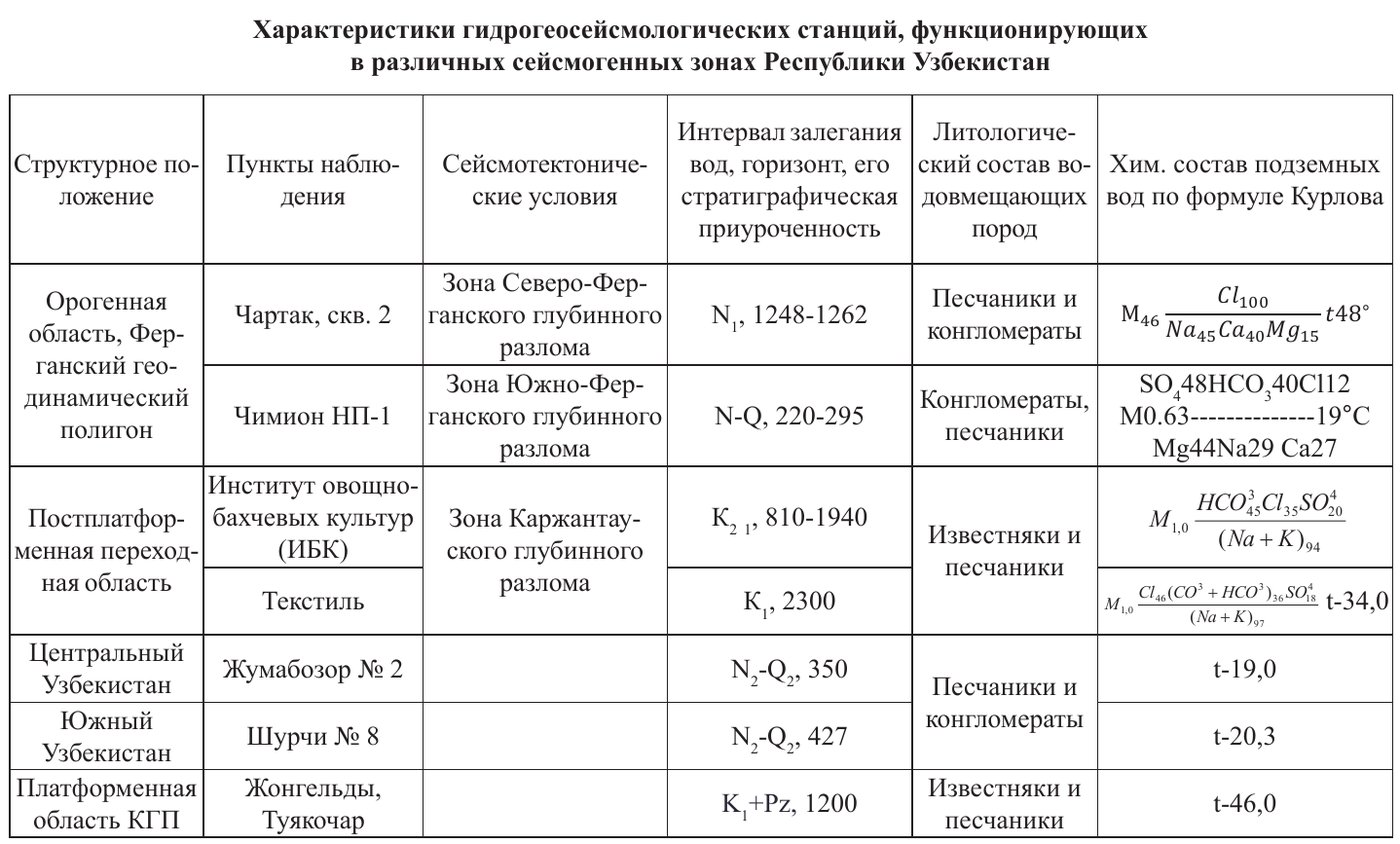
- Chartak well 2 (Fergana): Neogene (N₁) sandstones and conglomerates, 1,248–1,262 m; mineralisation 46 g/L, chloride water with Na 45, Ca 40 and Mg 15 (%-eq.); 48 °C.
- Tekstil well (Tashkent): Lower Cretaceous, 2,300 m; mineralisation 1.0 g/L, Cl 46, CO₃+HCO₃ 36, SO₄ 18, Na+K 97 (%-eq.); 34.0 °C.
- Jongeldi–Tuyakochar: Lower Cretaceous and Palaeozoic limestones and sandstones, 1,200 m; 46.0 °C.
- IBK well (Karzhantau fault zone): Cretaceous limestones and sandstones, 810–1,940 m; mineralisation 1.0 g/L, HCO₃ 45, Cl 35, SO₄ 20, Na+K 94 (%-eq.).
- Chimion well NP-1 (Fergana): Neogene–Quaternary conglomerates and sandstones, 220–295 m; mineralisation 0.63 g/L, SO₄ 48, HCO₃ 40, Cl 12, Mg 44, Na 29, Ca 27 (%-eq.); 19 °C.
- Jumabozor 2: Neogene–Quaternary (N₂–Q₂), 350 m, 19.0 °C. Shurchi 8: Neogene–Quaternary (N₂–Q₂), 427 m, 20.3 °C.
- Shurchi 8 (2000–2024, M ≥ 5.0): oxygen, nitrogen and carbon dioxide informative in 75–90% of cases.
- Tuyakochar (2014–2024, M ≥ 4.0): pH and Eh informative in more than 80% of cases.
Abstract
The article presents the results of assessing the information content of gas-chemical parameters of groundwater during the occurrence of earthquakes with a magnitude of M ≥ 5 that occurred in 2000-2024 in the territory of the Republic of Uzbekistan. The most informative gas-chemical indicators of precursor nature and the uninformative indicators associated with the region’s general geodynamic processes are identified.
English abstract from the journal issue PDF. The authors’ abstract, reproduced under .
In plain English
A. V. Rasulov, A. I. Tuychiev and B. R. Kayumov of the Institute of Seismology assess how well the gas and chemical readings of groundwater in observation wells reflect earthquakes of magnitude 5 and above in Uzbekistan in 2000–2024. The wells belong to the network of hydrogeoseismological stations in the country’s seismogenic zones. The authors give each earthquake a conditional energy at the observation point, K1 = K − 2.5·lgR, where K is the energy class of the earthquake and R the distance to the point, and compare anomalous changes in each parameter with the stages in which earthquakes build up and occur.
In the Fergana geodynamic test area, Chartak well 2, in the North Fergana deep fault zone at Chortoq, takes water from Neogene (N₁) sandstones and conglomerates at 1,248–1,262 m: chloride water with sodium, calcium and magnesium, 46 g/L, at 48 °C. Chimion well NP-1, in the South Fergana deep fault zone, draws sulphate–bicarbonate water of 0.63 g/L at 19 °C from Neogene–Quaternary conglomerates and sandstones at 220–295 m. In the Karzhantau deep fault zone, the well of the Institute of Vegetable and Melon Crops (IBK) taps Cretaceous limestones and sandstones at 810–1,940 m, with bicarbonate–chloride–sulphate sodium water of 1.0 g/L, and the Tekstil well in Tashkent Lower Cretaceous rocks at 2,300 m, with chloride–bicarbonate sodium water of 1.0 g/L at 34 °C. The other wells are Jumabozor 2 in Central Uzbekistan (Neogene–Quaternary, 350 m, 19 °C), Shurchi 8 in the south (Neogene–Quaternary, 427 m, 20.3 °C) and Jongeldi–Tuyakochar on the platform (Lower Cretaceous and Palaeozoic limestones and sandstones, 1,200 m, 46 °C).
The response differs from well to well. At Chartak 2, helium, methane, carbon dioxide, ethane, pH and Eh changed with earthquakes more often than not, while hydrogen, oxygen, nitrogen, bicarbonate and chloride mostly did not. At the Tekstil well most parameters, including helium, oxygen, nitrogen, pH, bicarbonate, chloride and water temperature, were informative; hydrogen and carbon dioxide mostly were not. At the IBK well (2002–2024) most gases, bicarbonate, chloride and temperature mostly showed background changes, and only pH and Eh were more often informative. At Shurchi 8 oxygen, nitrogen and carbon dioxide reacted in 75–90% of cases, helium and hydrogen rarely, and water temperature and flow rate varied mainly with hydrogeological and seasonal factors. At Tuyakochar (2014–2024, earthquakes of magnitude 4 and above) pH and Eh were informative in more than 80% of cases, while the gases, bicarbonate, chloride and temperature mostly were not. No gas analyses were made at Jumabozor 2 in 2002–2023; there Eh was the most informative reading.
The authors conclude that pH, Eh and some gases (oxygen, nitrogen, carbon dioxide) are the most stable indicators of earthquake preparation at several stations, including those in deep fault zones, while helium, hydrogen, water temperature and flow rate mostly reflect background, hydrogeological and seasonal changes. They recommend choosing the most sensitive parameters separately for each observation well, according to its tectonic and hydrogeological setting.
Figures (1)
How to cite
A. V. Rasulov, A. I. Tuychiev and B. R. Kayumov (2026). Assessment of the information content of hydrogeoseismological parameters. Geologiya i mineral'nye resursy (Geology and Mineral Resources), No. 3, 2026, pp. 80–83. https://mridm.uz/en/assets/journal/pdf/3_2026.pdf