Journal articleOpen access
Significant reduction of river discharge in the mountainous basins of Uzbekistan over the last decades
- Department of Environmental Physical and Chemical Processes Research, Hydrometeorological Research Institute, Tashkent, Uzbekistan
- Department of Hydrometeorology, National University of Uzbekistan, Tashkent, Uzbekistan
- Disaster Prevention Research Institute, Kyoto University, Uji, Japan
- Faculty of Biology, University of Warsaw, Warsaw, Poland
https://doi.org/10.3178/hrl.25-00024
Highlights
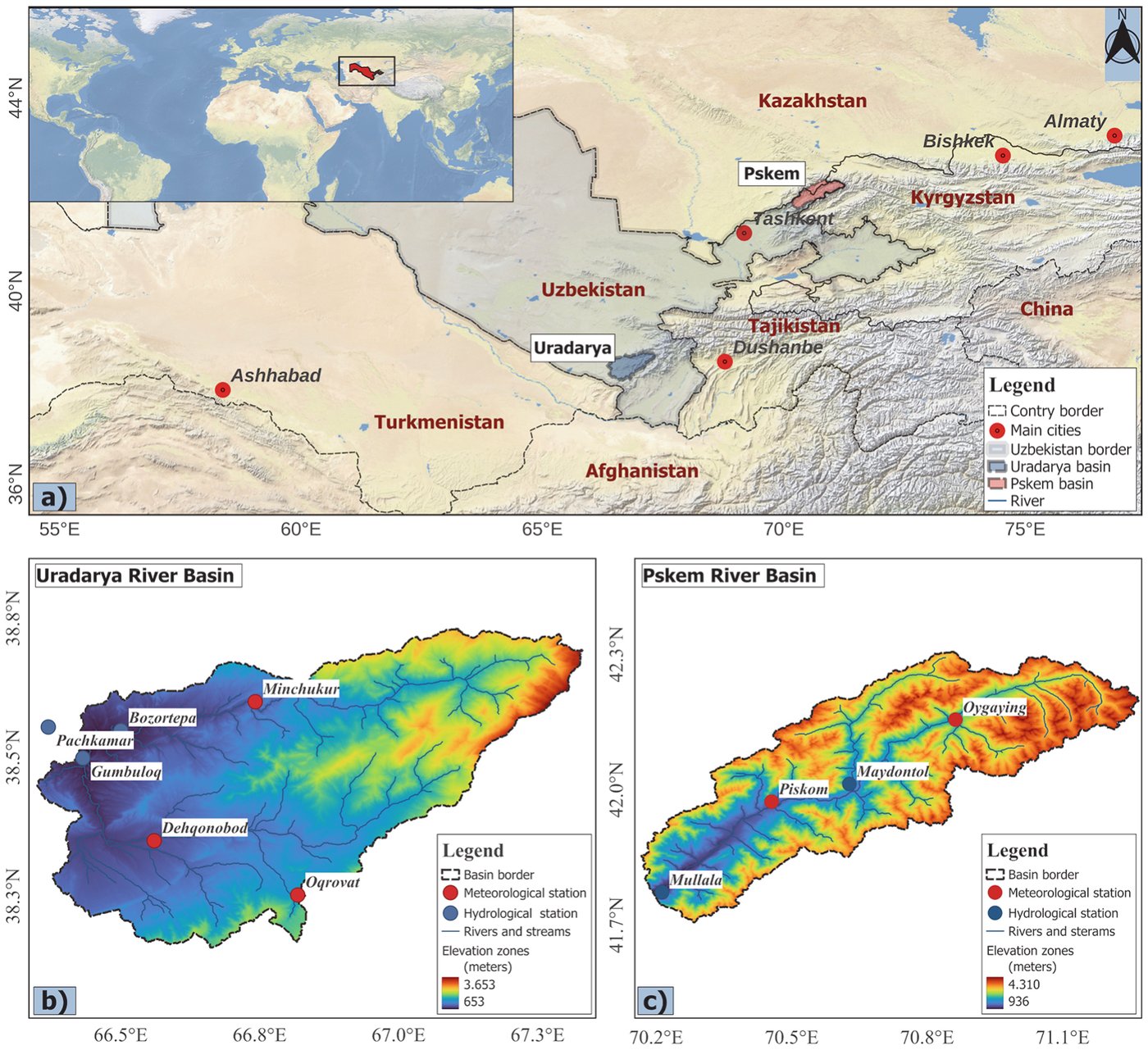
- Hydrological years 2001–2023; weather stations Oygaing (Pskem basin) and Minchukur (Uradarya basin), gauging stations Mullala and Pachkamar.
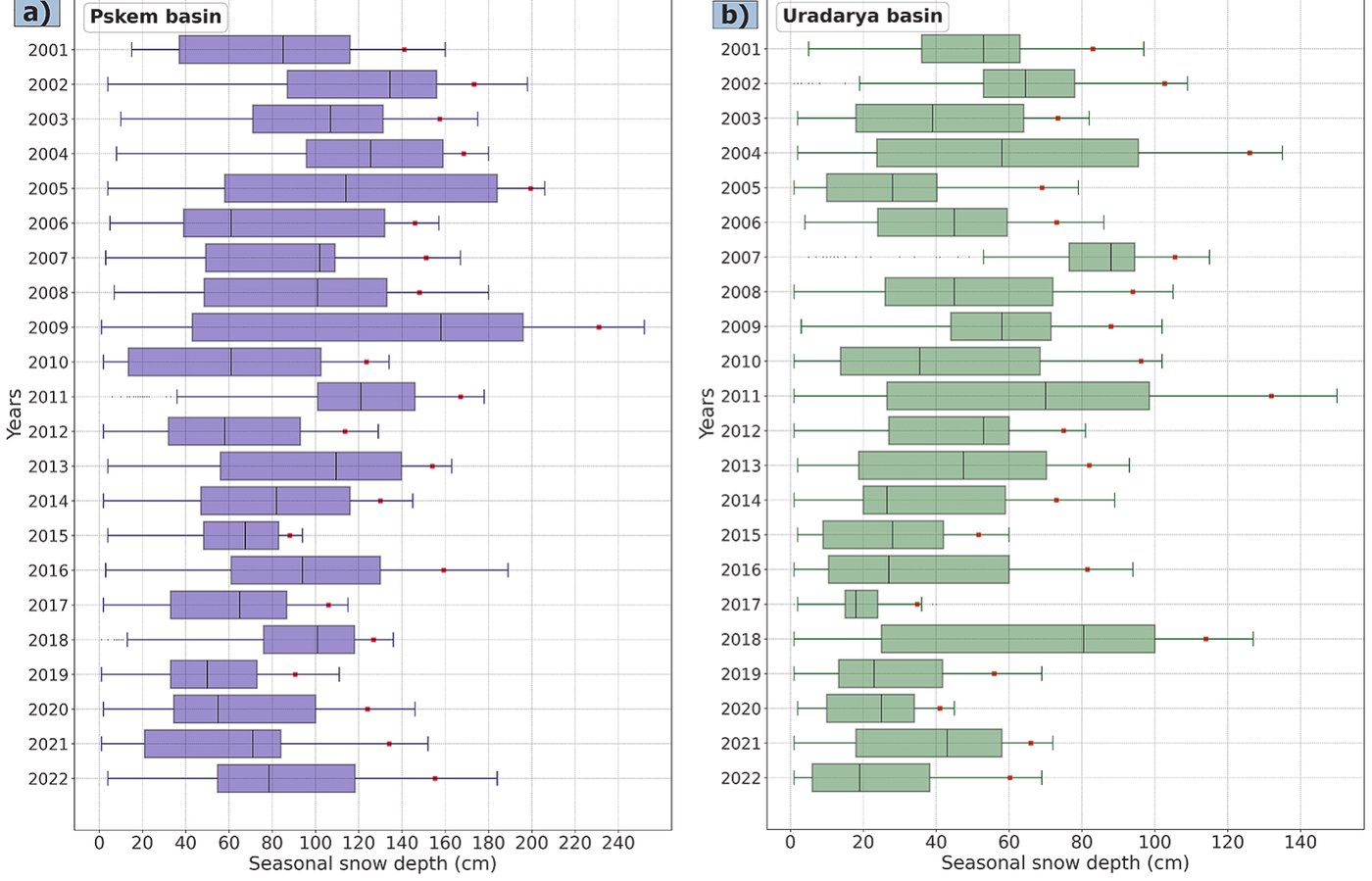
- 90th percentile of seasonal snow depth: Pskem basin often above 200 cm in the early 2000s (about 230 cm in 2009), mostly below 140 cm after 2011; Uradarya basin rarely above 120 cm, mostly below 60 cm after 2018.
- Spring air temperature: +0.09 °C a year in the Pskem basin (1.98 °C in all), +0.07 °C a year in the Uradarya basin (1.54 °C).
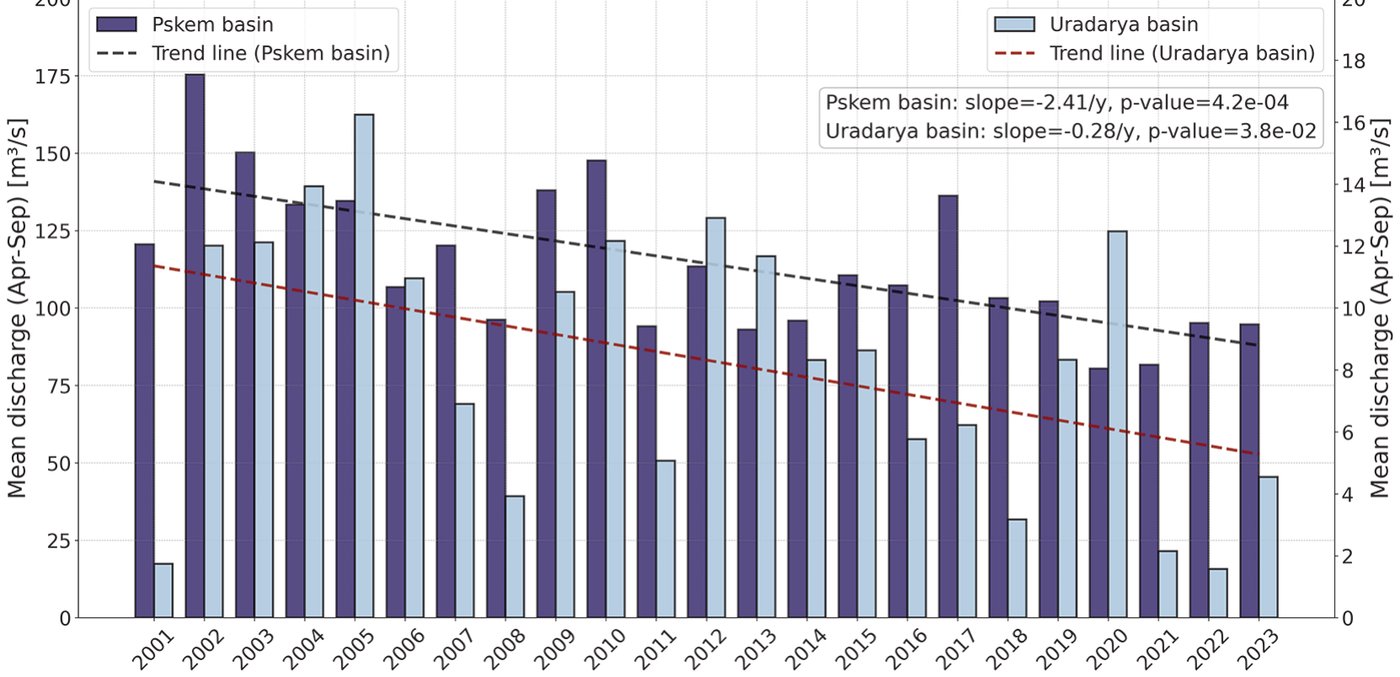
- Growing-season (April–September) river flow: −2.41 m³/s a year in the Pskem (p = 0.0004; about −53 m³/s in all), −0.28 m³/s a year in the Uradarya (p = 0.038; about −6 m³/s).
- River flow in 2021–2022: Uradarya 70–80% and Pskem 30% below the long-term average.
- Correlation of January–March snow depth with June–August river flow: R = 0.53 (Pskem), 0.54 (Uradarya).
Abstract
Snow is the main hydrological component, and its contribution plays a key role in runoff formation in Uzbekistan, Central Asia. However, climate change has altered snow accumulation dynamics over the past two decades. This study investigated the impacts of seasonal changes in snow on river runoff in the Pskem and Uradarya Basins over the past 22 hydrological years (2001–2023), considering air temperature and precipitation variations. In-situ data from meteorological and hydrological stations in the study areas were used to examine the trend dynamics during the study period. Pearson’s correlation analysis was applied to examine the statistical relationship between the winter snow accumulation and summer discharge. The statistical significance of the trend dynamics was tested using the Mann-Kendall test. The results revealed a significant reduction in snow accumulation over the study period and the number of overall snowfall days, with a marked decline observed in recent years. Consequently, the contribution of seasonal snow to river runoff has markedly decreased, leading to a reduction in the discharge volume during the vegetation period. A reduction in discharge volume in both basins over the past 22-year period (2001–2023) was statistically confirmed based on in-situ data.
English abstract from the paper. The authors’ abstract, reproduced under CC BY 4.0.
Keywords
- snow cover
- discharge
- mountain basin
- climate change
- runoff
In plain English
The study uses daily station records for the hydrological years 2001–2023 from two mountain basins: the Pskem in north-eastern Uzbekistan, the main headwater of the Chirchik, and the Uradarya in the south, in the Kashkadarya basin. Snow depth (November–April), air temperature and precipitation come from the Oygaing and Minchukur weather stations, river flow from the Mullala (Pskem) and Pachkamar (Uradarya) gauging stations of Uzhydromet. Trends were tested with the Mann–Kendall test and linear regression, and snow depth in January–March was compared with river flow in June–August.
Snow depth fell significantly at all percentiles in both basins. In the Pskem basin the 90th percentile of seasonal snow depth often exceeded 200 cm in the early 2000s and reached about 230 cm in 2009; after 2011 most years stayed below 140 cm. In the Uradarya basin it rarely exceeded 120 cm and has stayed below 60 cm in most years since 2018. Hot extremes of air temperature (90th percentile) rose by about 0.05 °C a year, some 1.1 °C over the period, and spring warmed most: by 0.09 °C a year in the Pskem basin (1.98 °C in all) and 0.07 °C a year in the Uradarya basin (1.54 °C). Winter warming was weak and not significant, and autumn cooled slightly. Annual precipitation fell by 4.64 mm a year in the Pskem basin (p = 0.48) and 11.13 mm a year in the Uradarya basin (p = 0.06).
Mean river flow in the growing season (April–September) fell by 2.41 m³/s a year in the Pskem, about 53 m³/s over the period, and by 0.28 m³/s a year in the Uradarya, about 6 m³/s. Flows above 125 m³/s in the Pskem and 10 m³/s in the Uradarya were common before 2012 and rare after it; in 2021–2022 the Uradarya ran 70–80% and the Pskem 30% below the long-term average. Winter snow depth and summer flow are correlated (R = 0.53 in the Pskem, 0.54 in the Uradarya), so the authors see the shrinking snowpack as a main cause of the lower summer flow, with spring warming and the shift from snow to rain also playing a part. They call for hydrological modelling with more stations and for water management adapted to earlier melt and lower summer flow.
Figures (3)
How to cite
A. Mamaraimov, B. Nishonov, A. Gafurov and T. Khujanazarov (2026). Significant reduction of river discharge in the mountainous basins of Uzbekistan over the last decades. Hydrological Research Letters, 20(1), 1–8. https://doi.org/10.3178/hrl.25-00024