Journal articleOpen access
Geological controls on the geothermal system and hydrogeochemistry of the deep low-salinity Upper Cretaceous aquifers in the Zharkent (eastern Ily) Basin, south-eastern Kazakhstan
https://doi.org/10.3389/feart.2023.1212064
Highlights
- Upper Cretaceous reservoir up to about 2,850 m deep, 30–50 m thick, permeability up to eight darcies.
- Wellhead water temperatures of 96–102 °C; well 5539 (about 2,850 m) produces 103 °C water; initial natural flow up to 75.2 L/s.
- Salinity of the geothermal water 0.3–0.9 g/L; Paleogene waters up to 22 g/L.
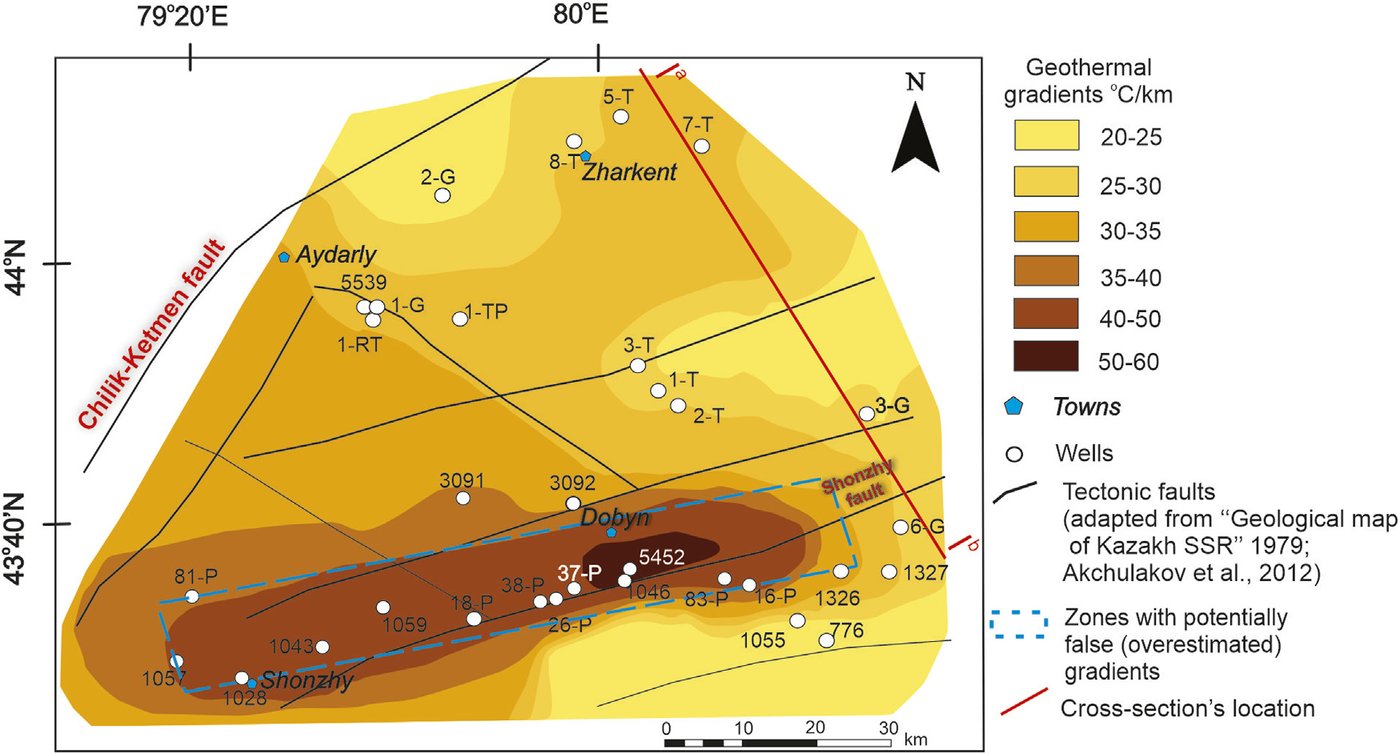
- Geothermal gradients: east 21.1–30.3 °C/km, centre 25.1–32.9 °C/km, south 27.3–53.5 °C/km; anomaly of 40–60 °C/km near Dobyn and Shonzhy.
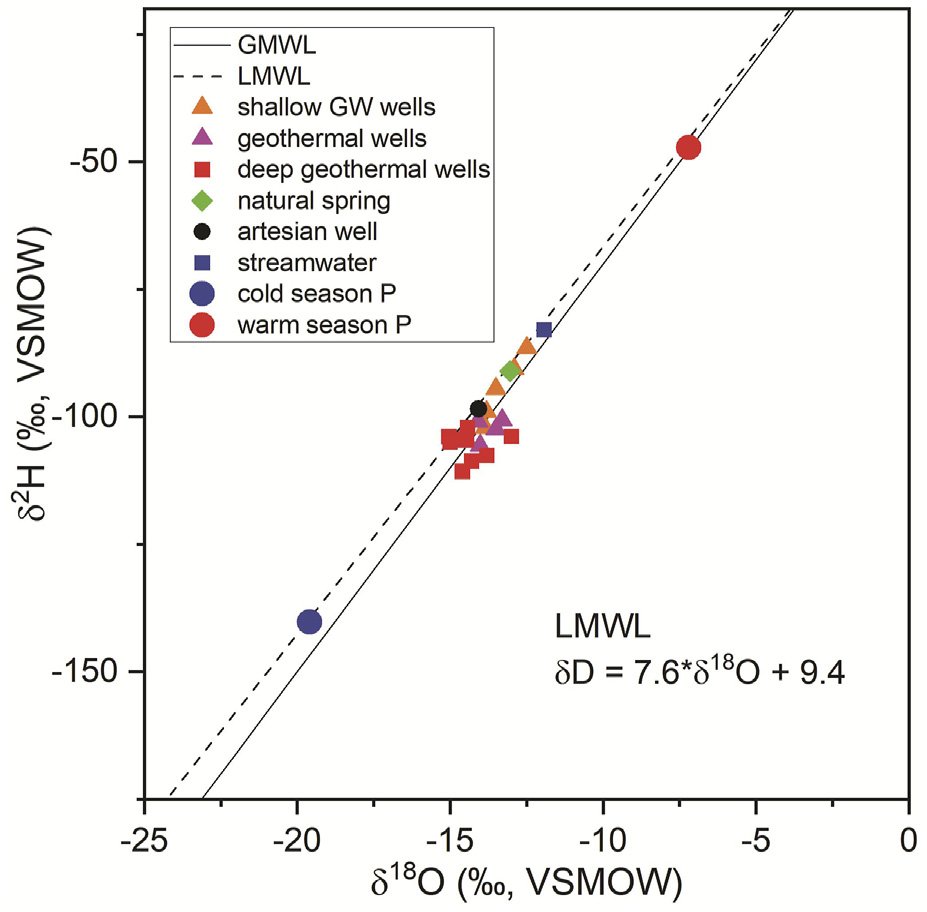
- Mean of all samples: δ²H −99.9 ± 7.61‰, δ¹⁸O −13.7 ± 0.76‰, d-excess 9.52 ± 4.21‰; deep geothermal wells (n = 6) δ²H −106.56 ± 2.85‰.
- Local meteoric water line: δD = 7.6·δ¹⁸O + 9.4.
Abstract
The Zharkent (eastern Ily) Basin is renowned for its low-salinity natural hot springs and geothermal wells, primarily utilized for recreational purposes. Despite the growing commercial interest, the geothermal system in this area is very poorly documented or understood. Accordingly, we conducted a multi-disciplinary study, focusing on the advanced characterization of waters from productive Cretaceous strata, along with the interpretation of geothermal gradients and reservoir recharge in a geological context. Conventional wisdom asserts that Ily is an intracratonic basin characterized by high geothermal heat in its central part and by geothermal aquifers that are rapidly replenished by meteoric water recharge via porous strata exposed on the basin margin. Our results argue for an alternative and expanded interpretation of these systems. Elevated geothermal gradients (with average of up to 40°C/km in the southern part of the basin and locally possibly up to 55°C/km) are likely associated with crustal thinning owing to the development of a pull-apart basin. Anomalously fresh water (<1 g/L) in the deep (up to 2850 m depth) Upper Cretaceous reservoir is charged laterally, predominantly by snowmelt waters from basin bounding mountains. Recharge includes both mountain-front recharge (MFR), where water infiltrates into outcrops of reservoir rock near the mountain fronts, and mountain-block recharge (MBR), characterized by deep groundwater flow through fractured, predominantly rhyolite basement rocks (as evidenced from their solutes in reservoir waters). The combination of elevated geothermal gradients, low salinity water chemistry, and excellent reservoir properties makes the studied reservoir horizon an attractive target for geothermal development. Our results are applicable to other geothermal systems in strike-slip settings across Central Asia, and potentially worldwide.
The authors’ abstract, reproduced under CC BY 4.0.
Keywords
- geothermal energy
- Zharkent Basin
- hydrogeochemistry
- pull-apart basin
- groundwater
- stable isotopes
In plain English
The Zharkent (eastern Ily) Basin in south-eastern Kazakhstan is known for low-salinity hot springs and geothermal wells, used mainly for recreation. Oil exploration in the 1950s found hot water, about 96 °C at the wellhead, in Upper Cretaceous reservoirs at 2,682–2,730 m; a recent well, 5539, about 2,850 m deep, produces water at 103 °C from the same interval. The productive horizon is 30–50 m thick and highly permeable, up to eight darcies.
The authors reprocessed temperature, water-chemistry, stratigraphic, gravity and structural data and sampled wells and springs in May–June 2021 and May–June 2022: four deep geothermal wells over 2.5 km, five geothermal wells 600–700 m deep, shallow groundwater wells, a spring, a warm artesian well and a stream. Geothermal gradients from 18 wells range from 21.1–30.3 °C/km in the east of the basin and 25.1–32.9 °C/km in the centre to 27.3–53.5 °C/km in the south, with a strong anomaly of 40–60 °C/km near the towns of Dobyn and Shonzhy.
The authors argue that the basin is a pull-apart basin formed by strike-slip faulting, and that its uneven gradients come from uneven thinning of the crust. Heat moves mainly by conduction, though water flowing up open faults may add heat locally. The Upper Cretaceous water is fresh, 0.3–0.9 g/L, while the overlying Paleogene and Neogene layers hold water up to 20 times saltier, fed by water seeping down from the surface.
Stable isotopes point to snowmelt as the main source of the deep water: the deep geothermal wells are the most depleted. Dissolved silica and other ions suggest that water reaches the reservoir both where it crops out at the mountain front and through fractured rhyolite basement under the mountains. The authors conclude that high gradients, fresh water and excellent reservoir properties make the Upper Cretaceous horizon an attractive geothermal target, and that the results apply to other strike-slip geothermal systems in Central Asia.
Figures (2)
How to cite
Ashirgul Kozhagulova, Vadim Yapiyev, Leila Karabayanova, Antoine Dillinger, Vyacheslav Zavaley, Aisulu Kalitova, Emil Bayramov, John Holbrook, Stephen E. Grasby and Milovan Fustic (2023). Geological controls on the geothermal system and hydrogeochemistry of the deep low-salinity Upper Cretaceous aquifers in the Zharkent (eastern Ily) Basin, south-eastern Kazakhstan. Frontiers in Earth Science, vol. 11, 1212064. https://doi.org/10.3389/feart.2023.1212064