Journal articleOpen access
Justification of Prospects Sulfurous Waters in Depleted oil Fields (for Example Chimions Structure)
Обоснование перспективных площадей сероводородных вод на выработанных нефтяных месторождениях (на примере Чимионской структуры)
https://doi.org/10.18500/1819-7663-2014-14-2-73-80
Highlights
- Reserves approved in 1969: strong H₂S waters of 7.6–7.9 g/L with 180–200 mg/L H₂S, 138.2 m³/day (well III), and H₂S brines of 74–97 g/L with 300–330 mg/L H₂S, 15.5 m³/day (well I).
- Total approved reserves of the Bukhara–Alai complex later raised to 266 m³/day.
- Wells sampled at depths of 404–1,238 m: H₂S 75–306 mg/L, salinity 7.3–158 g/L, specific yield 0.002–0.12 L/s.
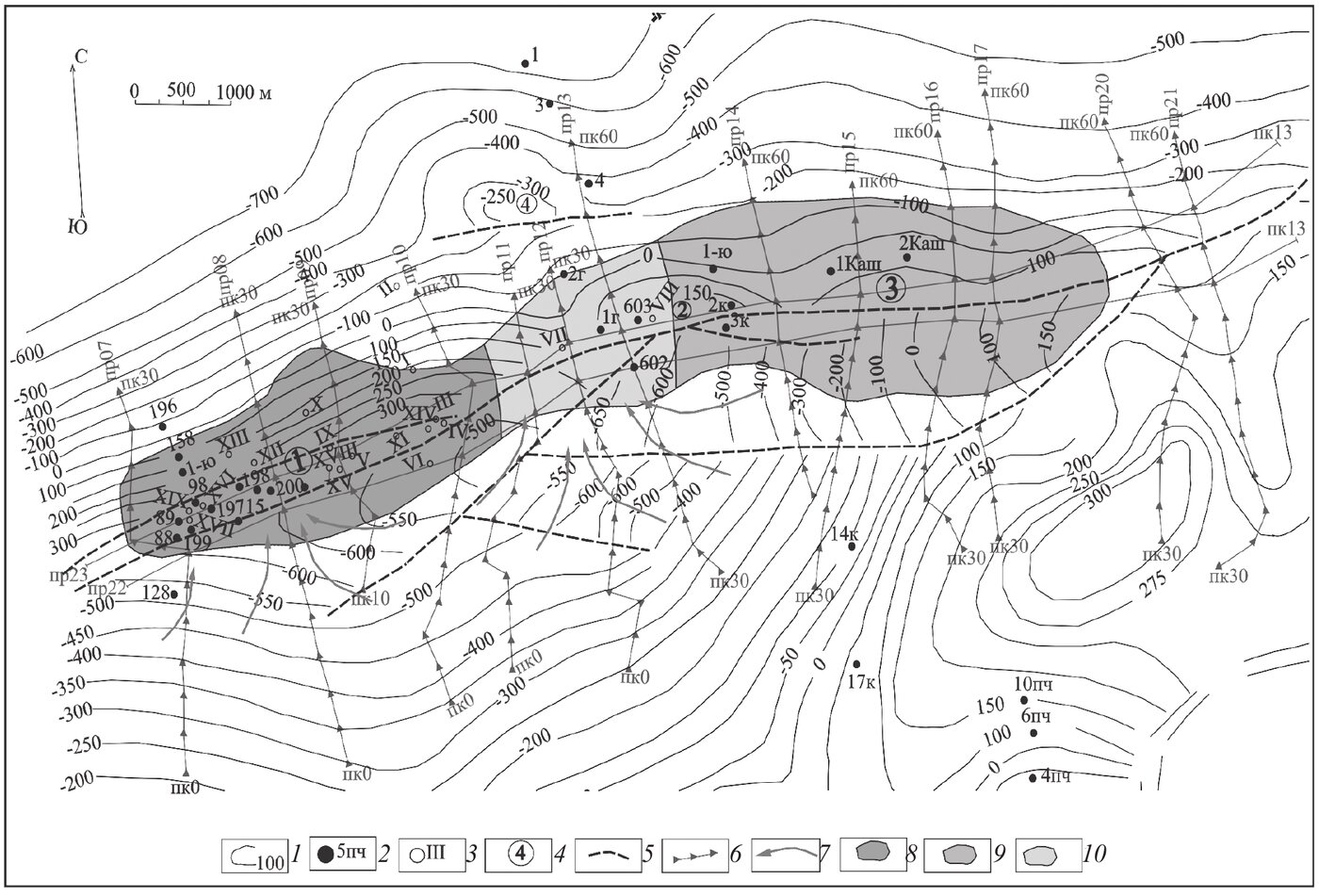
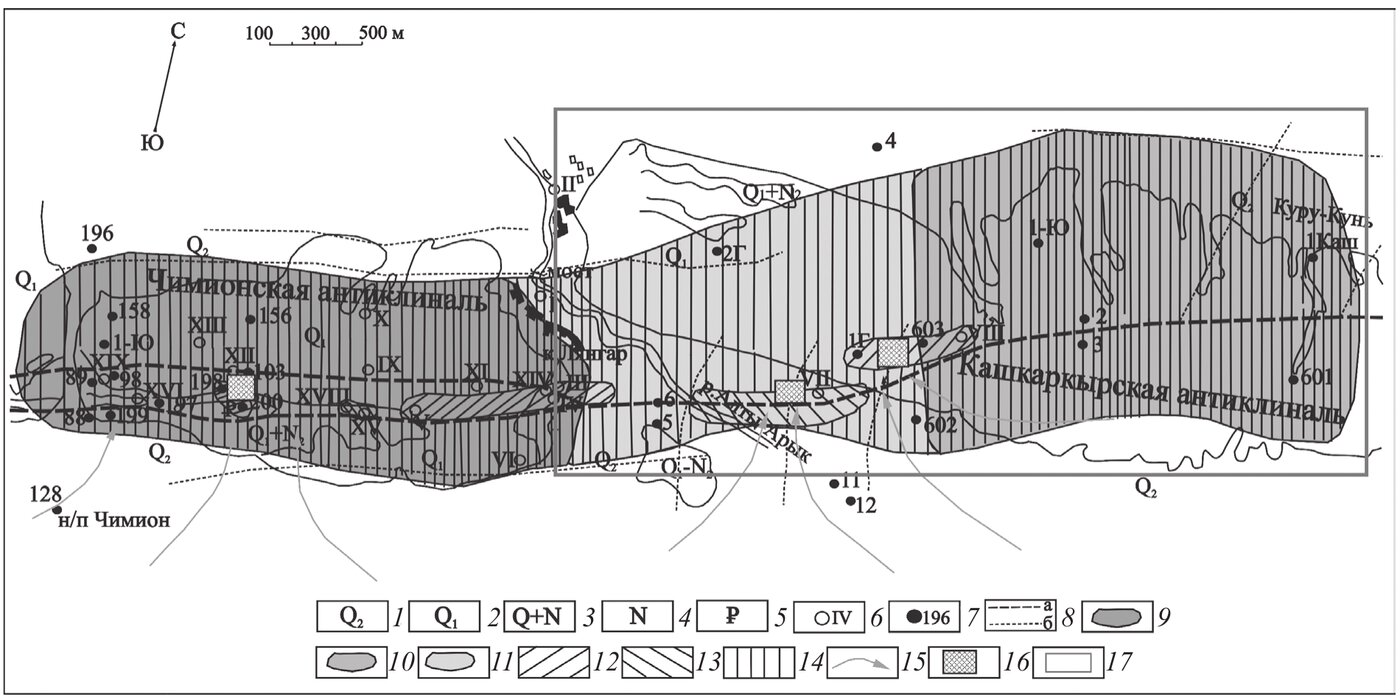
- Induced polarisation: background 1.4–1.5%; anomalies of 3–5% at Chimion, 2–3% at Kashkarkyr and 1.6–2.1% where the two structures meet.
- Fault displacement of 400–500 m; recharge area 20 km away on the northern slope of the Turkestan Range.
Abstract
On the territory of the Republic, in the Ferghana valley are depleted oil fields, where it was noted the manifestation of hydrogen sulfide, thermal waters. Based on materials from oil exploration and individual hands-on mizhplastovi water were established relationship between hydrochemical and geophysical parameters, the unloading area in faults; delineated the most promising areas of accumulation of hydrogen sulfide waters, increased concentration, determined by their place in the structures Chimion-Kashkarkyr.
English abstract from the journal’s website. The authors’ abstract, reproduced under CC BY 4.0.
Keywords
- physical and geological model
- apparent resistivity
- induced polarization
- reservoir properties
- hydrogen sulfide water
In plain English
The Chimion oil field lies on the southern step of the Fergana depression, in the Chimion–Auval anticline zone. Oil production began in 1900. The same structure holds hydrogen sulphide (H₂S) waters that supply the Chimion sanatorium and resort, which is short of this medicinal water. The aim was to find new areas of H₂S water at the Chimion and neighbouring Kashkarkyr structures.
The waters sit in the Turkestan and Bukhara–Alai aquifers of the Palaeogene, made up mainly of fractured, dolomitised limestones. They are recharged from the northern slope of the Turkestan Range, 20 km away. A longitudinal reverse-thrust fault runs along the structure; its northern side is pushed up over the southern side by 400–500 m. In the authors’ view, sulphate water rising along faults reacts with hydrocarbons in the oil-bearing beds and forms the H₂S waters.
The authors combined seismic data with resistivity and induced-polarisation soundings and data from 19 hydrogeological wells. Higher polarisability matched higher H₂S content. On this basis they mapped very strong H₂S waters at Chimion, strong ones at Kashkarkyr and weak to medium ones where the two structures meet. They recommend new wells in these places.
Figures (2)
How to cite
M. R. Juraev, I. A. Agzamova and R. E. Djuraev (2014). Justification of Prospects Sulfurous Waters in Depleted oil Fields (for Example Chimions Structure). Izvestiya of Saratov University. New Series. Series: Earth Sciences, 14(2), 73–80. https://doi.org/10.18500/1819-7663-2014-14-2-73-80