Journal articleFree to read
Current state and prospects for development of resources of mineral water deposits of Uzbekistan
Современное состояние и перспективы освоения ресурсов месторождений минеральных вод Узбекистана
- Institute of Hydrogeology and Engineering Geology (HYDROENGEO), Tashkent, Uzbekistan
Highlights
- Mineral-water deposits and sites with approved reserves on 1 January 2023: 58, of which 40 in operation; forecast resources: just over 2 million m³/day.
- More than 50 sanatoriums and sanatorium-prophylactoriums and more than 35 physiotherapy clinics operate.
- Altynsai deposit (Navoi region): nitrogen–alkaline thermal water, 1.2–1.4 g/L, pH 7.5–7.7, 62–65 °C.
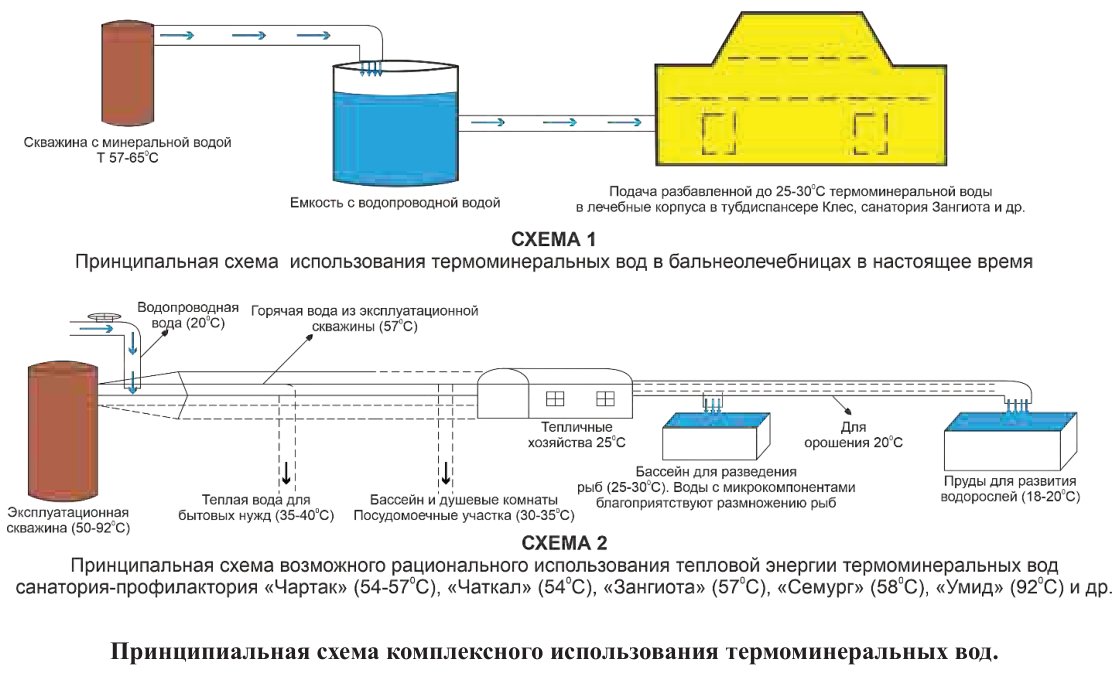
- Present use: well water at 57–65 °C is diluted with tap water to 25–30 °C before it reaches treatment buildings, for example at the Keles tuberculosis dispensary and the Zangiota sanatorium.
- Proposed cascade: production well 50–92 °C; warm water for domestic needs 35–40 °C; pools, showers and dishwashing 30–35 °C; greenhouses 25 °C; fish-breeding pools 25–30 °C; irrigation 20 °C; algae ponds 18–20 °C.
- Sanatorium-prophylactorium water temperatures in the proposed scheme: Chartak 54–57 °C, Chatkal 54 °C, Zangiota 57 °C, Semurg 58 °C, Umid 92 °C.
- Chimbay well 4-r (South Aral basin): iron–bromine water at 657–675 m in Albian deposits, resources about 500 m³/day.
Abstract
The current state and prospects of mineral water resources in the Republic of Uzbekistan are examined. Recommendations are provided for further research efforts aimed at preserving and making rational use of these valuable natural medicinal resources. This includes strengthening and enhancing the hydromineral base of medical and recreational institutions, as well as developing medical and recreational facilities and resorts within the Republic.
English abstract from the journal issue PDF. The authors’ abstract, reproduced under .
In plain English
Uzbekistan has mineral waters in the Bukhara–Karshi, Zarafshan, South Aral, Fergana, Surkhandarya and Pretashkent artesian basins, and most of those in use are in the Fergana valley and the Pretashkent region. On 1 January 2023, 58 deposits and sites had approved reserves and 40 of them were in operation; forecast resources of all types were put at just over two million m³ a day. Weakly mineralised nitrogen–alkaline thermal waters are among the types found across whole regions, and those of the Pretashkent and Fergana basins, and partly of the Bukhara–Karshi basin, are the main waters used today.
In Navoi region, the Altynsai deposit gives nitrogen–alkaline thermal water of 1.2–1.4 g/L and pH 7.5–7.7 at 62–65 °C. Besides treatment and bottling, it supplies heat to the Altynsai and “Mother and Child” sanatoriums and the Altynsai greenhouse farm. Weakly mineralised thermal water has also been explored at Djuyzar in Bukhara region and found at the Pravda and Gulistan deposits in Syrdarya region. Tashkent sanatoriums use nitrogen–alkaline thermal water from the Cenomanian aquifer complex of the Upper Cretaceous, and such water can also be obtained from Palaeogene beds at Chimgansay, in the Tashkent area and in the Akhangaran valley. In Kashkadarya region the authors recommend exploring for nitrogen–alkaline thermal water at Khodjakuduk, Raimsufi and Azlyartepe.
Most deposits are operated at a low level, and after use the water is often discharged at temperatures high enough for other uses. To get the most from both its heat and its minerals, the authors propose a technological scheme for each deposit, with the water passing in turn to domestic hot water, pools, greenhouses, fish ponds, irrigation and algae ponds. Future demand, including from modern greenhouses and fish farming, is to be assessed against government decisions on industry, energy, health tourism, farming and resorts, as also proposed in their 2022 review of Uzbekistan’s thermal waters. At some deposits actual withdrawal far exceeds need, which changes the quality and quantity of the water.
Figures (1)
How to cite
B. Zh. Ismailov, S. A. Bakiev and A. S. Ibragimov (2024). Current state and prospects for development of resources of mineral water deposits of Uzbekistan. Geologiya i mineral'nye resursy (Geology and Mineral Resources), No. 6, 2024, pp. 88–94. https://mridm.uz/en/assets/journal/pdf/6_2024.pdf