Conference paperOpen access
Analysis of the Stable Isotopic Composition of Precipitation in Uzbekistan Using Different Regression Methods
https://doi.org/10.17794/cgc.2026.11
Highlights
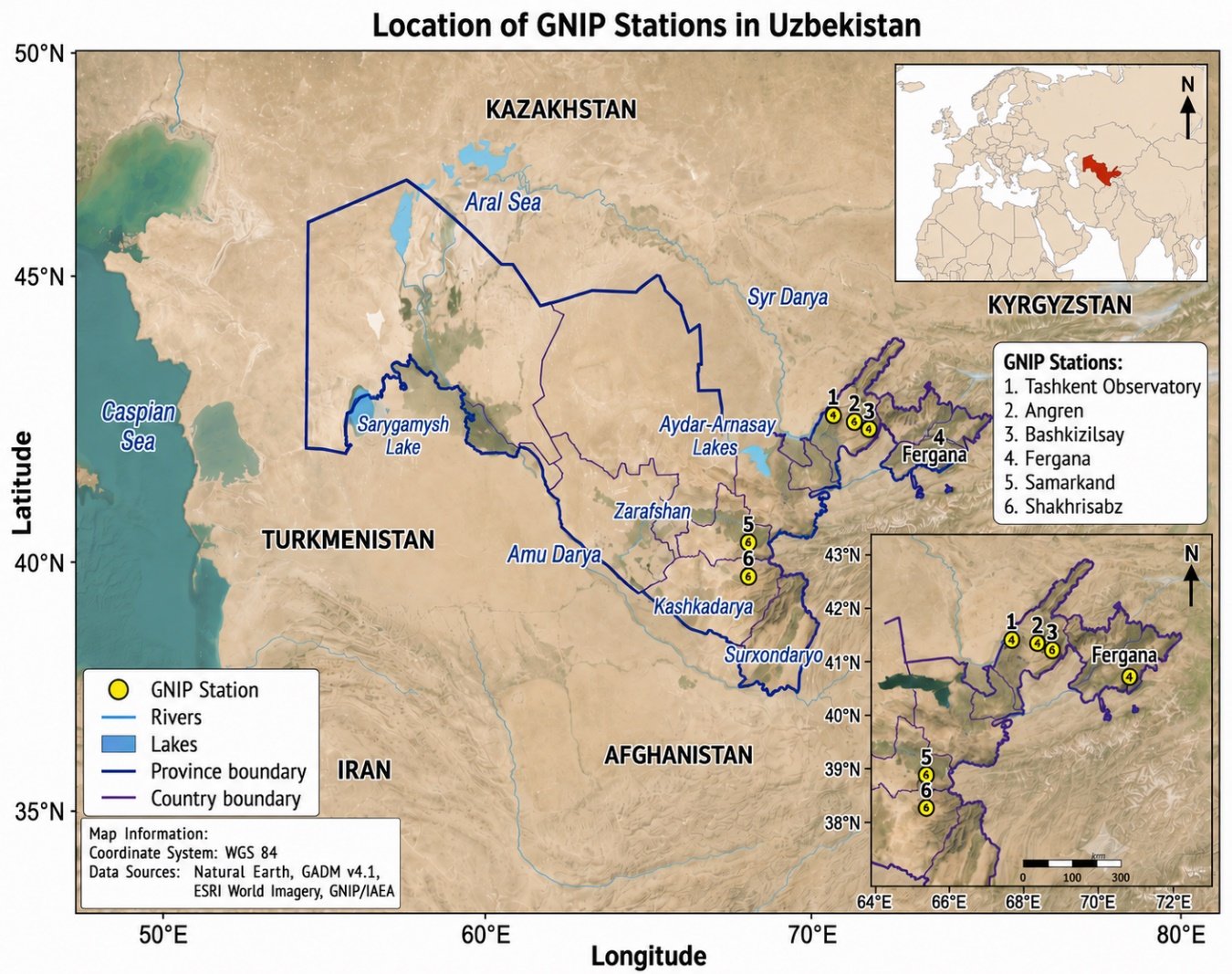
- Six GNIP stations, 2022–2025: Tashkent (467 m), Angren (945 m), Bashkizilsay (1,272 m), Fergana (582 m), Samarkand (726 m) and Shakhrisabz (625 m).
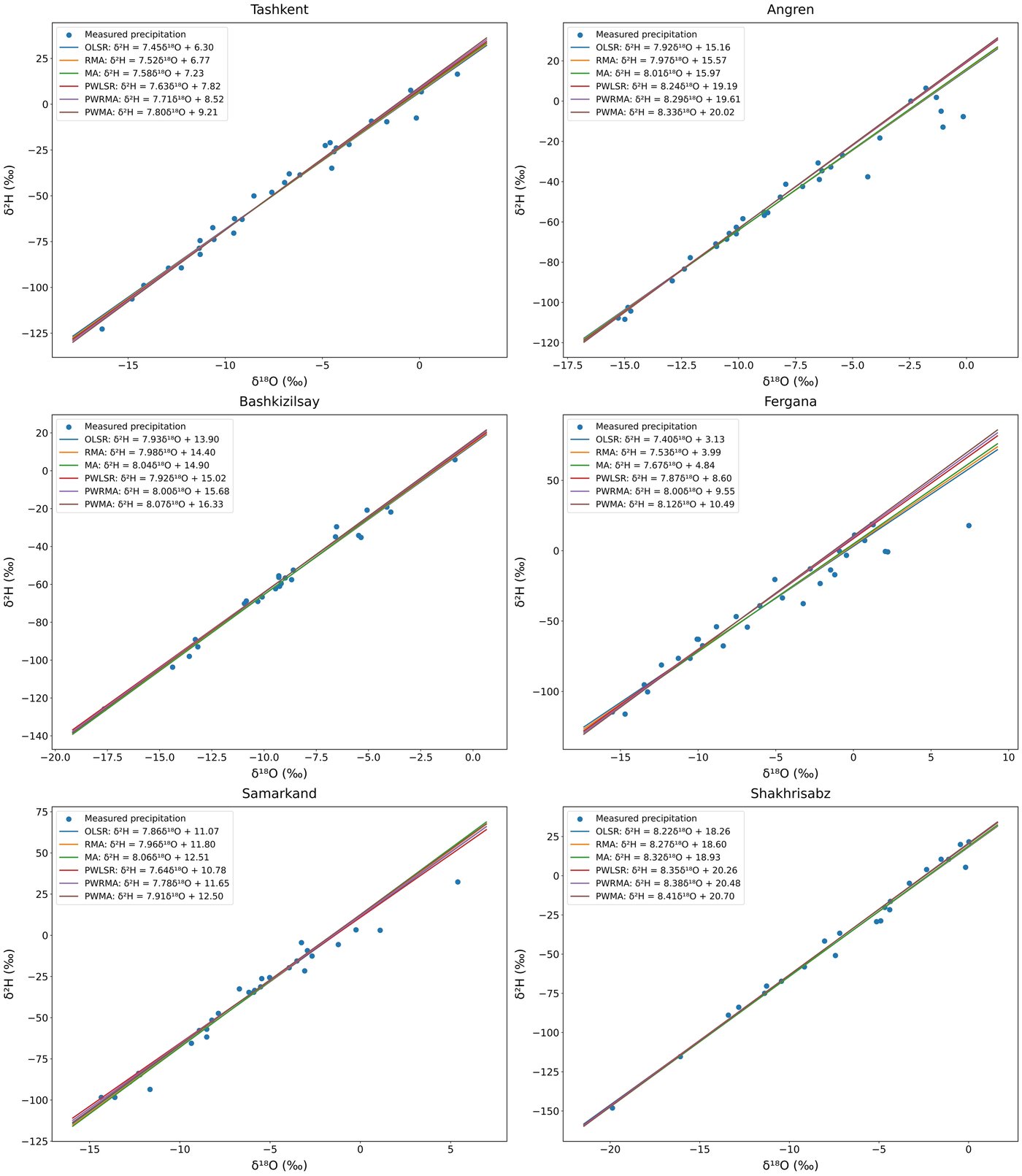
- Local meteoric water lines by ordinary least squares: Tashkent δ²H = 7.46 δ¹⁸O + 6.30; Angren δ²H = 7.93 δ¹⁸O + 15.16; Bashkizilsay δ²H = 7.93 δ¹⁸O + 13.90.
- Local meteoric water lines by ordinary least squares: Fergana δ²H = 7.40 δ¹⁸O + 3.13; Samarkand δ²H = 7.86 δ¹⁸O + 11.07; Shakhrisabz δ²H = 8.22 δ¹⁸O + 18.26.
- Lines weighted by precipitation amount (PWLSR): slopes 7.63–8.35 and intercepts 7.82–20.26, lowest at Tashkent and highest at Shakhrisabz.
- Six regression methods compared: ordinary least squares, reduced major axis and major axis, each unweighted and weighted by precipitation amount.
Abstract
Stable isotopes δ¹⁸O and δ²H are widely used as tracers for investigating hydrological processes, including groundwater recharge, evaporation, and surface water–groundwater interactions. This study evaluates the isotopic composition of precipitation in Uzbekistan, using data from six Global Network of Isotopes in Precipitation (GNIP) stations. Local Meteoric Water Lines (LMWLs) were established using six different regression methods and compared with the Global Meteoric Water Line (GMWL) to assess regional isotope variability and the influence of climatic and geographic factors. The results reveal considerable spatial variability in isotopic composition of precipitation across Uzbekistan. Most LMWLs closely follow the GMWL, indicating that equilibrium condensation is the dominant isotope-fractionation process. Mountain stations exhibit higher slopes and intercepts, reflecting reduced evaporation effects and stronger orographic influences, whereas lowland stations show evidence of enhanced evaporative enrichment. These spatial variations are primarily controlled by altitude, continentality, and local climatic conditions. The derived LMWLs provide an important reference framework for future hydrological, hydrogeological, and climate-related investigations in Uzbekistan and contribute to a better understanding of regional water-cycle processes.
English abstract from the paper. The authors’ abstract, reproduced under CC BY 4.0.
Keywords
- δ¹⁸O and δ²H
- correlation
- precipitation
- GNIP stations
- Uzbekistan
In plain English
The stable isotopes of oxygen and hydrogen (δ¹⁸O and δ²H) in precipitation were analysed at six stations of the Global Network of Isotopes in Precipitation (GNIP) in Uzbekistan for 2022–2025: Tashkent, Angren, Bashkizilsay, Fergana, Samarkand and Shakhrisabz. The stations lie between 467 and 1,272 m above sea level. A local meteoric water line was fitted for each station with six regression methods, three of them weighted by the amount of precipitation, and compared with the global line δ²H = 8 δ¹⁸O + 10.
With ordinary least squares, the slopes range from 7.40 at Fergana to 8.22 at Shakhrisabz, and the intercepts from 3.13 at Fergana to 18.26 at Shakhrisabz. Most slopes are close to 8, which points to equilibrium condensation as the main control. The authors relate the higher slopes and intercepts at Shakhrisabz and Bashkizilsay to cooler conditions, less evaporation and orographic effects, and the lower values at Tashkent and Fergana to evaporation of falling rain in warm, dry air. Regressions weighted by precipitation amount generally give slightly higher slopes and intercepts than unweighted ones.
δ¹⁸O is higher in summer and lower in winter at the stations. Shakhrisabz has too little rain in June–August for a summer comparison. The authors present the lines as a reference for future hydrological and hydrogeological work in Uzbekistan.
Figures (2)
How to cite
Serik Isabekov, Bakhriddin Nishonov, Utkir Balxiev, Bekhzod Nishonov and Tamara Marković (2026). Analysis of the Stable Isotopic Composition of Precipitation in Uzbekistan Using Different Regression Methods. Proceedings of reviewed papers: 6th Croatian geomathematical congress (University of Zagreb, Faculty of Mining, Geology and Petroleum Engineering), 167–175. https://doi.org/10.17794/cgc.2026.11