Journal articleOpen access
Source-Rock Potential of Jurassic Deposits on the Northern and South-Western Flanks of the Kosbulak Trough (North Ustyurt Basin, Kazakhstan): Evidence from Rock-Eval Pyrolysis of Two Exploration Wells
- Department of Geology and Petrochemical Engineering, Yessenov University, Aktau, Kazakhstan
https://doi.org/10.3390/en19215097
Highlights
- Present-day geothermal gradient of the Kosbulak depression: 30–36.6 °C/km (32.2 °C/km for the isotherms in Fig. 7); palaeogeothermal gradient: 37.5–44 °C/km.
- Present-day formation temperatures: 155–175 °C at 3,700–4,100 m depth in the south-western part of the depression; 72 °C at 2,300–2,400 m north-west of it.
- Estimated present temperature of the Middle Jurassic: about 70–75 °C in Well N and 120–160 °C in Well S.
- Formation tops in Well S: Upper Jurassic 2,920 m, Middle Jurassic 3,242 m, Lower Jurassic 4,010 m, Triassic 4,420 m; total depth 4,750 m.
- Formation tops in Well N: Upper Jurassic 1,507.5 m, Middle Jurassic 1,685 m, Lower Jurassic and Upper Triassic 1,875 m; total depth 2,025 m.
- Cretaceous rocks about 2,600 m and Palaeocene–lower Miocene rocks about 1,400 m thick in the Kosbulak depression; platform cover 4.5–5 km.
- Middle Jurassic in Well N: median TOC 5.81 wt.% (up to 32.2 wt.% in coal); in Well S: median TOC 1.06 wt.%.
Abstract
The Kosbulak Trough, in the eastern part of the North Ustyurt Basin in western Kazakhstan near the border with Uzbekistan, is one of the deepest Mesozoic depocentres of the basin, yet published organic geochemical data on its source rocks remain scarce. This study evaluates Rock-Eval pyrolysis data from two exploration wells located on opposite flanks of the trough: Well N on the northern flank (11 cuttings samples, 1657–1975 m depth) and Well S on the south-western flank (752 cuttings samples, 450–4688 m depth). Formation tops from well logs and palynology were used to compare the same stratigraphic units in both wells. In Well N, the Middle Jurassic coal-bearing interval (1685–1875 m depth) has median TOC of 5.81 wt.% (up to 32.2 wt.% in coal), S2 of 1.08–31.59 mg HC/g rock and HI of 43–189 mg HC/g TOC, indicating gas-prone Type III organic matter; Tmax of 424–429 °C and measured vitrinite reflectance of 0.43–0.44% show that it is thermally immature. In Well S, the Middle Jurassic (3242–4010 m depth) is leaner (median TOC 1.06 wt.%, median S2 1.16 mg HC/g rock), but its richest coaly beds at 3522–3563 m depth (TOC 3.32–4.93 wt.%, S2 5.41–8.34 mg HC/g rock) have Tmax of 435–441 °C, corresponding to the onset of the oil window. In the Lower Jurassic and Triassic of Well S (below 4010 m depth), Tmax decreases to about 407 °C; this is attributed to low S2, oil-based-mud contamination and bitumen impregnation observed in core, rather than to decreasing maturity. Regional vitrinite reflectance and palaeotemperature data support this interpretation. The results indicate that Middle Jurassic source rocks are richer but immature on the northern flank and leaner but more mature on the deeper south-western flank; the deeper axial part of the trough, not sampled here, is suggested as the most probable gas-prone generation area.
English abstract from the publisher’s page of the article. The authors’ abstract, reproduced under CC BY 4.0.
Keywords
- North Ustyurt basin
- Kosbulak Trough
- Jurassic
- geothermal gradient
- formation temperature
- Rock-Eval pyrolysis
- burial history
In plain English
The Kosbulak Trough lies in the eastern part of the North Ustyurt basin of western Kazakhstan and Uzbekistan, near the border with Uzbekistan. The base of the Jurassic deepens from about 1.8–2.2 km on its northern flank to 4.2–4.4 km on the south-western flank and 4.6 km in the trough axis. The basement lies at about 11–12 km, and the trough has subsided without significant uplift or erosion since the Jurassic.
The authors analysed drill cuttings from two exploration wells about 80 km apart: 11 samples from Well N on the northern flank (1,657–1,975 m) and 752 from Well S on the south-western flank (450–4,688 m), with formation tops from well logs and palynology. In Well N, the coal-bearing Middle Jurassic (1,685–1,875 m) is rich in organic matter but thermally immature (Tmax 424–429 °C, vitrinite reflectance 0.43–0.44%). In Well S, the Middle Jurassic (3,242–4,010 m) is leaner, but its richest coaly beds at 3,522–3,563 m have Tmax of 435–441 °C, the onset of the oil window. In both wells the organic matter is mainly gas-prone Type III.
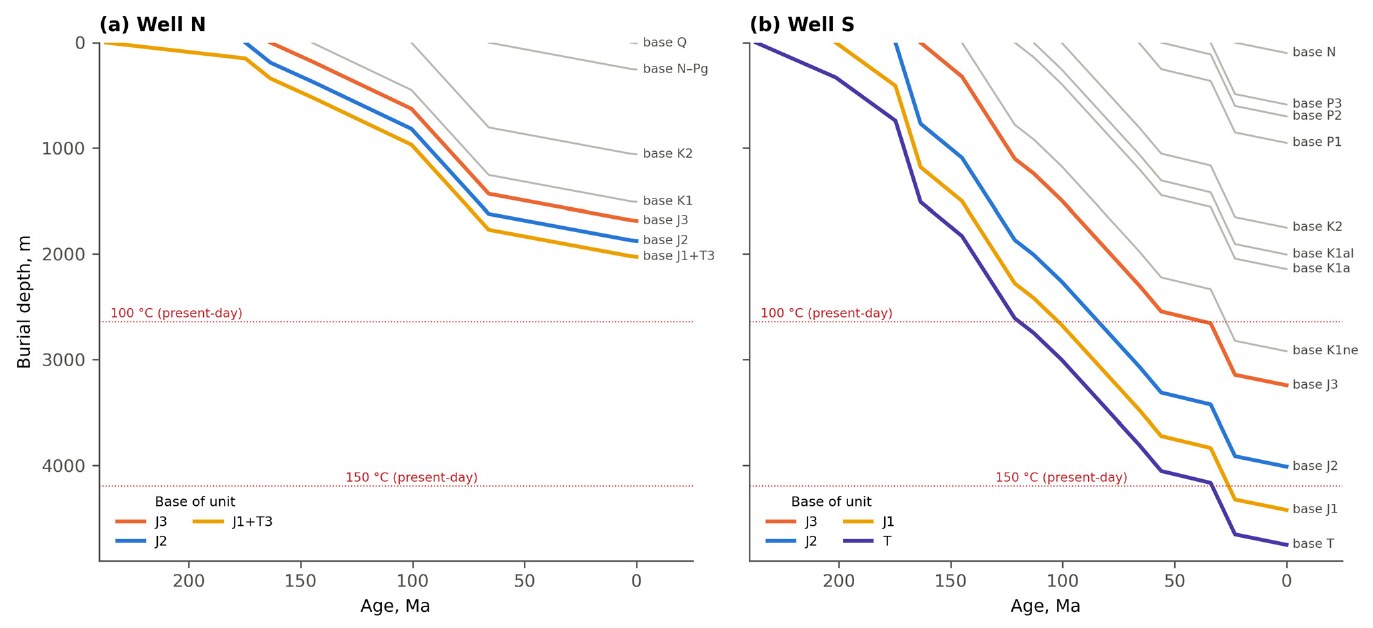
Burial histories of both wells show continuous burial since the Jurassic (Fig. 7). With the regional present-day geothermal gradient of 30–36.6 °C/km, the authors estimate that the Middle Jurassic is at about 70–75 °C today in Well N and 120–160 °C in Well S. Regional studies give present-day formation temperatures of 155–175 °C at 3,700–4,100 m in the south-west of the depression and 72 °C at 2,300–2,400 m north-west of it, and palaeotemperatures of 160–175 °C to about 190 °C at the base of the Middle Jurassic. The authors suggest that the unsampled axis of the trough is the most likely area of gas generation.
Figures (1)
How to cite
Zhanna Bekeshova, Kosarbay Kozhakhmet and Nurlygul Kylyshbayeva (2026). Source-Rock Potential of Jurassic Deposits on the Northern and South-Western Flanks of the Kosbulak Trough (North Ustyurt Basin, Kazakhstan): Evidence from Rock-Eval Pyrolysis of Two Exploration Wells. Energies, vol. 19, no. 21, 5097. https://doi.org/10.3390/en19215097