Journal articleOpen access
Origin and Hydrogeochemical Evolution of Jety-Oguz Mineral Waters (Issyk-Kul Basin, Tien Shan)
- Faculty of Geology, Lomonosov Moscow State University, Moscow, Russia
- Heat and Mass Transfer Laboratory, Geological Institute of the Russian Academy of Sciences, Moscow, Russia
- Department of Mathematics and Natural Sciences, Branch of Lomonosov Moscow State University, Dushanbe, Tajikistan
- Laboratory of Hypergene Processes Geochemistry, Far East Geological Institute, Far Eastern Branch of the Russian Academy of Sciences, Vladivostok, Russia
https://doi.org/10.3390/w18010075
Highlights
- Resort well MW-01: 32.0 °C, dissolved solids 12.8 g/L, pH 7.7; Cl 7,517 mg/L, Na 2,605 mg/L, Ca 2,005 mg/L; Na–Ca–Cl water.
- MW-01 trace elements: Sr 43.4 mg/L, Si 23.7 mg/L, B 11.3 mg/L, Li 5.5 mg/L, Br 1.6 mg/L; Cl/Br 4,584.
- Reservoir temperature of MW-01: quartz 102.4 °C, Na–K 80.2 °C, K–Mg 67.0 °C, Mg–Li 80.3 °C, Na–K–Ca 160.2 °C; about 105 °C overall.
- Circulation depth with a 32 °C/km gradient: about 3.0 km (MW-01), up to 2.0 km (spring MW-04), up to 0.8 km (wells in alluvium MW-02 and MW-03).
- Mineral waters: δ¹⁸O −13.4 to −10.8‰, δ²H −91.5 to −77.8‰; dissolved gas 97–100% nitrogen.
- Spring MW-04 (17.9 °C, 1.8 g/L): 8.5% (from chloride) to 10.6% (from dissolved solids) deep fluid.
Abstract
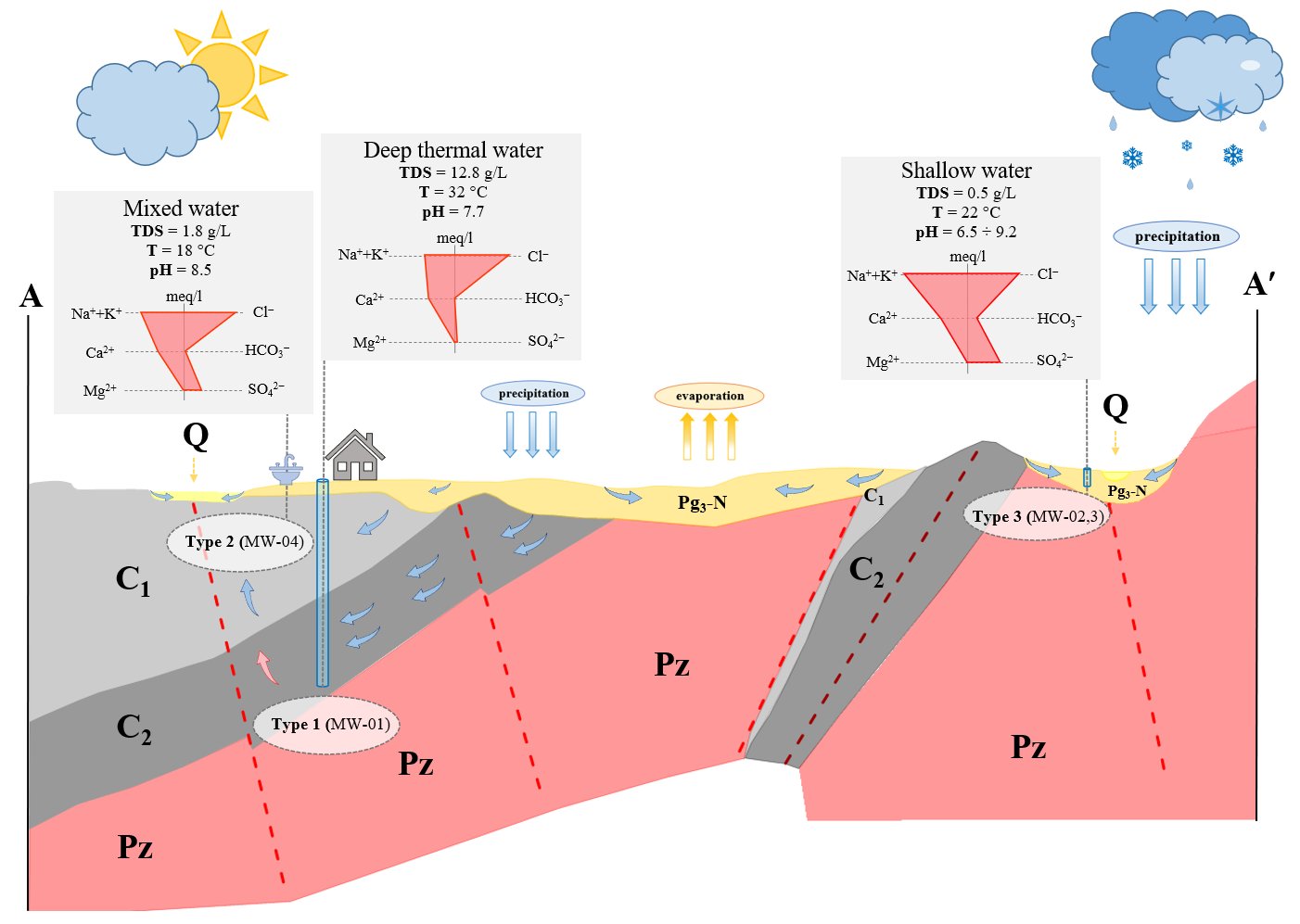
This article presents a comprehensive study of the nitrogen-radon thermal mineral waters of the Jety-Oguz area, located in the southeastern part of the Issyk-Kul intermountain artesian basin (Northern Tien Shan). Based on new data from chemical and isotopic (δ18O, δD) analyses of natural waters (lake, river, and mineral) and the chemical composition of the water-bearing rocks, we identify the formation mechanisms of mineral waters with diverse composition, total dissolved solids (TDS), and temperature. Three main genetic types have been identified: (1) saline, high-TDS (up to 12.8 g/L) chloride sodium-calcium thermal waters (up to 32 °C). These waters are of meteoric origin and circulate within Middle Carboniferous carbonate rocks, acquiring their unique composition at depths of up to 3.0 km, where reservoir temperatures reach ~105 °C; (2) chloride-sulfate sodium-calcium waters (0.5 g/L, fresh, 22 °C), formed in alluvial deposits within the zone of active water exchange; and (3) low-TDS (1.8 g/L, brackish) waters of mixed composition, resulting from the mixing of a deep fluid with infiltrating meteoric waters. Isotopic data confirm a meteoric origin for all studied waters, including the high-TDS thermal types. The chemical composition diversity is attributed to several processes: mixing between the deep, high-TDS fluid and low-TDS infiltration waters, intense dissolution of evaporite rocks, and water–rock interaction. These findings are crucial for understanding the genesis of mineral waters in the Tien Shan intermountain basins and provide a scientific basis for their sustainable balneological exploitation.
English abstract from the paper. The authors’ abstract, reproduced under CC BY 4.0.
Keywords
- thermal mineral waters
- chemical composition
- stable isotopes (δ18O; δD)
- intermountain artesian basins
- Jety-Oguz
- Issyk-Kul
- Northern Tien Shan
In plain English
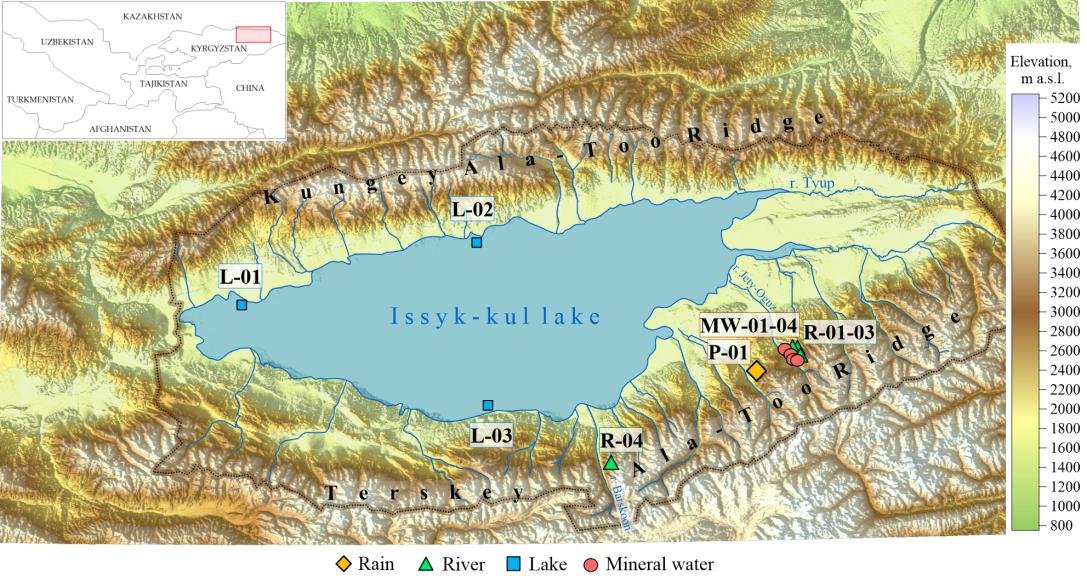
Ekaterina I. Baranovskaya and Natalia A. Kharitonova of the Faculty of Geology of Lomonosov Moscow State University, George A. Chelnokov of the Geological Institute of the Russian Academy of Sciences, Farid S. Salikhov of the Dushanbe branch of Lomonosov Moscow State University and Irina A. Tarasenko of the Far East Geological Institute study the nitrogen–radon thermal mineral waters of Jety-Oguz in the south-east of the Issyk-Kul intermountain artesian basin in Kyrgyzstan. The area lies at about 2,050 m, 25–30 km south of Lake Issyk-Kul and a similar distance from Karakol. The basin is filled with up to 5.0 km of Mesozoic–Cenozoic continental sediments over a folded Lower Palaeozoic basement. The waters discharge on the right bank of the Jety-Oguz River from fractured Middle Carboniferous limestones on the northern limb of the Jety-Oguz brachyanticline, whose core is made of Proterozoic schists and granites. A sanatorium uses them for baths and drinking cures.
In 2023–2024 the authors sampled four mineral waters (the resort well, two wells in alluvium and a spring), three lake, four river and one rain sample, and analysed major ions, trace elements, δ¹⁸O and δ²H, as well as five rock samples. The resort well (MW-01) gives sodium–calcium chloride water at 32.0 °C with 12.8 g/L of dissolved solids, 43.4 mg/L of strontium, 23.7 mg/L of silicon, 11.3 mg/L of boron, 5.5 mg/L of lithium and 1.6 mg/L of bromine; its Cl/Br ratio is 4,584. The two wells in alluvium give fresh chloride–sulphate sodium–calcium water at 22.0 °C (0.5 g/L), and the spring brackish water at 17.9 °C (1.8 g/L). The dissolved gas is 97–100% nitrogen. The mineral waters have δ¹⁸O of −13.4 to −10.8‰ and δ²H of −91.5 to −77.8‰ and plot on or near the global meteoric water line, so all of them are of meteoric origin; the three less saline waters are recharged mainly by high-altitude snowmelt.
For the resort water, the quartz geothermometer gives a reservoir temperature of 102.4 °C (Na–K 80.2 °C, K–Mg 67.0 °C, Mg–Li 80.3 °C, Na–K–Ca 160.2 °C). On the Giggenbach diagram this water lies near full equilibrium, and the authors put its formation temperature at about 105 °C. With a mean annual air temperature of 6 °C, a geothermal gradient of 32 °C/km and a neutral layer at 22 m, this means circulation to about 3.0 km; the spring water circulates to up to 2.0 km and the waters of the alluvium to up to 0.8 km. Mixing calculations with chloride and dissolved solids give the spring 8.5–10.6% of deep fluid. The deep water is undersaturated in halite, gypsum, anhydrite and celestine, which the authors read as ongoing dissolution of evaporites. Its strontium comes from foraminiferal limestone, and its lithium and boron from basement rocks with biotite and tourmaline.
The authors distinguish three types of water: deep thermal water of balneological value (the resort well), mixed water with potential as a drinking cure (the spring), and shallow fresh groundwater fit for domestic and farm supply. The Jety-Oguz springs are also among the mineral waters of northern Kyrgyzstan described by Dyushembieva and Baktyar kyzy (2026).
Figures (2)
How to cite
Ekaterina I. Baranovskaya, Natalia A. Kharitonova, George A. Chelnokov, Farid S. Salikhov and Irina A. Tarasenko (2025). Origin and Hydrogeochemical Evolution of Jety-Oguz Mineral Waters (Issyk-Kul Basin, Tien Shan). Water, vol. 18, no. 1, 75. https://doi.org/10.3390/w18010075