Journal articleFree to read
Thermal waters of Uzbekistan and prospects for their use
Термальные воды Узбекистана и перспективы их использования
- Institute of Hydrogeology and Engineering Geology (HYDROENGEO), Tashkent, Uzbekistan
Highlights
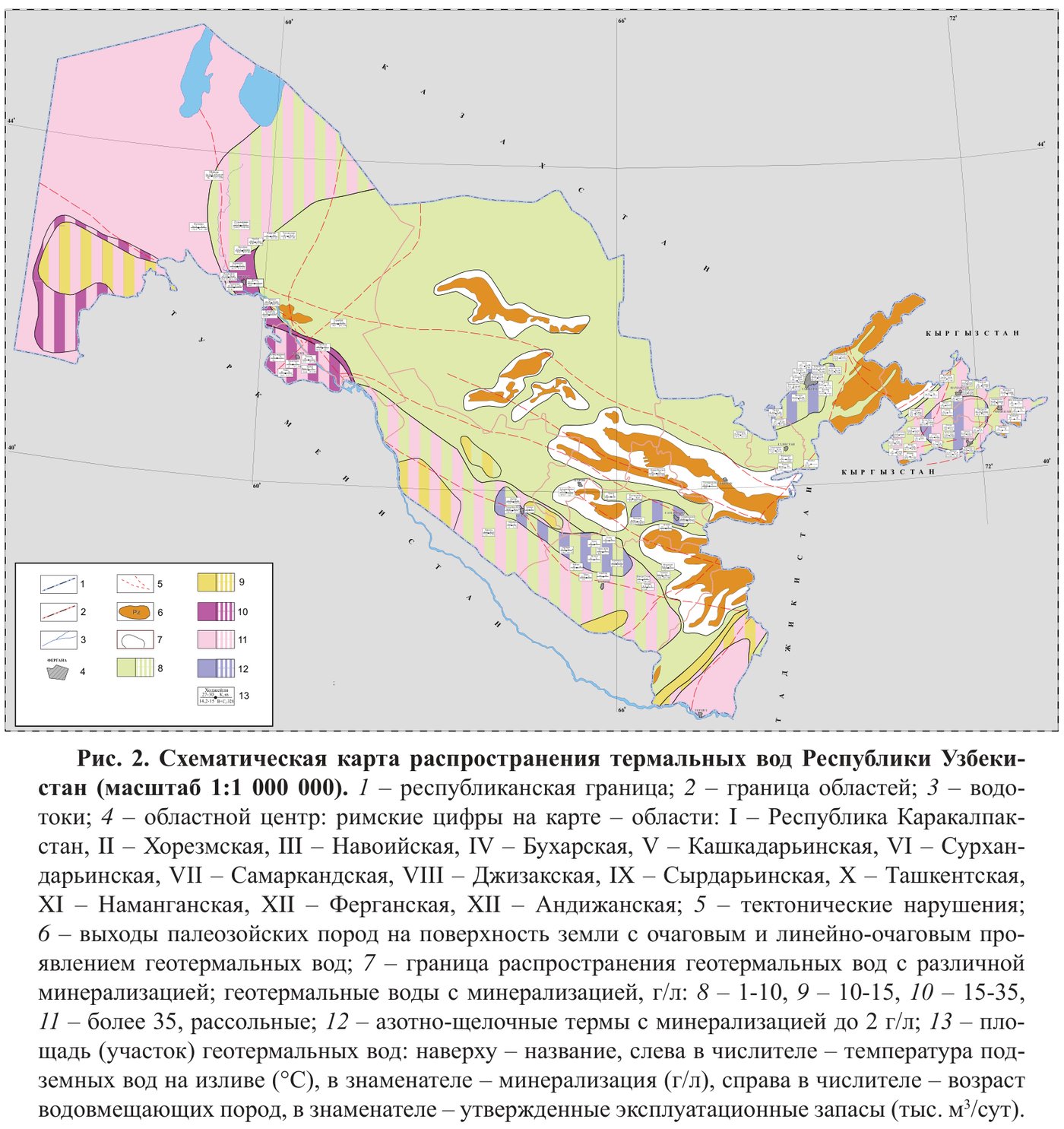
- Geothermal gradient in the upper crust away from major faults: 1.2–2 °C per 100 m; in intermontane depressions next to mountain ranges: 2–3.3 °C per 100 m.
- Pretashkent basin: Palaeogene water at 350–770 m in the Akhangaran valley, self-flowing at 0.1–23.5 L/s, 34–43 °C, up to 2 g/L; Upper Cretaceous water 34–45 °C at the margins and 65–70 °C in the centre, 0.6–1 g/L, bicarbonate–sodium.
- Palaeozoic limestones, wells 3-pr (Chirchik) and 8-pr (Kibray): self-flowing chloride–sodium water of up to 4 g/L, 20–40 L/s, 55 °C at the outflow.
- Fergana basin: temperature rises by 1.8–2.86 °C per 100 m in Upper Neogene beds, 1.54–2.86 °C in Cretaceous beds and 2.2–3.45 °C in Lower Neogene and Palaeogene beds; Massaget water at 450–1,000 m flows at 72 °C near Chartak.
- Zarafshan basin: up to 2 g/L; calculated temperatures on top of the complex 22–103 °C; Kattakurgan well 45 °C at 600 m, Ulus 25.4 °C at 142 m; flowing wells give 17 L/s.
- Surkhandarya basin (gradient 2.7 °C per 100 m): Alay-stage water 24.2–46 °C at the outflow; Upper Cretaceous water 37–45 °C in the centre and 11–18 °C at the margins; forecast formation temperatures 100–150 °C in the west and south-east.
- Bukhara–Karshi basin: formation temperature 60 °C near Gijduvan; 92 °C at the outflow from Upper Jurassic beds at 2,950 m at Umid; 100–150 °C in the south-east of the Chardzhou step.
- Hottest thermal-water areas on the map (temperature at the outflow): Kuuksaray 88 °C (0.9 g/L), Gurtepa 81 °C, Mubarek 38–78 °C, Zangiota 75.1 °C.
Abstract
The article discusses the resources of thermal waters of Uzbekistan. The zones of thermal water distribution are highlighted. The resource potentials of thermomineral waters for individual structures are estimated. The scheme of complex using of thermomineral waters is given based on the study of world experience.
English abstract from the journal issue PDF. The authors’ abstract, reproduced under .
In plain English
Thermal waters, here groundwater at 20 °C or more, occur across Uzbekistan in the zone of recent mountain building, and almost everywhere they are also mineral waters. Away from major faults, the geothermal gradient in the upper crust is 1.2–2 °C per 100 m. Intermontane depressions next to mountain ranges reach 2–3.3 °C per 100 m, although cold recharge from the mountains lowers it. Warmer zones follow large revived Hercynian and Alpine faults, such as the Talas–Fergana, North Tien Shan, North Fergana and South Fergana faults, along which moving groundwater carries heat up from depth. The authors count water above 50 °C as having energy value and state that the country has large reserves of it.
In the Pretashkent artesian basin, the first thermal complex from the surface is the Palaeogene: in the Akhangaran valley it lies at 350–770 m and gives self-flowing water at 34–43 °C with no more than 2 g/L. Pressurised Upper Cretaceous water is 34–45 °C in wells at the edge of the basin and 65–70 °C in its deepest central part, and the gradient points to 80 °C where the beds sink furthest. Palaeozoic limestones at Chirchik and Kibray give self-flowing chloride–sodium water at 55 °C. In the Fergana basin, the Bactrian and Massaget strata of the Neogene and the Palaeogene beds are the most promising; Massaget water near Chartak, close to Namangan, flows at 72 °C. In the Central Kyzylkum basins, Upper Cretaceous sands and sandstones at 300–700 m hold water of 30–50 °C, warmed by hot water rising along faults.
The Zarafshan basin is little studied; calculated temperatures on top of its Palaeogene and Upper Cretaceous complex range from 22 to 103 °C with depth. The Surkhandarya basin is studied even less, and its deep temperatures are calculated from a gradient of 2.7 °C per 100 m: formation temperatures reach 100–150 °C in the west and south-east, while Upper Cretaceous water flows at 37–45 °C in the centre. In the Syrdarya basin, Upper Cretaceous water is 30–45 °C at the wellhead and may reach 50–60 °C along faults and 80–90 °C at the contact with the Palaeozoic. In the Bukhara–Karshi (Amu Darya) basin, Jurassic water warms steadily with depth: a well at Umid gave 92 °C water from Upper Jurassic beds at 2,950 m, and the south-east of the Chardzhou step reaches 100–150 °C. In the South Aral basin, water in the Cretaceous beds and near regional faults has a calculated temperature of 45–70 °C.
Today thermal mineral water is used mainly for treatment, in more than 50 sanatoriums and over 40 physiotherapy clinics. Heating and hot water for buildings need at least 50–60 °C, and the authors favour using the water in sequence: first for heating, then for baths once it has cooled to 37–38 °C in a heat exchanger, and for greenhouses, fish farming and warm irrigation. Most deposits are run at a low level and discharge water still hot enough for other uses, so each deposit needs its own technological scheme. Water above 80–100 °C with 30–50 g/L or more may clog the pipes that carry the heat; small power plants of up to 50 kW are proposed for study.
Figures (1)
How to cite
S. A. Bakiev, A. S. Ibragimov, T. I. Mumindzhanov, B. Zh. Ismailov and T. A. Gafurov (2022). Thermal waters of Uzbekistan and prospects for their use. Geologiya i mineral'nye resursy (Geology and Mineral Resources), No. 6, 2022, pp. 95–101. https://mridm.uz/en/assets/journal/pdf/6_2022.pdf