Journal articleOpen access
Horizontal well-assisted depressurization method for geothermal exploitation from fractured granite reservoir at Yangbajing geothermal field
https://doi.org/10.1038/s41598-025-34604-0
Highlights
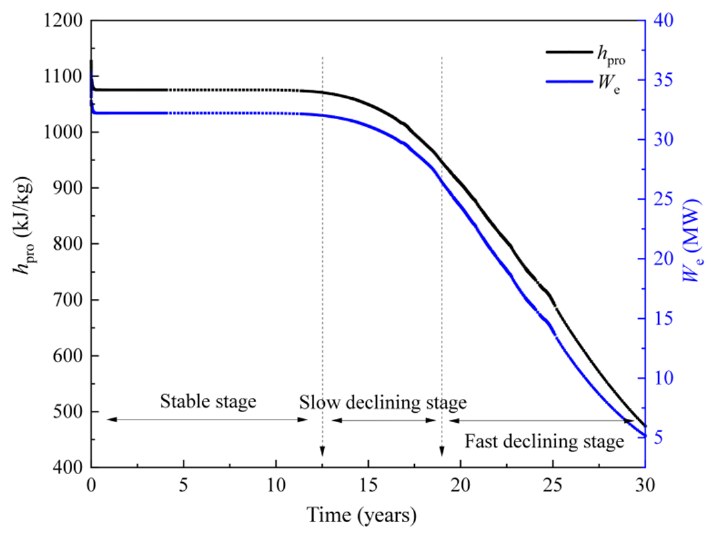
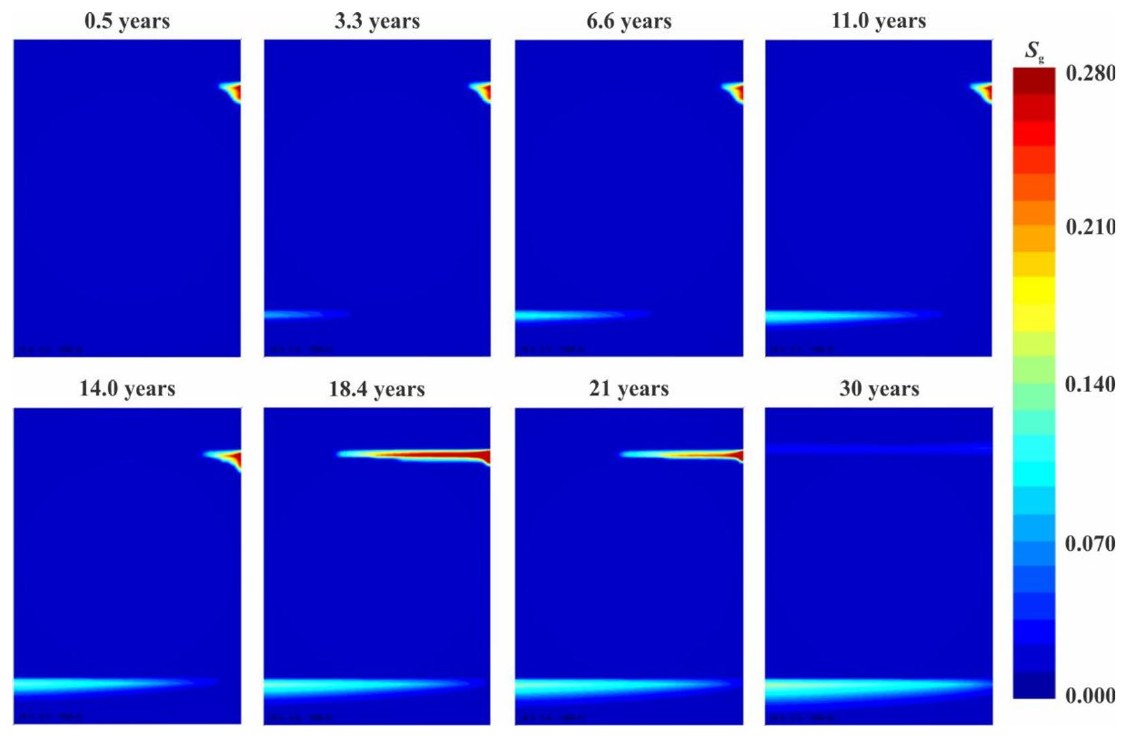
- Production temperature stays at 230 °C, with a steam saturation of 0.28, for the first 12.5 years.
- Over a 20.6-year lifespan: 32.28–23.12 MW of electric power, against 1.14–1.83 MW of pump power.
- About 4,820 GWh of net electricity over 20.6 years, after the system’s own use.
- Estimated levelised cost of $0.0137 per kWh, against an industrial electricity price of $0.09 per kWh in Tibet in 2022.
- Estimated greenhouse gas reduction of 1.63–5.63 million tonnes.
Abstract
Utilizing the geological information obtained from the ZK4001 borehole of Yangbajing geothermal field, a horizontal well system with depressurization method was proposed to achieve heat production from fractured granite reservoir. Numerical simulations under the assumed geological and operational conditions were conducted to investigate the geothermal exploitation performance, the power generation potential and its dependent factors. Assessment indicates that within a reservoir spanning depths of 950–1350 m and maintaining an average temperature of 248 °C, at a production pressure of 2.5 MPa, the production temperature remains stable at 230 °C with a steam saturation of 0.28 for 12.5 years, subsequently experiencing a decline. Over a lifespan of 20.6 years, the fundamental horizontal well system achieves an electric power of 32.28–23.12 MW, exhibits a reservoir impedance of 0.072–0.096 MPa/(kg/s), requires a pump power of 1.14–1.83 MW, and demonstrates an energy efficiency of 28.87–12.65, suggesting favorable geothermal exploitation performance under the modeled conditions. The estimated reduction in greenhouse gas emissions amounts to 1.63–5.63 Mt. Sensitivity analysis indicates that, for the geothermal exploitation by the depressurization method, the production pressure has a significant impact on geothermal exploitation performance. Enhancing the permeability of the reservoir can effectively decrease flow impedance, minimize internal energy consumption, and result in improved energy efficiency. Moreover, adjusting the injection flow rate within a specific range can enhance the system’s energy efficiency.
The authors’ abstract, reproduced under CC BY-NC-ND 4.0.
Keywords
- Yangbajing geothermal field
- Horizontal well
- Depressurization method
- Fractured granite reservoir
- Geothermal exploitation
In plain English
Yangbajing, about 90 km northwest of Lhasa, is China’s first high-temperature hydrothermal geothermal field. Using data from borehole ZK4001, the authors model a fractured granite reservoir at 950–1350 m depth with an average temperature of 248 °C.
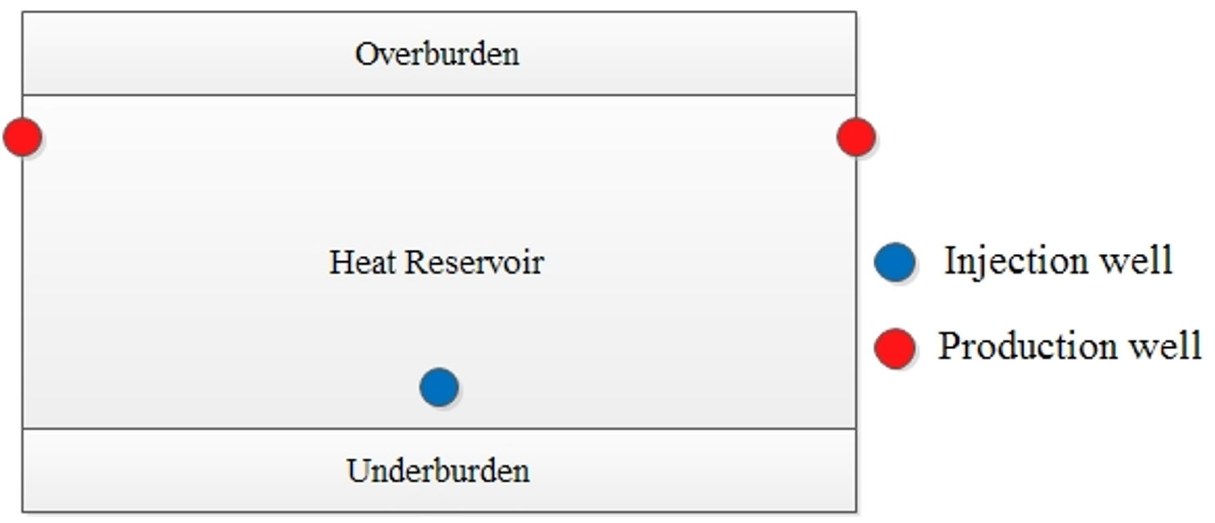
Cold water is injected through one horizontal well near the bottom of the reservoir, and two horizontal wells near the top produce hot fluid. The production wells are held at a low pressure (2.5 MPa) so that the reservoir yields a mix of steam and water, the “depressurization method”. The fluid feeds a double-flash power plant.
The model covers heat and fluid flow only; rock deformation, fracture changes and chemical effects are not included, and the authors note that the results are specific to the modelled conditions.
Figures (3)
How to cite
Yuchao Zeng, Lixing Ding, Nengyou Wu, Xiangyang Shen, Yan Sun, Elbek Ochilov, Lihua Huang, Qixiu Li and Haizhen Zhai (2026). Horizontal well-assisted depressurization method for geothermal exploitation from fractured granite reservoir at Yangbajing geothermal field. Scientific Reports, 16, 4558. https://doi.org/10.1038/s41598-025-34604-0
In our news
 Study co-authored by an Uzbek researcher models 32 MW of geothermal power from Tibet’s Yangbajing field3 February 2026