Journal articleOpen access
Studies of the element composition of the hydrothermal underground salt water of the Kattakum-2 well of the Haudag deposit
Изучение элементного состава гидротермальных подземных соленых вод скважины «Каттакум-2» месторождения Хаудаг
- Termez State University, Termez, Uzbekistan
Highlights
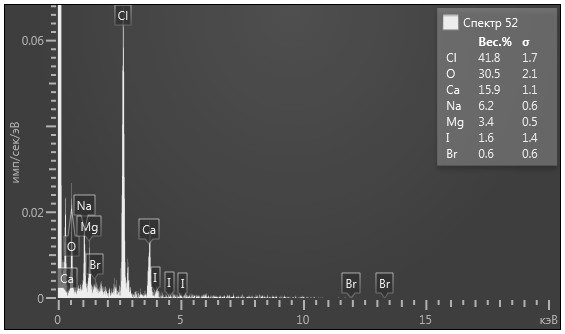
- Salt from dried Kattakum-2 water (SEM-EDX, spectrum 52), % by weight: chlorine 41.79, oxygen 30.52, calcium 15.86, sodium 6.23, magnesium 3.38, iodine 1.61, bromine 0.61.
- Waters of the Khaudag area: iodine 17.4–24.43 mg/L, bromine 313.2–426.4 mg/L, pH 5.1–6.8, 39–76 °C, mineralisation 113.0–283.0 g/L.
- Urtabulak hydrothermal water: 113.1 g/L, pH 6.8, 45 °C, iodine 24.43 mg/L, bromine 376.24 mg/L.
- Khaudag hydrothermal water: 219.7 g/L, pH 5.2–5.6, 72–76 °C, iodine 21.32 mg/L, bromine 414.99 mg/L.
- World iodine production in 2011 (preliminary): 29,000 t, of which Chile 18,000 t and Japan 9,800 t; Uzbekistan 2 t a year in 2007–2011.
Abstract
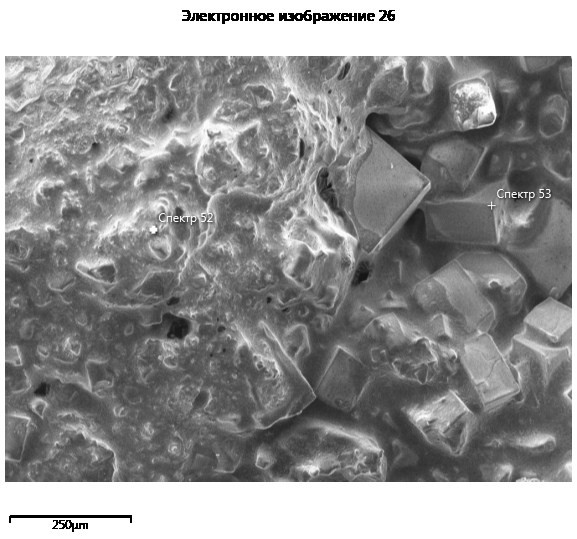
The elemental composition of the hydrothermal underground salt water of the Kattakum-2 well in the Khudag field was carried out using a SEM scanning electron microscope (scannedelectron EVO MA 10), and the film compositions were determined using an EDX energy-dispersive element analyzer (Oxford Instrument).
English abstract from the paper. The authors’ abstract, reproduced under CC BY 4.0.
Keywords
- iodine
- bromine
- iodine-containing water
- deposits
- salt water
In plain English
The authors see underground hydrothermal water as the main source from which Uzbekistan could produce iodine on an industrial scale. In 2011, by preliminary figures, the world produced 29,000 tonnes of iodine, 18,000 tonnes of it in Chile and 9,800 tonnes in Japan; Uzbekistan produced 2 tonnes a year in 2007–2011.
Among the industrial hydrothermal waters of Surkhandarya region assessed in 1998–2017, water at Kokayty has 142.9 g/L at 39 °C, with 14.8 mg/L of iodine and 265.93 mg/L of bromine; at Khaudag, 219.7 g/L at 72–76 °C, with 21.32 and 414.99 mg/L; at Uchkyzyl, 319.9 g/L at 40 °C, with 20.7 and 470.09 mg/L; and at Urtabulak, 113.1 g/L at 45 °C and pH 6.8, with 24.43 and 376.24 mg/L. Associated oil-field water has 136.5 g/L at 40 °C at Kokayty and 178.6 g/L at 27 °C at Khaudag. In the waters of the Khaudag area, iodine ranges from 17.4 to 24.43 mg/L and bromine from 313.2 to 426.4 mg/L, at pH 5.1–6.8, 39–76 °C and 113.0–283.0 g/L, depending on the field. Most of these figures also appear in an earlier paper by the same authors.
Salt from the dried water of the Kattakum-2 well was examined with an EVO MA 10 scanning electron microscope, and its composition measured with an Oxford Instruments energy-dispersive analyser. Spectrum 52 gave, by weight, 41.79% chlorine, 30.52% oxygen, 15.86% calcium, 6.23% sodium, 3.38% magnesium, 1.61% iodine and 0.61% bromine. From their measurements over many years, the authors conclude that by iodine content and reserves the waters are well suited to industrial iodine extraction, and they propose studying the forms in which iodine occurs in them, to find cheap ways of extracting it.
Figures (2)
How to cite
I. A. Umbarov and H. Kh. Turaev (2019). Studies of the element composition of the hydrothermal underground salt water of the Kattakum-2 well of the Haudag deposit. Universum: khimiya i biologiya (Universum: Chemistry and Biology), 2019, No. 9 (63), pp. 9–12. https://7universum.com/ru/nature/archive/item/7758