Conference paperOpen access
Development of the renewable geothermal energy in Uzbekistan (as an example – the Muruntau area)
https://doi.org/10.1088/1755-1315/1212/1/012001
Highlights
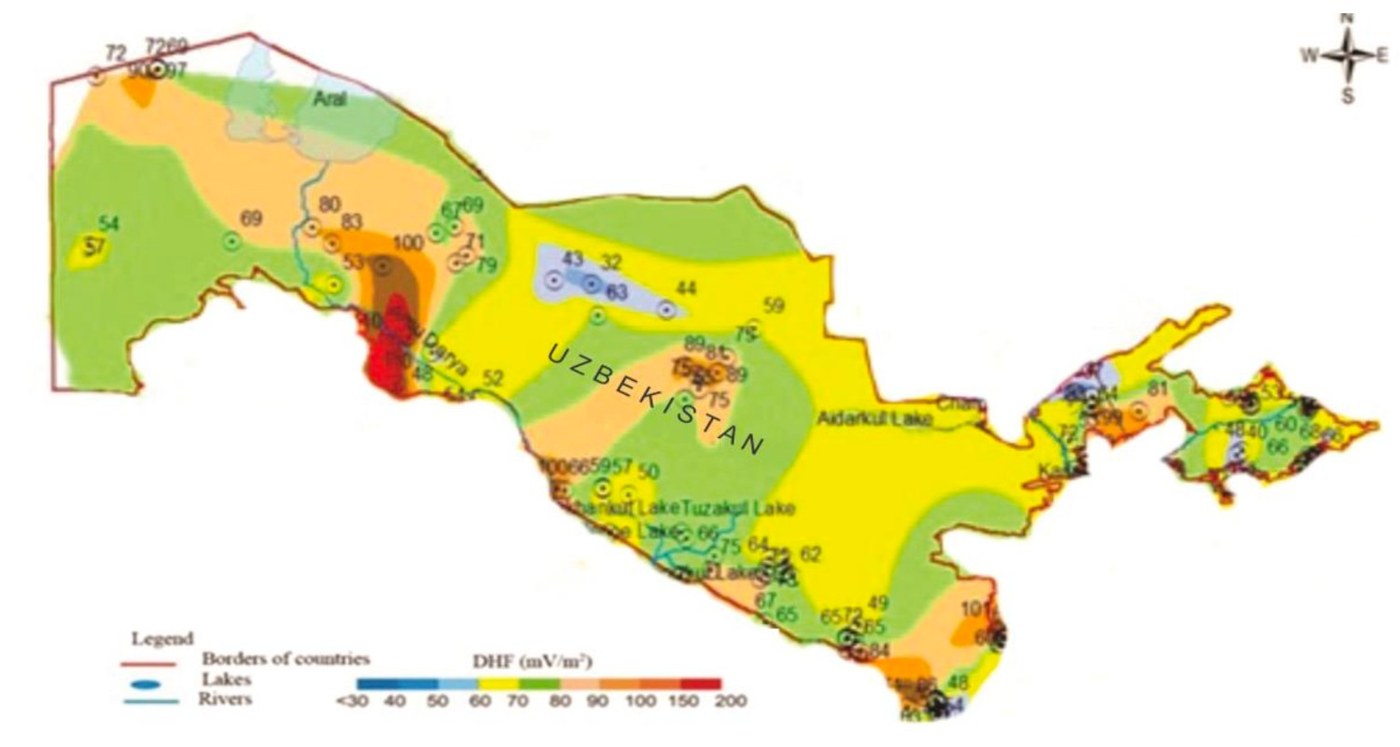
- Heat flow density measured in the Muruntau area: 89 mW/m².
- Methods combined: gravity, seismic and magnetotelluric surveys.
Abstract
This paper presents a Multidisciplinary geophysical study of the geothermal areas in Uzbekistan. Based on the developed new geothermal map, data on anomalous geothermal areas were analyzed. Based on the study of the Muruntau area, a comprehensive methodology has been developed for detailing geothermal anomalies. New data of integrated geophysical surveys (gravity survey, seismic survey, magnetotelluric survey) and their interpretation at the stage of geophysical exploration are presented.
The authors’ abstract, reproduced under CC BY 3.0.
In plain English
Using a new geothermal map of Uzbekistan, the authors analyse the country’s anomalous geothermal areas. Taking the Muruntau area as their example, they develop a method for detailing geothermal anomalies with gravity, seismic and magnetotelluric surveys.
Plans for Muruntau include a geothermal station that would supply electricity and heat to a new settlement needed as the gold quarry expands.
Figures (1)
How to cite
I. P. Sidorova, R. I. Saxobidinov and E. A. Golovko (2023). Development of the renewable geothermal energy in Uzbekistan (as an example – the Muruntau area). IOP Conference Series: Earth and Environmental Science, 1212, 012001. https://doi.org/10.1088/1755-1315/1212/1/012001
In our news
 A method for pinpointing geothermal anomalies, tested at Muruntau1 July 2023