Journal articleFree to read
Prospects for searching for natural hydrogen deposits in the territory of the Republic of Uzbekistan
Перспективы поиска залежей природного водорода на территории Республики Узбекистан
- Institute of Geology and Exploration of Oil and Gas Fields (IGIRNIGM), Tashkent, Uzbekistan
Highlights
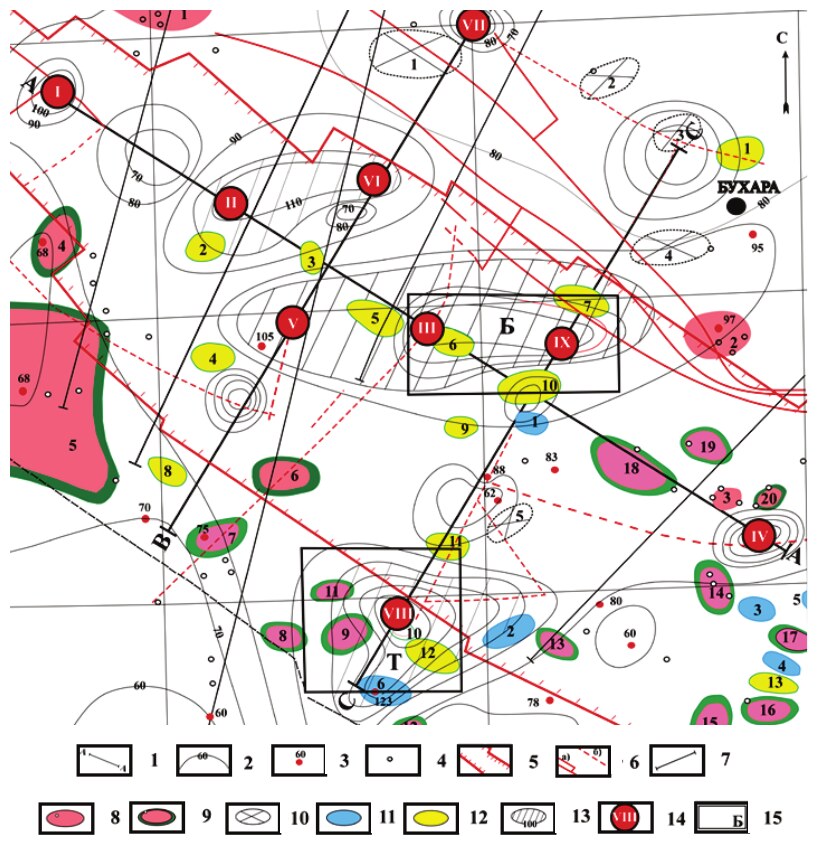
- Heat-flow isolines on the map: 60–110 mW/m²; point values 60–105 mW/m².
- Areas of anomalously high heat flow: more than 100 mW/m².
- Nine channels of deep heat and mass transfer in the western Bukhara–Khiva palaeorift.
- 2006–2008 thermobarogeochemical survey, Beshtepa–Chukurkul area: 54 points plus 10 control points, 2 m holes, one point per 4 km², 472 gas determinations.
- Hydrogen in the gas of tested wells in Bukhara–Khiva fields: 0.036–14.7% (highest at Yangi Karatepa well 9, 3,577–3,583 m).
Keywords
- heat flow
- geothermal survey
- natural hydrogen
- Bukhara–Khiva palaeorift
- deep heat and mass transfer
- Beshtepa
Summary
The authors, of the Institute of Geology and Exploration of Oil and Gas Fields (IGIRNIGM), review natural hydrogen as an energy source, the geological settings where it is found, and hydrogen in the gases of oil and gas fields of the Bukhara–Khiva region, where its share in tested intervals reaches 14.7%.
In 2006–2008 IGIRNIGM mapped geothermal and gas-chemical anomalies to pick out anomalous thermobarogeochemical zones in the Beshtepa–Chukurkul area of the Bukhara–Khiva oil and gas region. The field survey measured temperature and sampled gas from 2 m holes at 54 points, with 10 control points, one point per 4 km², and made 472 gas determinations. It found two anomalous zones, West Beshtepa and Beshtepa, which the authors link to channels of deep heat and mass transfer.
The paper's map, after Abidov, Dolgopolov and Kamalkhodzhaeva (2007), shows regional geothermal survey profiles, heat-flow isolines and measurement points, the boundaries of the Bukhara–Khiva palaeorift, areas of anomalously high heat flow (more than 100 mW/m²) and nine deep heat-and-mass-transfer channels: Tashkuduk, Guzhayli, West Beshtepa, West Kokchi, South Guzhayli, Muradkuduk, Atbakar, Tegermen and Beshtepa. The authors propose searching for hydrogen in oil and gas, ore and coal regions.
Figures (1)
How to cite
T. Kh. Shoimurotov and O. A. Karshiev (2025). Prospects for searching for natural hydrogen deposits in the territory of the Republic of Uzbekistan. Geologiya fanlari universiteti xabarlari (Bulletin of the University of Geological Sciences), No. 3, 2025, pp. 19–26. https://files.uzgeouniver.uz/media/files/%D0%92%D0%B5%D1%81%D1%82%D0%BD%D0%B8%D0%BA_3_2025.pdf