Journal articleOpen access
Dushanbe Artesian Basin: Opportunities for Ground Source Heat Pump (GSHP) Deployment
https://doi.org/10.5188/ijsmer.689
Highlights
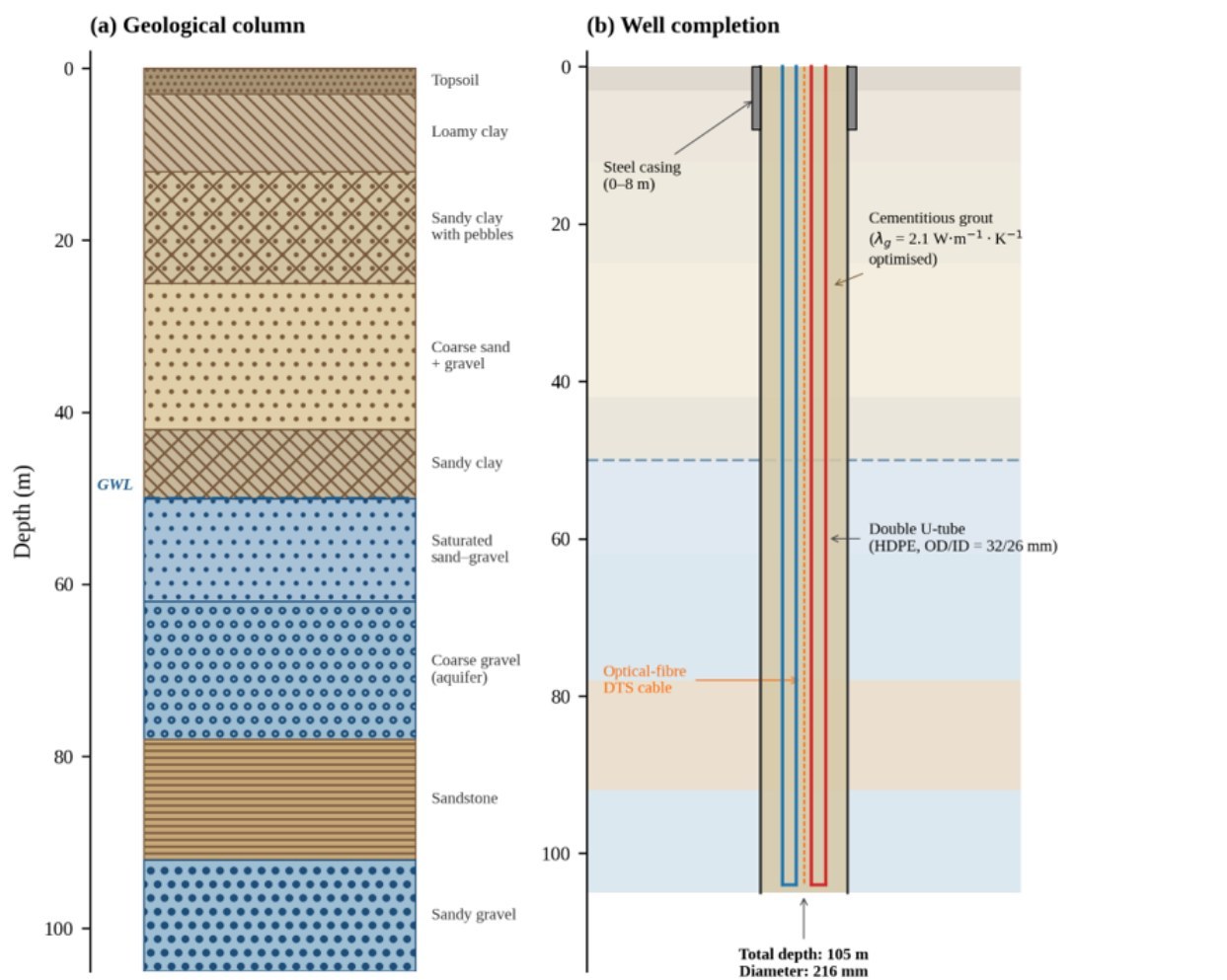
- Pilot installation: two vertical boreholes, 105 m deep, 216 mm in diameter, 5 m apart; double U-tube with 102 m active length.
- Thermal response test: 48 h heating with a 3.87 kW heater at 19.9 L/min, then 48 h recovery; injected heat fell from 6.25 kW to 3.74 kW.
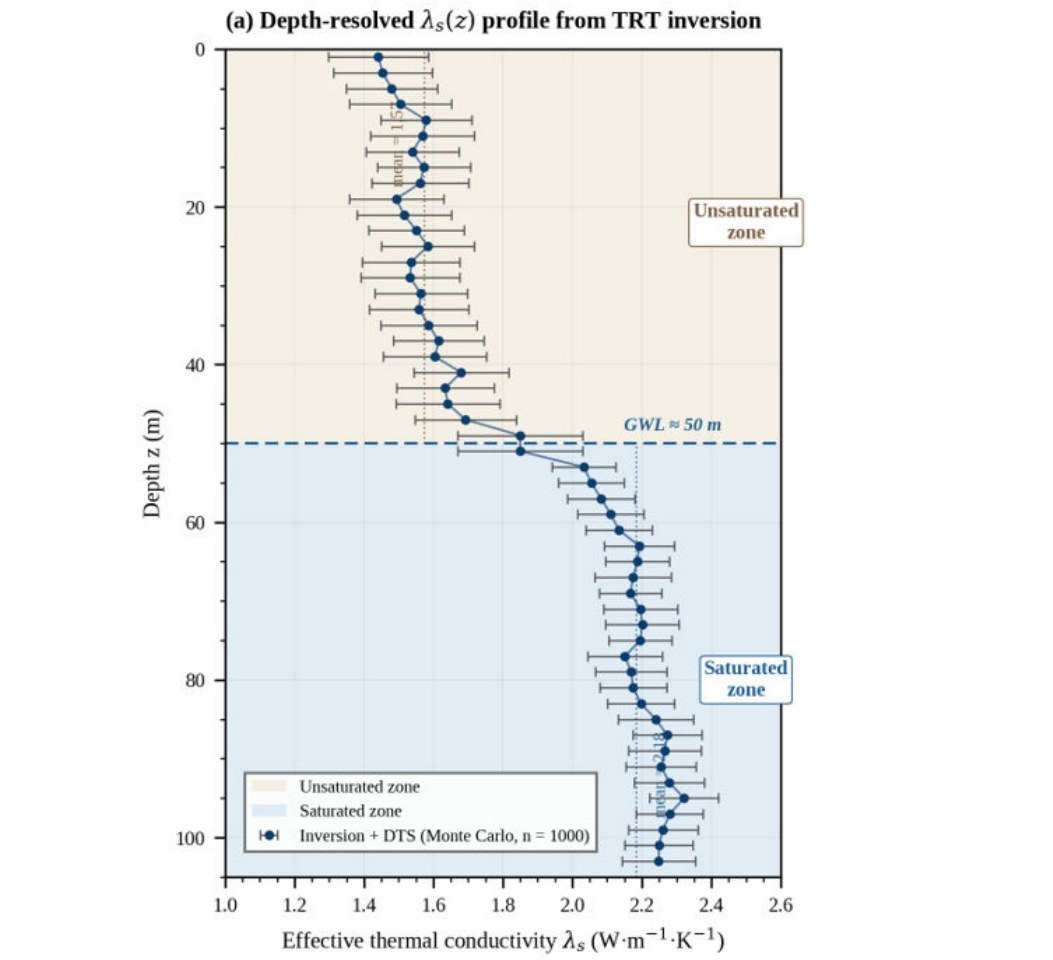
- Effective ground thermal conductivity about 1.9 W/(m·K) (95% CI 1.71–2.04); unsaturated zone (0–50 m) 1.4–1.7, saturated zone (50–105 m) 2.0–2.4 W/(m·K).
- Undisturbed ground temperature about 16.5 °C; water table at about 50 m.
- 95 groundwater samples (2022–2024): pH 7.1–7.6, Eh about 400–500 mV, bicarbonate 3.5–8.0 mmol/L; scaling risk where EC exceeds 1,500 µS/cm and bicarbonate exceeds 6 mmol/L.
- Quartz-enhanced grout (CEM I 42.5R with 40 wt% quartz): grout conductivity 2.1 W/(m·K); borehole thermal resistance down from 0.177 to 0.090 m·K/W (measured 0.105 m·K/W).
- Heat-transfer gain from the grout: 26% after one month, about 20% after one year, 16% after ten years.
- Borehole-wall cooling after 30 years: −0.01 °C with balanced load; −3.44 °C (single borehole) and −4.63 °C (two boreholes 5 m apart) with a 30% heating deficit; −0.93 °C with 80% solar-assisted recharge.
Abstract
This study evaluates the shallow-geothermal potential of the Dushanbe Artesian Basin (DAB) for ground source heat pump (GSHP) deployment. One of the two 105 m vertical boreholes of a pilot installation was instrumented with a double U-tube and optical-fibre distributed temperature sensing (DTS) and tested by a single thermal response test (TRT); 95 groundwater samples (2022–2024) provided basin-wide hydrochemical characterisation. Analytical inversion of the TRT data, with Monte Carlo uncertainty quantification (1000 realisations, percentile confidence intervals), yielded an average effective ground thermal conductivity λ̄ ≈ 1.9 W·m⁻¹·K⁻¹ (95 % CI 1.71–2.04) and a depth-dependent contrast between the unsaturated (1.4–1.7 W·m⁻¹·K⁻¹) and saturated (2.0–2.4 W·m⁻¹·K⁻¹) zones, with a stable undisturbed temperature near 16.5 °C. Hydrochemical analysis identifies scaling and corrosion risks for open-loop and semi-open-loop configurations but confirms that closed-loop circuits are unaffected. First-order multipole calculations for the as-built double U-tube show that an optimised quartz-enhanced grout (CEM I 42.5R + 40 wt% quartz, λg = 2.1 W·m⁻¹·K⁻¹) reduces the borehole thermal resistance Rb from 0.177 to 0.090 m·K·W⁻¹. At a fixed fluid-to-ground temperature difference this raises the specific heat-transfer rate by ≈ 20 % after one year of continuous operation (26 % at one month, 16 % at ten years), in either heat-extraction or heat-injection mode. The work provides a reproducible interpretation framework and engineering recommendations for GSHP deployment in arid, lithologically heterogeneous basins.
English abstract from the paper. The authors’ abstract, reproduced under CC BY-NC-ND 4.0.
Keywords
- ground source heat pump (GSHP)
- thermal response test (TRT)
- shallow geothermal energy
- hydrochemistry
- Dushanbe Basin
- borehole thermal resistance
In plain English
The authors assess the shallow geothermal potential of the Dushanbe Artesian Basin in the Gissar Valley for ground-source heat pumps. A pilot installation at their centre in Dushanbe has two vertical boreholes, 105 m deep and 5 m apart, each with a double U-tube of plastic (HDPE) pipe. One borehole, drilled through clays, sandy gravels and sandstones of the valley’s Quaternary alluvial–proluvial deposits, was fitted with a fibre-optic temperature cable and tested with a 48-hour thermal response test and 48 hours of recovery. The authors also analysed 95 groundwater samples taken across the basin in 2022–2024.
The ground conducts heat at about 1.9 W/(m·K) on average. The dry upper 50 m conduct less heat than the water-saturated sediments below the water table at about 50 m. The undisturbed ground temperature is stable near 16.5 °C. The groundwater is neutral, oxidising, hard and rich in bicarbonate, so systems that pump groundwater through the heat exchanger (open-loop and semi-open-loop) face scaling and corrosion. Closed loops, where the fluid stays in sealed pipes, are not affected directly.
Replacing plain cement grout with cement containing 40% quartz raises the grout’s conductivity from 0.8 to 2.1 W/(m·K) and halves the borehole’s thermal resistance. At the same temperature difference, a borehole then moves about 20% more heat after one year of operation. The pilot borehole was completed with this grout.
Thirty-year models show no long-term cooling of the ground when winter heat extraction is balanced by summer cooling. With heating 30% larger than cooling, the borehole wall cools by more than the 3 °C the authors accept, especially with two boreholes 5 m apart; solar-assisted recharge of 80% of the imbalance keeps the change below 1 °C. The authors conclude that closed-loop heat pumps are technically viable in the central part of the basin, and that basin-wide figures need tests at more sites.
Figures (2)
How to cite
Jamshed Sh. Rahmatov, Mamadsho Ilolov, Fumiaki Inagaki and Sabur Rasulov (2026). Dushanbe Artesian Basin: Opportunities for Ground Source Heat Pump (GSHP) Deployment. International Journal of the Society of Materials Engineering for Resources, advance online publication, article 689. https://doi.org/10.5188/ijsmer.689