Journal articleOpen access
Method of extraction deposition of crystalline iodine from reservoir waters of the Umid oil field
Метод экстракционного осаждения кристаллического йода из пластовых вод нефтяного месторождения «Умид»
- Department of Chemical Technology, Navoi State University of Mining and Technologies, Navoi, Uzbekistan
https://doi.org/10.32743/UniTech.2024.125.8.18078
Highlights
- Untreated formation water, Umid field: pH 7.9; chloride 51,975 mg/dm³; sodium 21,997 mg/dm³; calcium 3,607 mg/dm³; potassium 685.7 mg/dm³; magnesium 668.8 mg/dm³; total hardness 234.8 mmol/dm³.
- Bromide 411.0 mg/dm³; sulphate 410.0 mg/dm³; bicarbonate 61.00 mg/dm³; iodide 36.2 mg/dm³; cobalt 6.08 mg/dm³; nickel 4.10 mg/dm³; iron under 0.05 mg/dm³.
- After lime–soda softening: pH 11; calcium 35.0 mg/dm³; magnesium 2.0 mg/dm³; sulphate 235.5 mg/dm³; iodide 34.7 mg/dm³; total hardness 1.98 mmol/dm³.
- Iodine yield with benzene (untreated / softened water): sulphuric acid 45.7% / 64.2%; sodium hypochlorite 69.4% / 78.1%; sodium nitrite 88.0% / 96.0%; hydrogen peroxide 92.0% / 98.0%.
- Best conditions: oxidant 2%; oxidant-to-water volume ratio 0.12 (yield 97.9%); organic-to-water phase ratio 0.02; sodium sulphite 0.15 M.
- Iodide concentrated 30 times, from 34.7 mg/L to 1.12 g/L; iodine precipitates with 20% hydrogen peroxide from 3 g/L of iodide.
Abstract
This article is based on the isolation of iodine from the reservoir waters of the Umid oil and gas condensate field in the Bukhara-Karshi Artesian basin of the Republic of Uzbekistan, by chemical oxidation and extraction with an organic solvent. The extraction method compared the iodine yield in purified and untreated groundwater samples, studied the ratio of the aqueous phase and the solvent phase during extraction, as well as the ratio of refined and reducing solution. In addition, the processes of precipitation of iodine and reduced from raffinate and enriched to a solid state are highlighted. X-rays of the iodine obtained were taken and analyzed. According to the results of the experiment, a technology for extracting iodine was proposed.
English abstract from the paper. The authors’ abstract, reproduced under CC BY 4.0.
Keywords
- hydrothermal waters
- crystalline iodine
- extraction
- organic solvent
- oxidiser
- reducing agent
In plain English
The authors study formation water of the Umid oil and gas condensate field, in the Bukhara–Karshi artesian basin in Kashkadarya region, as a source of iodine, which it holds as iodide. Untreated, the water has pH 7.9 and contains 51,975 mg/dm³ of chloride, 21,997 mg/dm³ of sodium, 3,607 mg/dm³ of calcium, 685.7 mg/dm³ of potassium, 668.8 mg/dm³ of magnesium, 411.0 mg/dm³ of bromide, 410.0 mg/dm³ of sulphate, 61.00 mg/dm³ of bicarbonate and 36.2 mg/dm³ of iodide, with 6.08 mg/dm³ of cobalt and 4.10 mg/dm³ of nickel; total hardness is 234.8 mmol/dm³. Softening by the lime–soda method raises the pH to 11 and lowers calcium to 35.0 mg/dm³, magnesium to 2.0 mg/dm³, sulphate to 235.5 mg/dm³ and hardness to 1.98 mmol/dm³, while chloride, sodium, bromide and iodide change little.
Iodide is oxidised to molecular iodine, which passes into an organic solvent. Of four solvents tested (tetrachloromethane, trichloromethane, cyclohexane and benzene), benzene gave the highest yields. With benzene, the yield rose from sulphuric acid (45.7% in untreated and 64.2% in softened water) through sodium hypochlorite and sodium nitrite to hydrogen peroxide (92.0% and 98.0%). The best conditions were a 2% oxidant solution, an oxidant-to-water volume ratio of 0.12 (yield 97.9%), an organic-to-water phase ratio of 0.02 and 0.15 M sodium sulphite to take the iodine back into water; over eight extraction cycles the mean yield was 94%.
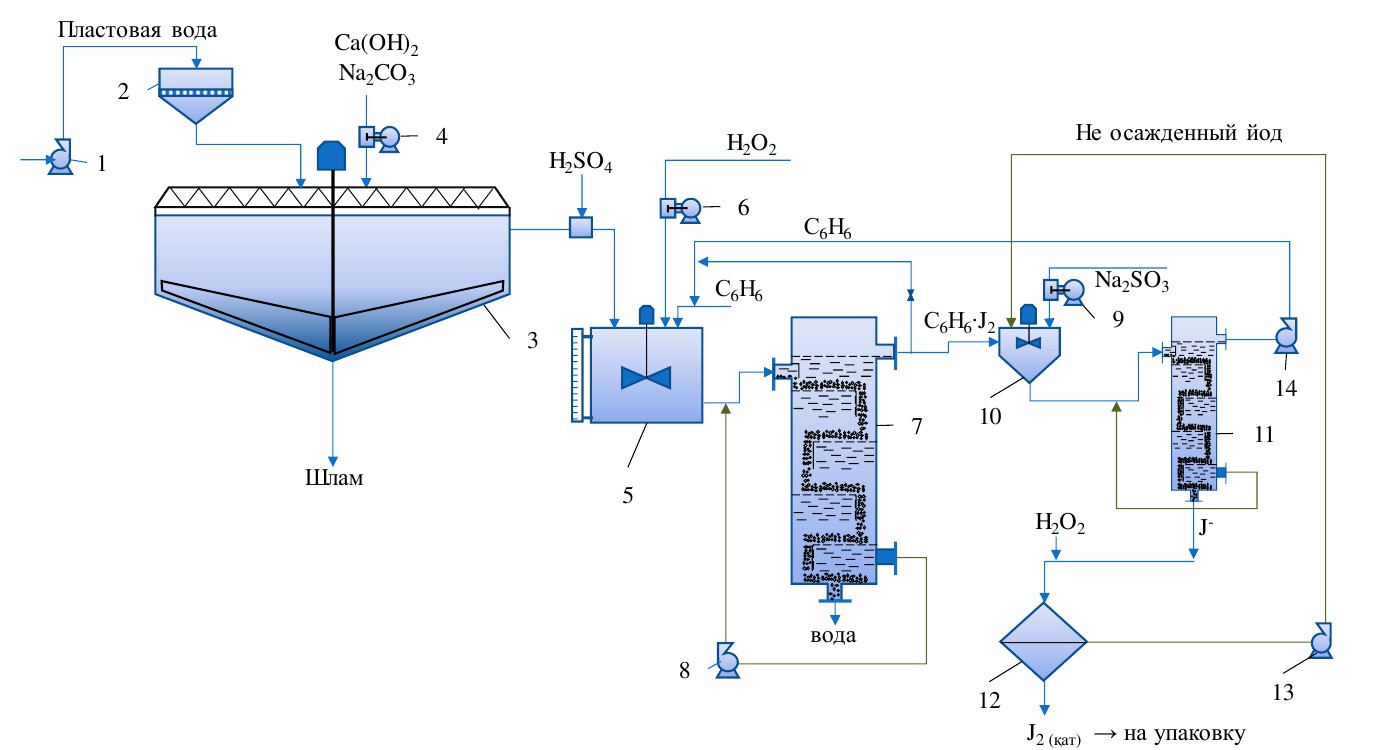
This raised the iodide concentration 30 times, from 34.7 mg/L in the softened water to 1.12 g/L; solid iodine precipitates with 20% hydrogen peroxide once iodide reaches 3 g/L, and X-ray diffraction confirmed the product as iodine. On these results the authors base a process (Figure 8): the water is filtered, softened in a settling tank with 0.4 L of 8% calcium hydroxide solution and 0.04 L of 0.1% polyacrylamide flocculant per litre, acidified with 5% sulphuric acid, mixed with hydrogen peroxide and benzene and separated in an extractor; the iodine is then reduced into sodium sulphite solution, the benzene goes back to the mixer, and crystalline iodine is taken from a separator.
Figures (1)
How to cite
S. N. Begmanov, B. F. Mukhiddinov, Kh. M. Vapoyev, O. J. Turdiyeva and Sh. E. Pulatov (2024). Method of extraction deposition of crystalline iodine from reservoir waters of the Umid oil field. Universum: tekhnicheskie nauki (Universum: Technical Sciences), 2024, No. 8 (125), pp. 15–23. https://doi.org/10.32743/UniTech.2024.125.8.18078