Superhot rock geothermal targets rock above about 374 °C, where water becomes supercritical and carries far more energy. That rock lies kilometres down, and the technology to reach it is still being developed.
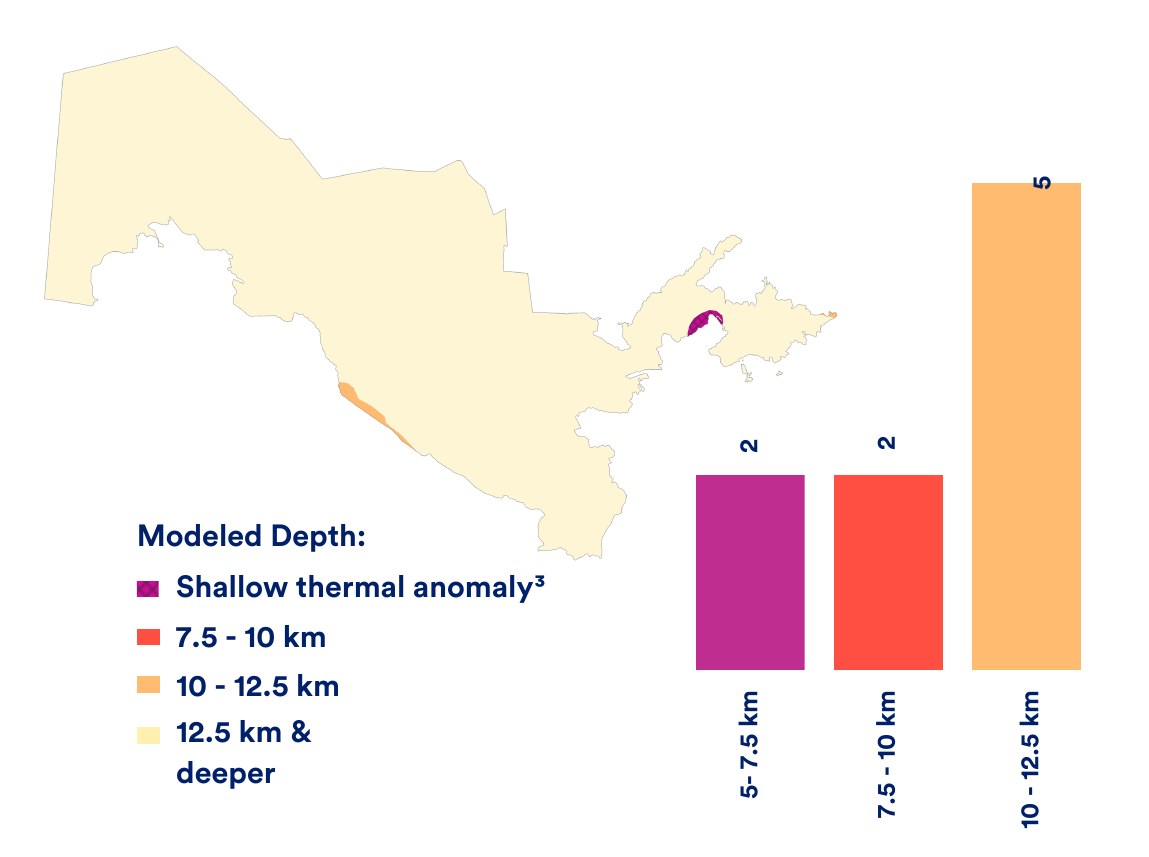
In June 2025, Clean Air Task Force (CATF) published a regional assessment for Uzbekistan based on preliminary modelling with the University of Twente, covering depth bands from 5 km to beyond 12.5 km. Its headline estimate: developing just 1% of the resource could provide about 8 GW of capacity and over 69,871 GWh of electricity a year, about 98% of Uzbekistan’s 2021 consumption of 71,362 GWh.
The assessment also estimates land use of about 12 km² per gigawatt, compared with about 160 km² for natural gas and 180 km² for solar.
Read it carefully
These are modelled, national-level figures, not a resource survey, and the assessment doesn’t name specific regions. They show the scale of what may lie at depth. Deep drilling and measurement would be needed to confirm it.