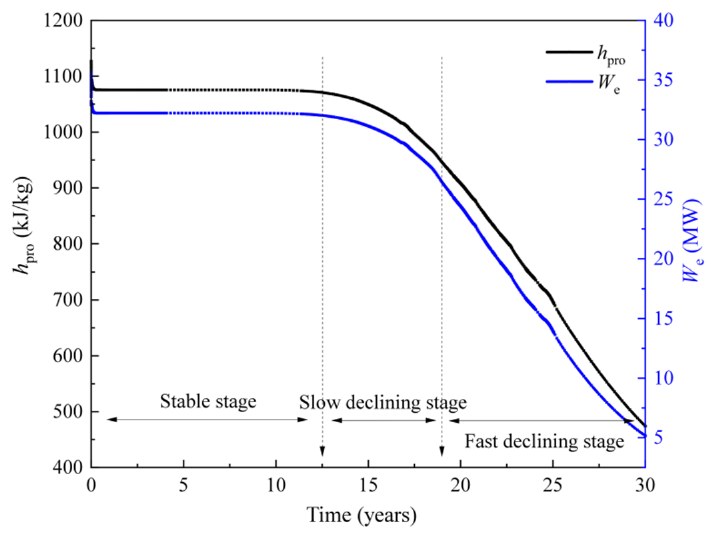
Three horizontal wells could produce about 32 MW of electricity for 12.5 years from the fractured granite reservoir of the Yangbajing geothermal field in Tibet, according to a modelling study published in Scientific Reports on 3 February 2026. The authors include Elbek Ochilov of Navoi State University of Mining and Technology.
The study looks at Yangbajing, about 90 km northwest of Lhasa, China’s first high-temperature hydrothermal geothermal field. Its first experimental unit was built in 1975, and its installed capacity has reached 24,180 kW, the largest of any geothermal power station in China, the paper says.
Using data from borehole ZK4001, the authors model a fractured granite reservoir at 950–1350 m depth with an average temperature of 248 °C. Water is injected through one horizontal well near the bottom. Two horizontal wells near the top are kept at a low pressure of 2.5 MPa, so the reservoir yields a mix of steam and water, which feeds a double-flash power plant.
In the model, the wells produce fluid at a steady 230 °C for 12.5 years. Over a 20.6-year lifespan, the system gives 32.28–23.12 MW of electric power and uses 1.14–1.83 MW for pumping. The authors estimate a cost of $0.0137 per kWh, against an industrial electricity price of $0.09 per kWh in Tibet in 2022, and greenhouse gas savings of 1.63–5.63 million tonnes. The model covers heat and fluid flow only, and the results apply to the modelled conditions.
Why it matters
Yangbajing is far hotter than any thermal water reported on this site for Uzbekistan, where the highest is 137 °C. But the method, modelling how pressure, rock permeability, temperature and flow rates change power output before anything is drilled, is the kind of work any future geothermal power project in Uzbekistan would need.