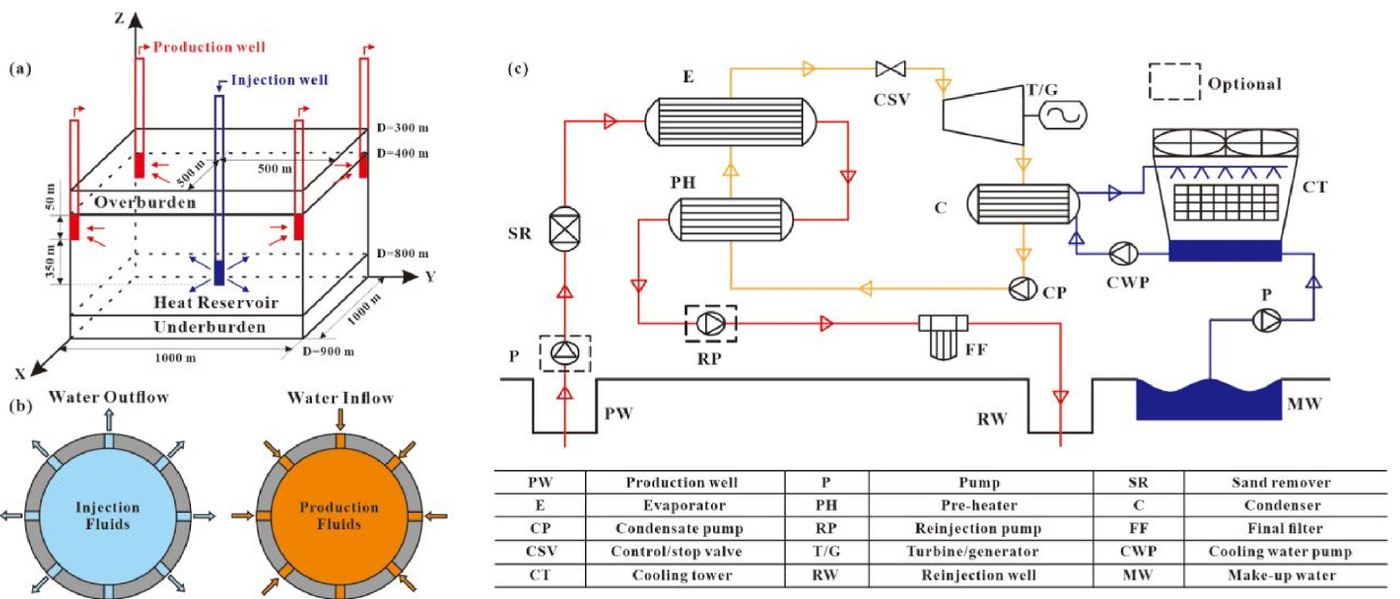
Five vertical wells feeding a binary power plant could generate up to 1.49 MW of electricity from the medium-low temperature water of China’s Fengshun geothermal field, according to a modelling study published online in Renewable Energy on 9 January 2024. The authors include Elbek Ochilov of Navoi State University of Mining and Technology.
The study looks at the Fengshun geothermal field, the first medium-low temperature geothermal field in China used to generate electricity. A 300 kW flash-steam unit installed there in 1985 ran for more than 30 years, but the plant was shut down in 2016 because of low efficiency and poor economics.
Using data from well ZK11, the authors model a new layout: one injection well in the centre and four production wells at the corners, sending hot water to a binary power plant. In the model, electric power rises to 1.49 MW over the first 32.5 years and falls to 1.05 MW by year 60, while pumping uses 0.30–0.49 MW.
The authors also test four factors: the permeability of the rock above and below the reservoir, the water production rate and the injection temperature. All four have a significant effect on the results.
Why it matters
Uzbekistan’s known thermal waters are warm rather than hot. The 31 sites on our map are at 22–78 °C, and the hottest wells we have reported reach 92 °C in Kokand and 137 °C in the Gissar region. Fengshun’s water, at about 90 °C, is in a similar range. Fengshun shows that power from such water is possible but hard to make pay; this study tests a design meant to do better.